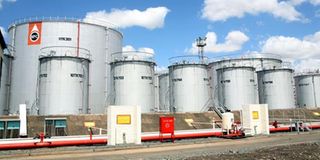
Oil storage tanks at the Kenya Pipeline Company, Industrial Area, Nairobi. The new pipeline will have an initial capacity of 311,000 litres per hour. Photo/FREDRICK ONYANGO
Construction of a new broader pipeline between Nairobi and western Kenya has begun as Kenya Pipeline Company positions itself for increased transportation of oil products to the region’s landlocked economies.
Transporting petroleum by pipeline is cheaper compared to road, and the move will bring relief to consumers who are already bearing oil-generated inflationary pressures through the cost of goods as well as thermal-powered bills.
Kenya Pipeline Company managing director, Selest Kilinda, told the Business Daily that construction of the line had started after previous delays caused by a financing hitch.
“The banks have approved and disbursed the money. Pipes have also been ordered. “It has taken a while for this project to see the light of the day, but with the progression made so far, it will now see the light of day ,” he said on phone.
The 14-inch 325 km pipeline between Nairobi and Eldoret which will be ready in 18 months will raise petroleum flow from the current hourly rate of 220,000 litres to 330,000 litres.
Chinese firm, China Petroleum Pipeline Engineering Corporation (CPEEC), will build the line parallel to the existing one with two booster pumps erected in Nairobi and Nakuru.
The company won the contract for the Sh14.8 billion project to be jointly funded by five banks to the tune of Sh8.2 billion along with KPC .
The new line has an initial capacity of 311,000 litres per hour.
In the next two decades, the refined petroleum products flow-rate to Western Kenya will be increased to 531,000 litres per hour and will eliminate incessant shortages experienced in the region.
Currently, the region is served by an 8-inch diameter pipeline from Nairobi to Burnt Forest where it narrows down to 6-inch diameter to Eldoret.
Another 6-inch pipeline branches at Sinendet to Kisumu.
The flow-rate to Western Kenya is currently at 220,000 litres per hour.
The construction plans had initially been thrown into disarray after financiers questioned the company’s ability to service the loan.
The lenders were seeking guarantees before disbursing the loans following revelations about two recent scandals --Triton and expansion of the Mombasa Nairobi section (Line 1) -that cost the corporation Sh15.7 billion.
But the concerns were addressed under different negotiating terms, Kilinda says.
CfC Stanbic Bank, Barclays Bank of Kenya, Commercial Bank of Africa, Citibank, N. A Kenya and Kenya Commercial Bank are KCB’s partners in the Sh8.2 billion syndicated loan for Line 4.CfC Stanbic, Commercial Bank of Africa, Citibank and KCB will each lend KPC Sh1.6 billion while Barclays Bank of Kenya Ltd will advance Sh1.5 billion.
KPC is to raise Sh6.6 billion for the project.
One of the banks in the financing syndicate --KCB -- is seeking to recover Sh2 billion from the Triton saga under a collateral financing agreement it had entered into for the stocks that disappeared from the pipeline system.
Under the system, the pipeline should not release products to marketers without the consent of the financiers.
Energy ministry and KPC have termed the Triton case as theft of property held in trust .
MPs, tax payers and oil marketers have expressed concerns over the recent expansion of the Line 1-Mombasa-Nairobi Line to double the white petroleum products flow-rate from Mombasa to Nairobi 880,000 litres per hour and demanded that the Sh8.1 billion project’s engineering, prompting corrective engineering works to be undertaken at the Kipevu Oil Storage Facility (KOSF) to up the suction pressure.
Road transport is twice as costly as pipeline transport. Between Nairobi and western Kenya, transportation along the pipeline costs Sh3.20 per litre of fuel while transporters charge Sh7.50 per litre of fuel trucked.
Trucking rates are higher due to demand for the few available trucks following restrictions on weight limits.
“We are still facing constraints over the pipeline. The line is not fully operational as numerous tests were not done before commissioning,” said one industry CEO
Increasing the flow of the pipeline is also critical to meeting growing demand in Uganda, Rwanda, Burundi and Southern Sudan and reducing reliance on oil tankers for transporting petroleum products to those markets by road, damaging surfaces.
PAYE Tax Calculator
Note: The results are not exact but very close to the actual.