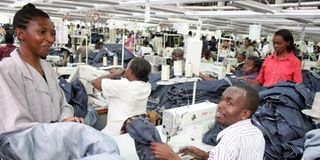
Kenyan workers prepare clothes for export at the export processing zone (EPZ) factory in Athi River. Photo/FILE
Investor interest in Kenya’s Export Processing Zones has nearly doubled in the past six months, brightening growth prospects for the country’s nascent exports sector and promising new jobs for the ever rising number of unemployed youth.
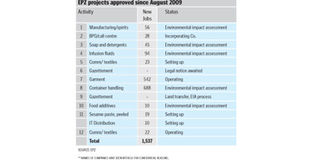
Latest data from Export Processing Zones Authority (EPZA) indicates that the number of foreign firms applying to set up operations in the special industrial zones rose to 12 since August last year double the annual average of six in the preceding period.
Investor interest in EPZs is in tandem with recent trends in the capital markets where the return of foreigners has been driving recovery since the last quarter of 2009.
Though the applications are at different stages of approval, EPZA estimates that they could generate at least 1,500 jobs in the first year of operation and add Sh2 billion to the value of Kenya’s EPZ exports which stood at Sh31.3 billion in 2008.
Joseph Kosure, the acting EPZA chief executive links the increased investor interest to the ongoing global recovery and the marketing blitz that Kenya enjoyed when it hosted the African Growth and Opportunities Act (AGOA) conference last year.
“We have received hundreds of enquiries from local and foreign investors since the Agoa conference,” said Mr Kosure, adding that the 12 new applicants have the potential to roll-out operations valued at more than Sh3.7 billion in the special production zones.
US Secretary of State, Hillary Clinton, attended the Agoa forum coming along with hundreds of American investors and trade policy experts and putting the country on the global media’s radar screen.
Delegates from dozens of African countries and their peers from Asia and other less developed countries that also qualify for preferential access to US market also attended the talks.
Kenya’s EPZs were established through an Act of Parliament in 1990 to promote export oriented investment through provision of ready infrastructure and tax holidays to entrepreneurs who set up operations in the regulated production zones.
Investors in the EPZs have been the biggest beneficiaries of the Agoa pact, the brainchild of former US president Bill Clinton that congress gave the seal of approval in the 1990s and offers preferential, duty free access to the US market to more than 6,000 goods and services from Africa.
The programme has since been expanded to other less developed countries as a way of fast tracking their growth through trade.
Kenya’s EPZs operators have benefited immensely from the free access to US markets with nearly all apparel and clothing products from the zones going into American shops.
EPZ firms employ more than 30,000 low to mid-level skilled Kenyans directly, and offers one of the most comprehensive downstream linkages by taking in a wide range of locally-produced goods and raw materials, boosting overall demand in the economy.
There are 99 EPZ enterprises operating from 35 gazetted zones in Nairobi, Mavoko, Mombasa, Kerio Valley, Kajiado and Voi. Total investments in the zones are valued at Sh21.7 billion.
Majority of the EPZ investors (61 per cent) are foreigners from China, UK, USA, Netherlands, Qatar, Taiwan and India while a quarter of the firms are joint ventures between Kenyans and foreigners. Only 14 per cent of the enterprises are fully owned by Kenyans.
“What is most encouraging however is the numerous enquiries we are getting from Kenyans who want to set up operations in the EPZ,” said Mr Kosure in an interview.
One such Kenyan, Patrick Kariuki, who has invested in an apparel accessories manufacturing company Garment Labels EPZ Ltd, says the perception that EPZs are exclusive to foreign investors could be slowly changing.
“It is all about self belief, I have been in this business for several years now and all I can say is that things are looking up,” said Mr Kariuki.
Data compiled last year shows inter-linkages between EPZ firms and local producers injected a total of Sh11.4 billion into the economy in 2008 in the form of expenditure on local purchases, salary payments, power and water consumption.
“It is estimated that the Athi River area alone (where EPZ headquarters are located) gets Sh150 million every month from the EPZs making it one of the fastest growing townships in Kenya,” said Mr Kosure.
But despite the substantial gains that EPZs continue to spin off into the economy, critics have questioned the quality of employment that the sector provides for indigenous Kenyans, claiming that workers are poorly paid and are forced to put up in hazardous conditions.
EPZ companies have also come under heavy criticism for allegedly setting up operations in Kenya to benefit from the 10-year tax holiday, which exempts the operators from paying income tax, only to close shop at expiry of the grace period.
More recently, the critics have cited the decline in the number of workers in the zones from about 38,000 in 2005 to the current 30,000 as “evidence” of the entrepreneurs “relocating” to other production locations.
Mr Kosure says most of the criticism is borne out of ignorance on how the zones operate.
“When one apparel manufacturer closes down and sends home 2,000 workers, the picture out there is that EPZs are collapsing. The reality however is that we may at the same time be licensing many new enterprises with the potential of creating many more jobs,” he said.
Mr Kosure cites the growth in number of EPZ enterprises from 68 in 2005 to 99 in 2008 as evidence that the sector is not only growing numerically, but also diversifying into less labour intensive sectors.
He also cites the increase in total sales from Sh23.8 billion in 2005 to Sh31.3 billion as evidence of growth.
The EPZA attributes the exit of some investors to uncertainty surrounding the renewal of the AGOA pact for African countries, which the US pegs on democratic governance besides applying stringent approval requirements for some commodities.
Several of the new applicants on Mr Kosure’s list are US companies, whose licensing could boost and diversify trade between Kenya and the world’s largest economy.
The US International Trade Commission (USITC) data indicates that trade with Africa is still dominated by export of natural resources.
Four oil-producing countries account for more than 90 per cent of the $56 billion that Africa earned from the sale of goods and services to the US under the Agoa pact as per the 2008 data.
Export of crude oil, precious metals, medicinal chemicals, oil seeds, steel has grown steadily under AGOA while exports of motor vehicles and parts, computer peripherals, consumer electronics, lumber and apparel dropped.
Exporters blame the US Department of Agriculture (USDA) which they say sometimes takes up to three years to clear a single agricultural product to start trading in the US market, making the Agoa dream of increased trade a mirage.
The total value of Kenya’s exports to the US has decline from $277 million in 2004, $270 million in 2005, $262 in 2006, $ 249 million in 2007 and $246 last year.
PAYE Tax Calculator
Note: The results are not exact but very close to the actual.