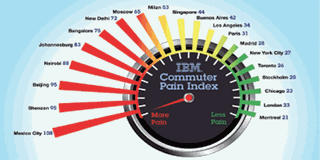
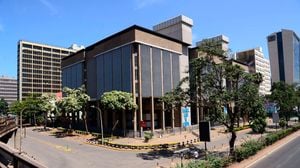
Nairobi and Moscow topped the list of cities that host the world’s longest traffic jams — 2.1 hours — which is 40 per cent higher than the survey’s average of 1.3 hours-IBM report
What you need to know:
This is IBM’s fourth annual Commuter Pain survey. IBM began conducting the survey in the United States in 2008 and expanded it to 20 global cities in 2010.
Smarter transportation systems can help traffic and public transit systems flow more smoothly, anticipate and improve congestion in advance, reduce emissions and increase the capacity of infrastructure.
Nairobi has been ranked as the fourth most grueling commute of 20 cities surveyed in a new IBM international traffic study. The annual IBM Commuter Pain survey polled 8,042 individuals on commuting patterns and the relationship between roadway traffic and work/school performance, health and lifestyle, trip planning, and other issues.
The study was designed to gauge the physical and emotional toll that everyday traffic and related issues have on people around the world.
According to the report, Nairobi and Moscow topped the list of cities that host the world’s longest traffic jams — 2.1 hours — which is 40 per cent higher than the survey’s average of 1.3 hours.
“Perhaps what’s behind these jams are the sheer number of cars on the road. Commuters in Nairobi (71 per cent) came in with the second highest per centages of drivers who drive a car alone to work — superseded by 76 per cent of commuters in Johannesburg who reported that they do the same,” said Anthony Mwai, the country general manager, IBM East Africa, noting that this figure is significantly higher than the global average of 55 per cent.
In a number of cities, more people preferred public transport to driving, when compared with last year’s survey. And in many cities, there were big jumps in the percentage of respondents who said that roadway traffic had improved either “somewhat” or “substantially” in the past three years.
But that’s only part of the story.
Over 61 per cent of Nairobi residents polled said that traffic was affecting their productivity, forcing them to sacrifice time with their families and work in order to get to destinations on time.
The majority of commuters are on the road as early as 5am to beat the jams, spending over 45 minutes to travel an average 13km to get to work or school.
While on the roads, 36 per cent said that rude drivers were the most frustrating part of their commute, beating out the unreliable jams and start-stop traffic cited as major areas of stress in other parts of the world while driving.
Another 63 per cent of Nairobi residents said that they would support traffic restrictions in downtown areas.
Globally, more respondents noted that roadway traffic has increased their levels of personal stress and anger and is negatively affecting their performance at work or school. Global statistics indicate that a three per cent reduction in traffic can lead to a corresponding two per cent rise in employment.
“Commuting doesn’t occur in a vacuum,” said Mr Mwai. “A person’s emotional response to the daily commute is coloured by many factors – pertaining both to traffic congestion as well as to other, unrelated, issues.
This year’s Global Commuter Pain survey indicates that drivers in cities around the world are much more unsettled and anxious compared with 2010.”
The global survey results suggest that aggressive infrastructure investment in some of the most rapidly growing economies seems to be paying off. Compared with other cities surveyed, more commuters in Bangalore, New Delhi, Beijing and Shenzhen reported improvement in traffic conditions over the past three years.
The survey results also reflect an increased willingness to use public transport and technology to improve the commute. Overall, 41 per cent believe improved public transit would help reduce traffic congestion. An astonishing 70 per cent of Nairobi residents report taking public transit more often in the last year on their daily commute.
Considering that even though globally only 35 per cent of people changed the way that they get to work or school in the last year, 45 per cent of those who have, are opting for public transit.
The biggest movement to public transit is in emerging cities including Nairobi, Mexico City, Shenzhen, Buenos Aires and Beijing. If this continues, it could help mitigate increasing traffic due to population growth and urbanization. Interestingly, the desire for more accurate and timely information about road conditions as a way to reduce stress was shared across a number of cities from Los Angeles and Chicago to Moscow and Bangalore.
“We can’t simply build our way out of congestion no matter which city,” said Vinodh Swaminathan, director of intelligent transportation systems, IBM.
“In order to improve traffic flow and congestion, cities need to move beyond knowing and reacting; they have to find ways to anticipate and avoid situations that cause congestion that could turn the world into one giant parking lot.”
Commuter Pain survey is conducted by IBM to better understand consumer attitudes around traffic congestion as the issue reaches crisis proportions around the world and higher levels of auto emissions stir environmental concerns.
Findings from the Commuter Pain survey will be used to assess citizen concerns about traffic and commuter issues; enhance smarter transportation solutions such as traffic prediction intelligent tolling systems, road user charging, advanced traffic management and integrated fare management and serve as a basis for pioneering new approaches to improving transportation.
IBM is working with cities, governments and others around the world to make their transportation systems smarter.
By Kui Kinyanjui, External Relations, IBM East Africa
PAYE Tax Calculator
Note: The results are not exact but very close to the actual.