Cancel poor states’ debts to hasten MDGs realisation
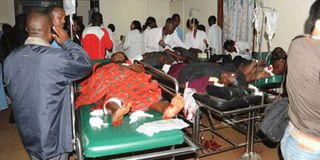
The government spends the bulk of her income servicing loans while very little money is set aside for basic services such as healthcare. Photo/FILE
Last week, the world marked the Global Action against Debt and International Financial Institutions week with calls for immediate cancellation of debts.
Though activities calling for debt cancellation were staged by civil society organisations both in the North and South, the events were not covered by the mainstream media.
As we take stock of this important week in our calendar, it is important to interrogate how the enormous debt burden Kenya struggles under is affecting her quest to achieve millennium development goals.
Since the signing of the Millennium Declaration in 2000, the government has made considerable progress towards attaining the MDGs.
For instance, on eradicating extreme poverty and hunger in Kenya the percentage of the poor has dropped from 38 in 1992 to 20 by the end of 2005.
From 1990 to 2008, the percentage of the poor in sub-Saharan Africa decreased from 31 per cent to 27 while in Kenya it dropped from 22.3 per cent to 20.9 per cent over the same period.
The government has implemented a number of programmes to enhance poverty reduction.
These include enterprise funds for women and the youth that act as credit facilities, implementation of social welfare programmes such as Kazi Kwa Vijana (jobs for the youth), and a cash transfer programme.
These have helped reduce the number of people living below the poverty line.
Other initiatives include the implementation of the Economic Stimulus Programme (ESP) and subsidies on fertiliser and seeds which have increased agricultural productivity.
The debt crisis in Africa is a major concern as it misdirects the continent’s resources from essential human needs to loan repayment.
A major setback to the continent’s achievement of the MDGs is her indebtedness to creditors such as international financial institutions, commercial banks, and clubs of developed nations.
The Kenya government spends the bulk of her income to service loans and very little money is set aside for basic services such as healthcare and education.
Yet with all the money that goes into debt servicing, the debts are far from being cleared while the government is still committing itself to more borrowing due to fluctuating revenues and the need to expand the economy.
Currently, Kenya’s debt burden stands at Sh1.19 trillion.
This means that each of the 40 million Kenyans owes foreign and domestic creditors Sh29,750, which is more than the take-home salary of most workers.
In 2009, the government allocated Sh60 billion to service public debts, representing seven per cent of the total budget, while apportioning Sh83 billion for the same exercise in the 2010 budget.
Lion’s share
This represents eight per cent of this year’s total budget and is Sh18.9 billion more than the agriculture allocation, exceeds the Sh55 billion for health and Sh36 billion for energy.
This indicates that debt servicing is consuming the lion’s share of budgetary allocations.
Such funds would be of great meaning if they were channelled to the social sector such as agricultural to boost food security, the provision of health care, or to schools.
The large external debt burden is a major cause of poverty through its effects on economic growth and human development, hence the calls for debt relief.
High indebtedness and the resultant high debt servicing has significantly reduced resources available to the poor.
The effects of Kenya’s unchecked borrowing can have extreme consequences on fulfilling the socio-economic needs of her citizens as committed under the millennium declaration.
If the government invested more in human development rather than debt repayments, child mortality rates will improve, infrastructure such as roads, schools, health centres will be created to boost the fight against poverty and create enabling conditions for faster economic growth.
Goal eight of the MDG framework is to build a global partnership for development.
It is meant to reflect efforts of the international community in supporting developing countries to achieve their economic and social development goals.
Creating a global partnership for development was envisaged to help scale up aid flows and debt cancellation so as to address some of the factors that undermine sustainable development in the world’s poorest countries.
Despite commitments being made in delivering more effective aid, debt cancellation, increasing Official Development Assistance (ODA), and better financial and trading systems; the promises have been replaced by another scapegoat in the name of the financial crisis.
Fiscal crisis
With the fiscal crisis spreading in Northern countries, most governments have reduced their commitments to the achievement of the global partnership for development goal hence reduction of aid flows to the South.
This has sounded a death knell for poor countries as most are behind in realising the millennium goals.
External debt reduction has a long term impact on development and fulfilling the attainment of the MDGs.
Governments, international institutions, and civil society groups can steer this process by devising policies to reduce debts and channel the resources saved through debt relief to combat the most urgent needs and build human capital, offer decent healthcare, and education to the needy.
Mwaura is the regional youth co-ordinator at the United Nations Millennium Campaign — African Office. Orwochi is a researcher with the Kenya Debt Relief Network.
PAYE Tax Calculator
Note: The results are not exact but very close to the actual.