Where the world got real flavour of Kenya in London
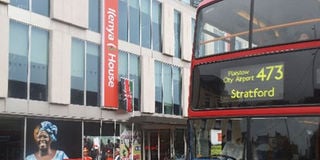
The entrance to the Kenya House in Stratford, London, which hosted a series of activities on the fringes of the Olympic Games. Photo/ELIAS MAKORI
What you need to know:
The Kenya House was open to market the country as an investment and tourism destination during the London Olympic Games and it is here where the rest of the world had an opportunity to get a feel of the country, enjoy its flavour and interact with its people.
At Kenya House there was a mix of private sector business executives, Government officials, artistes, journalists, sports men and women as well as friends of Kenya.
The Permanent Presidential Commission (PPC) presented a showcase of musical artifacts from Kenya and opportunities for investment in music while the Kenya Film Commission presentation was based on investment in theatre, film and animation.
The government, through Brand Kenya, developed the concept of Kenya House where athletes and Kenyans came together to network and display some of the positive aspects of the country. The government pumped in Sh470 million to set it up.
What was previously a quiet four-storey office building in Stratford, East London, was for the past fortnight transformed into a vibrant riot of music, dance and theatre.
The Kenya House was open to market the country as an investment and tourism destination during the London Olympic Games and it is here where the rest of the world had an opportunity to get a feel of the country, enjoy its flavour and interact with its people.
Country’s took advantage of the global sporting event to set up national hospitality venues hosting events including exhibitions, films, concerts and parties.
At Kenya House there was a mix of private sector business executives, Government officials, artistes, journalists, sports men and women as well as friends of Kenya.
Andy Patterson is one of the friends of Kenya who was attracted by the Culture and Heritage Theme Days. When he visited Kenya House during the last few days of the Olympics, he was greatly captivated by a performance by the dancing troupe from the Bomas of Kenya.
“Kenyans have been renowned for their friendly nature,” says Patterson, a sound engineer with The Singing Wells Project, a partnership between the UK-based Abubilla Music and Ketebul Music of Kenya.
In the last one year, the team from London has made three trips to East Africa and Kenya specifically, to record the endangered music of communities here.
Since March 2011, The Singing Wells Project has visited and recorded music of various regional communities including the Batwa of Uganda, the Marakwet, Pokot, and Tugen.
Patterson and the team have brought mobile recording facilities to the villages of some of the most marginalised areas in the region.
These experiences touring the countryside and interacting with these communities has convinced him even more that there should be a great emphasis in exploiting the cultural diversity of Kenya.
The internet based music map of East Africa, which is in progress, is a platform hosting information about instruments, costumes and vocal and dance styles of East African music.
So, the chance to meet a group from an institution that is one of the main custodians of traditional music of Kenya was the perfect opportunity to discover new ideas for the project to consider adding onto their free and open data base and possibly record the music during their next trip to Kenya in November this year.
“We started Singing Wells to put the music of East Africa on the map and so it is great to link up and to discuss the project with some of the main protagonists right here in London,” says Patterson.
The Bomas Troupe
To date, the project has recorded about 150 songs, across 25 communities and an additional 20 high quality performance and interview videos.
Patterson was with his film crew at the Kenya House in London last week recording the Bomas of Kenya troupe in action.
The performers from the Bomas of Kenya, in their colourful regalia, exuded pride at the opportunity to perform their music and dance to a new audience, outside their regular audience.
“We are here to bring a cultural experience to the whole world gathered in London,” said Bwire Ojiambo, Bomas of Kenya Production Manager.
Adding they had perfected the songs and dances from most communities in Kenya offering a wide diversity that would attract the interest of visitors to the country.
“Music is dynamic and I would prefer that pop musicians should stick to Kenyan idioms,” said Bwire. “There is no comparative advantage when we are all recording reggae or hip-hop because other people can play this music better that we can.”
He is an admirer of Zimbabwean star, Oliver Mtukudzi, whom he says is the best example of an African musician who has continued to base his rhythms on traditional sounds which will always be appealing to an international audience.
The Permanent Presidential Commission (PPC) presented a showcase of musical artifacts from Kenya and opportunities for investment in music while the Kenya Film Commission presentation was based on investment in theatre, film and animation.
Visitors to Kenya House also had a chance to watch Kenyan based movie ‘The First Grader’. The 2010 film is based on the life of the late Kimani Maruge, the world’s oldest primary school pupil.
The government, through Brand Kenya, developed the concept of Kenya House where athletes and Kenyans came together to network and display some of the positive aspects of the country. The government pumped in Sh470 million to set it up.
PAYE Tax Calculator
Note: The results are not exact but very close to the actual.