Mobile money turns Kenya into global transfers hub
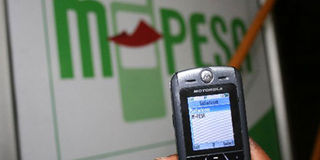
International companies, inspired by the success of Safaricom’s M-pesa, are rushing to create cash solutions targeted at millions of Africa’s unbanked. File
As the mobile phone sector stands poised to pose its stiffest challenge yet to the financial sector in the coming months, the country’s profile as the world’s innovation hub in the mobile finances market is on the rise.
Kenya is to mobile money solutions what Silicon Valley was to software in the last decade and companies are taking advantage of that to use the country as a testing ground for solutions they hope will translate into global success.
Analysts attribute the fact that at least five international companies— ranging from financial institutions to mobile phone manufacturers and service providers — are putting the final touches to what they hope will be financial masterpieces to rival M-pesa —Safaricom’s mobile money transfer solution that shifted the balance of power in the financial world with its launch nearly three years ago.
Within that short span, the country has emerged as the seat of innovation as other players try to replicate the success of M-pesa in capturing and retaining subscribers for Safaricom, the country’s leading mobile services provider and most profitable company in East Africa.
Countries such as Kenya, the Philippines, Tanzania, Uganda and Sudan form the world’s mobile money hotspots, with states like Ethiopia and Somalia following closely behind, said Norman Frankel, the founder and CEO of Mi-Pay, a Sudanese mobile money transfer company while speaking to industry journal MMT Explained.
“If you look at the World Bank Remittance Factbook and identify countries with a low percentage of the population who emigrate but with strong urban migration trends, you’ll see these countries embracing mobile money faster,” he said.
Of these, Kenya plays host to the greatest number of mobile money products, and with over eight million users of the services, has the distinction of recruiting the highest number of subscribers to the mobile money phenomenon.
Innovation in the Kenyan mobile money scene has progressed so fast that it is a long while since March 2007 when Vodafone, the world’s leading mobile services provider which owns 40 per cent of Safaricom, picked its Kenyan subsidiary to pilot what has essentially become the preferred medium of person-to-person transfers; creating new means to settle utility bills and enlisting commercial enterprises (over 75 to date) keen to avoid the security pitfalls of handling cash and the risk of bouncing cheques.
“M-pesa has served as a testing ground for mobile money transfer systems and processes and the eyes of much of the world has been on it. The success of M-pesa has acted as a starter’s pistol for a race to gain the upper hand in mobile money transfers throughout Africa, with at least half a dozen contenders already in the wings,” said Arthur Glodstuck, an industry analyst in an interview.
The race is now on to convert the citizens of other African countries to adapt to the new mobile world order.
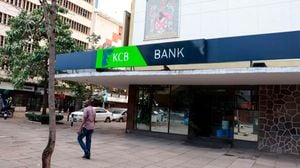
Standard Bank, Africa’s largest bank by assets and earnings, is said to have set up a desk to specifically draft a strategy for reaching the unbanked in the continent through mobile handsets. It is anticipated that it will utilize its Mzansi Money Transfer solution to allow customers in the 17 African countries it operates in to send and receive money without the need for a bank account. In South Africa, where the service is available, it is not just restricted to Standard Bank branches, but is available at any of the participating banks and the South African Post Office. The bank says on its website that Mzansi will be of special help to people in rural areas who can now receive money sent by relatives and friends at a bank without needing to have a bank account and it will also target migrant workers wishing to send money to their dependants back home. Its product would be a close fit to Mobile Wallet, a universal (independent of one’s bank and mobile services network) service that Kenya Commercial Bank (KCB), East Africa’s biggest retail bank hopes to roll out in the East African Community member states of Kenya, Uganda, Tanzania, Rwanda and Burundi.
According to information seen by Business Daily, although the service appears to be targeting the unbanked, its features and structure may appeal to an urban middle class target, possibly crafted with the small and medium enterprise business segment in mind.
Subscribers will be able to transfer up to Sh100,000 from virtual accounts held on their mobile phones, but notably, the money has to be cashed in one of KCB’s 200 outlets in the region
Meanwhile, mobile phone manufacturer Nokia has also announced its intention to launch a cross-network mobile money transfer product in conjunction with Obopay in the coming months.
Although the company is keeping its Kenyan launch date close to its chest, it is reportedly hunting for agents in the region, hoping to launch an assault that will place it at the forefront of regional developments that have seen the harmonisation of the East African region. Nokia will rely heavily on its affiliation to Obopay, an American mobile solutions provider to implement its service in the course of this year.
Obopay helps wireless carriers deliver a robust mobile payments platform easier, faster, and at less-cost than they could build and operate themselves, helping them streamline and manage complex financial services regulations. Obopay partners with wireless providers to deliver a mobile payment infrastructure to deliver additional services more cheaply and in a shorter period.
Carriers can then focus on increasing ARPU and customer loyalty and monetize, maintain and extend their customer base.
Obopay has also indicated that it will be partnering with Kenya’s fourth mobile service provider Essar, to release YuCash, which was announced for launch in the dying weeks of 2009. Although the company announced last December that it intended to launch the product in early January, it is yet to commercially begin services and Yu agents Business Daily spoke to said they were unaware of it.
“Obopay will provide the mobile money transfer platform from which yuCash will operate, while Equity Bank, being one of the leading banks in Kenya, is our banking partner hosting the trust account. We are rolling out a countrywide network of agents and anticipate to have more than 3,000 agents countrywide who are able to serve subscribers in the initial period, and this will keep growing with the market demand,” said Kunal Ramteke, Chief Commercial Officer of Essar Kenya. Srinivasha Iyengar, Essar CEO told Business Daily in a previous interview that the product was being positioned to capture a share of the youth market and the company was deliberately pricing it well below M-pesa’s transaction fees to capture a younger but less monied customer.
Mr Iyengar also indicated his firm was keen to roll out the service in new markets such as Uganda and Congo, where Essar recently announced stakes in Warid Telecom.
For Safaricom’s arch rival Zain, the changing mobile money landscape has forced the firm to rethink the strategy governing Zap, the only contender within the mobile market for subscriber attentions in the Kenyan money transfer market.
Zain last week extended its mobile money transfer product Zap to three more African countries —Malawi, Niger and Sierra Leone — bringing to seven the number of African countries the service is already in use after Kenya, Uganda, Tanzania and Ghana.
In all markets where it has launched Zap, the company is facing increasing challenges in maintaining profits as competition drives tariffs downwards and shrinks profit margins.
Like Safaricom, Zain is positioning Zap as a ‘stickiness’ product used to retain subscribers on its network by building stronger ties to the network.
Rounding out the list of M-Pesa competitors is mobile operator MTN, Africa’s biggest mobile operator by subscribers which is banking $9.7 million on mobile money solutions.
The mobile firm has signed a deal with Fundamo, a South Africa-based mobile banking and payment solutions group to provide mobile banking facilities.
Already commercially active in Uganda and Ghana, MTN’s Mobile Money begun trials in October 2008 in Uganda, Cameroon, Ghana, Cote d’Ivoire and Nigeria. Five additional pilots were recently launched in Benin, Congo Brazzaville, Guinea Bissau, Guinea Conakry and Liberia. In each market, MTN will partner with local banks to ensure that its MMT services are fully compliant with financial services regulations. Discussions are currently on-going with relevant authorities in various countries to ensure that all regulatory requirements are met.
PAYE Tax Calculator
Note: The results are not exact but very close to the actual.