KQ goes slow on fuel hedging after steps that didn’t pay off

PHOTO | BD GRAPHIC

With 35-40 per cent of airlines industry costs tied to fuel, volatility in oil prices is always a big concern for the industry.

Most gamble through this dilemma by hedging on the cost of fuelling but with varied results. For instance the slump in global oil prices by at least 70 per cent over the last two years has brought with it a mixed bag for airlines.

While carriers saved hundreds of millions of dollars from the falling prices, they forfeited a large portion of that gain because of the fuel hedges they bought as protection against oil rising.

Industry estimates showed that the bulk of those hedges, which effectively lock in fuel costs in advance, are set at levels that force airlines to pay more for fuel than current market prices, turning them into a hindrance rather than a help.

National carrier, Kenya Airways (KQ) is among airlines that have borne the pain of counterproductive hedging over the two-year window, coinciding with the drastic dip in global oil prices.

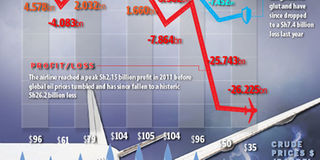
The Nairobi Securities (NSE) listed airline has racked up more than Sh11 billion in losses resulting from fuel hedging.

KQ lost Sh4.1 billion to oil hedging contracts in the year ending March alone. It lost Sh7.4 billion in the previous year while it made Sh942 million, Sh602 million and Sh2.5 billion gains in 2014, 2013 and 2012 respectively.

Overall the airline has lost Sh7 billion on a net basis to derivative bets raising concerns on the impact of fuel hedging on unsuspecting shareholders and whether hedging decisions should be left to management only.

Stirred by the hard knocks from fuel hedging, KQ is going easy on further hedging to minimise its exposure to the volatility in global oil prices.
KQ chief executive Mbuvi Ngunze, said the company has suspended fuel hedging going forward.

“My position is that we have put on hold new hedging contracts, no contract was entered this year. The existing ones were entered much earlier” he told the Business Daily.

The airline’s severe hedging losses have been driven by significant exposure to fuel derivatives ranging from 73 per cent to 50 per cent of its total fuel requirements, which significantly increases its value at risk should the bet go wrong.

This has been exacerbated by the inability of most of the so called hedging experts to predict future oil prices, which no one can. Fuel hedging is normally regarded as a sort of macho gambling game rigged in favour of oil dealers, hedge funds and banks who normally buy the underlying assets to offset the losses if the trend moves against them, most non-financial institutions do not.

Several airlines have over the years avoided fuel hedging to minimise their exposure to unpredictable global prices.

“We decided long time ago that we are not going to hedge, and it has been advantageous for us,” said Jimmy Kebati, Fastjet general manager for East Africa and former acting commercial director at Kenya Airways.

Helpless

Fuel derivatives are long-term contracts, sometimes running for three years, this normally leaves the airline helpless especially when oil prices are moving against it.

Mr Kebati says instead airlines raise ticket prices when jet fuel prices go up to offset costs, a simple basic hedging technique that has always worked in the world of business before financial alchemists invented derivatives. But KQ's high ticket prices leaves it with little room to hike prices again.

A drop in oil prices tends to be associated with economic downturns hence making the situation worse for airlines as hedging losses mount in times of low customer numbers.

“Kenya Airways should cease and desist from hedging entirely,” said analyst Alykhan Satchu adding that they have no expertise in the matter. And it shows.

If KQ had not hedged in the last two years it would have booked huge gains resulting from plummeting fuel prices but instead all these were lost by fuel bets going wrong.

The Parliamentary Committee for Transport chairman Maina Kamanda said fuel hedging is part of the bad decisions taken by KQ management who knew they were on their way out and that the committee will soon forward its report to the anti-corruption agency. “With 25 per cent shareholding held by the government such losses have a strong bearing on the taxpayer,” said Mr Kamanda.

The world’s biggest airlines such as Delta, American Airlines Group, United Continental and many others have since stopped or cut their exposure to oil contracts.

“The airline wouldn’t return to hedging even if oil prices went below $30 a barrel,” Delta chief executive Edward Bastian told Bloomberg mid last month after suffering Sh400 billion in hedging losses. American Airlines chief financial officer Derek Kerr was also quoted as saying, the airline has made “no change in its strategy of shunning fuel hedges.”

Those with hedge positions have cut them to less than 40 per cent of their total fuel requirements especially in the last two years when commodity markets went on the rampage destroying hedges and other artificial assets.

In Asia most government controlled Airlines have very little interest if any in fuel hedging due to volatility and uncertainty of oil prices.
[email protected]

PAYE Tax Calculator

Note: The results are not exact but very close to the actual.