Time flies with great content! Renew in to keep enjoying all our premium content.
Prime
Safaricom underlines role in Kenya economy with 845,000 jobs
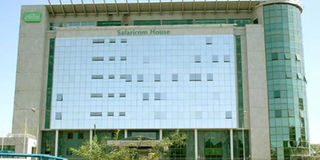
Safaricom House in Westlands, Nairobi. PHOTO | FILE
Telecoms operator Safaricom’s voice, data and M-Pesa business sustained more than 845,846 jobs in the year to March 2016, a newly released study shows.
The report by consulting firm KPMG — ordered and paid for by Safaricom — says the telecoms operator sustained the jobs through its own workers and the linkages created by products and services such as airtime dealers, mobile money agents and distributors.
The Safaricom juggernaut further injected Sh413.8 billion into the economy in the year to March, equivalent to 6.6 per cent of Kenya’s total output, technically known as gross domestic product (GDP).
“The greatest contribution the company makes to Kenya’s social value is through M-Pesa,” said Safaricom chief executive Bob Collymore during release of the ‘True Value’ sustainability report.
#The mobile money platform added Sh184.6 billion to the Kenyan economy “excluding transaction fees,” nearly fivefold the Sh41.5 billion Safaricom made in revenue from M-Pesa, Mr Collymore said.
More than 182,883 jobs are directly related to the mobile telecoms firm, while the rest are linked to the indirect activities.
Kenya added 841,600 new jobs to the economy in 2015, according to the latest Economic Survey — meaning Safaricom alone sustained an equal number of jobs.
“Safaricom cannot take full responsibility for indirect jobs as a number of them would exist without Safaricom,” the firm said.
This is the second year Safaricom is publishing a sustainability report, which quantifies the value it creates in East Africa’s largest economy, beyond the bottom-line.
The 2015 report showed Safaricom cumulatively supported more than 682,000 jobs and ploughed Sh315 billion into the economy.
KPMG’s “True Value” methodology involves summing up the company’s earnings, value-add operations, and capital expenditure, less costs incurred and an impairment for corruption.
Safaricom was founded in 1997 as a wholly-owned subsidiary of Telkom Kenya, and in June 2008 listed on the Nairobi Securities Exchange.
The firm had 4,602 employees in the period to March 2016, who raked in Sh12.56 billion in salaries, bonuses, pension contributions, and medicare schemes.
The additional jobs were made through Safaricom’s 485 dealers, 252,000 active retail outlets, 100,744 M-Pesa agents, 19 partner commercial banks, 43,603 merchants who accept Lipa Na M-Pesa, utility firms, and insurance companies that use the telecoms company’s services.
Safaricom said it spent Sh76.8 billion to procure goods and services from a total of 1,094 suppliers, who in turn created and sustained a significant portion of the 0.8 million jobs.
The total value created by Safaricom in the period under review is more than tenfold the Sh38.1 billion net profit it recorded.
The company had 25.16 million customers, with two-thirds or 16.6 million of them using M-Pesa at least once a month.
Safaricom — owned 35 per cent by the Kenyan government — paid taxes, levies and licence fees totalling Sh61.9 billion up from Sh54.8 billion in March 2015.
Mr Collymore said Safaricom last year spent Sh32.1 billion in capital expenditure, including laying 3,236 kilometres of metro fibre, upgrading 2G, 3G and 4G networks, as well as deploying a new M-Pesa platform.
Safaricom is currently sitting on cash reserves worth Sh30.4 billion, despite its heavy capex and spending Sh9.2 billion to set up the national police security network under credit terms.
The utility of mobile phone has greatly expanded with the birth of smart phones and mobile money.
Studies by the World Bank show that a 10 per cent growth in mobile subscription yields an estimated 1.2 per cent growth in GDP across the economy.
“Mobile technology has transformed the way in which economic activity is carried out in virtually all the sectors of the global economy, allowing more efficient ways for workers and businesses to communicate and access information,” The Mobile Economy 2015, a GSMA report, says.
Kenya had 26.8 million Internet subscribers as at June 2016, with mobile data accounting for 99 per cent of the total subscriptions, data from the Communications Authority of Kenya shows.
The 2016 FinAccess Household Survey released in February shows that three out of every four Kenyans or 75.3 per cent have access to financial services, thanks to mobile money services such as M-Pesa.
Mobile money apps have greatly transformed how Kenyans access loans, and consumers no longer need to fill lengthy paperwork, pledge collateral or undergo vetting by a credit officer.
Unlock a world of exclusive content today!Unlock a world of exclusive content today!