Time flies with great content! Renew in to keep enjoying all our premium content.
Prime
Leather sector seeks higher taxes on raw hide exports
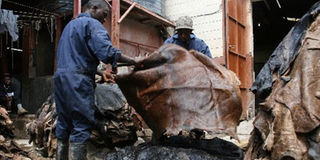
Players in the leather sector are piling pressure on the government to restore its export compensation scheme and double tax on export of raw skins and hides in a move aimed at boosting the segment’s job creation capacity.
Players in the leather sector are piling pressure on the government to restore its export compensation scheme and double tax on export of raw skins and hides in a move aimed at boosting the segment’s job creation capacity.
The proposals seeking to encourage export of finished products by doubling export duty on raw leather from 40 to 80 per cent has been prepared by the Kenya Leather Development Council (KLDC) and handed to the Cabinet.
The push eyeing the 2013/14 Budget comes five years after the industry successfully lobbied the government to double export tax on raw leather from 20 to 40 per cent.
“We estimate if export duty is doubled again, the tanneries will operate at a capacity of 100 per cent,” said Charles Ndung’u, KLDC’s head of technology development.
The leather industry earns the country some Sh5 billion in foreign exchange and employs around 400 people directly.
‘‘The previous tax intervention raised the uptake of leather from farmers with 11 surviving local tanneries now operating at 70 per cent of their capacity, up from 40 per cent in 2007,’’ said Mr Ndung’u.
Industry players said majority of traders seeking to avoid the steep tax regime are still exporting skins and hides processed up to wet-blue level, the lowest in leather processing.
The push to double export tax on leather comes as the government steps up tax reform which is expected to scrap Value Added Tax (VAT) refund on exports it introduced five years ago to encourage value addition in the leather industry.
“Our main quarrel with exporters of raw leather is buyers still find their products affordable because not all of them are subjected to the 40 per cent export duty,” Fahd Faisel, managing director of Nakuru Tanneries told the Business Daily on Friday.
In their proposal to prop up the limping leather industry, players have also proposed increased funding from the national budgets.
So far, the government has invested Sh175 million under its 2009 economic stimulus programme to build six tanneries which are to be run by different communities.
“We hope Parliament will also approve our proposal once it is cleared by Cabinet so that this industry can also create jobs,” said Mr Faisel.
Under the economic liberalisation of 1990s, most tanneries were closed down, leading to losses of jobs for hundreds of thousands of Kenyans.
“Five years ago, the tanneries were operating at 40 per cent capacity, when we increased the export duty from 20 to 40 per cent; they are now operating at 70 per cent,” said Mr Ndungu.
The Cabinet is expected to make the decision any time because leather industry is among those identified by the government as ingredients of industrialisation.
Kenya currently produces 8.5 million skins of goats and sheep and 1.5 million hides from cows every year.
The country has also commercialised sale of skins of crocodiles and ostrich mostly for South Africa market. The Kenya Leather Development Council is now preparing to commercialise the skins of rabbits and fish.
Research done by several organisations among them Traidcraft Exchange and Oxfam Germany on the Kenya leather industry recommended use of export duty strategy to restrict exports and enable growth of local leather processing industries.
“The indications are this policy has contributed to increasing the number of tanneries in the country, created 7,000 jobs, increased incomes for another 40,000 people and boosted earnings from the sector by almost 8 million euros from 2005 to 2008,” notes the report.
Since 2003, the number of tanneries has risen from three to seven, increasing employment,” the report notes.
The document also notes the leather sector in Kenya shows how a developing country can achieve benefits for its people by defying ideological commitment to free trade.