Kenya’s threatre movement finally heads to the counties

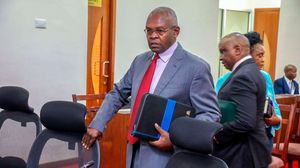
The Kenya Cultural Centre CEO Michael Pundo during an interview at his office along Harry Thuku Road in Nairobi on June 28, 2025.

Photo credit: Bonface Bogita | Nation Media Group

When a paper titled, Is the National Theatre Really National? was presented at a performing arts conference in 2022, it struck a nerve.

For decades, Nairobi has been the undisputed hub of Kenya’s theatre scene, while artistes in the counties struggled with limited access to training, funding, and performance spaces. For Michael Pundo, CEO of the Kenya Cultural Centre (KCC), the moment sparked a turning point.

“We felt challenged to respond. we felt the need to take theatre outside Nairobi,” he says.

That response came in the form of the County Theatre Fiesta, a roving theatre development programme that has seen KCC venture far beyond its Nairobi base to train and stage productions across Kenya.

The initiative equips local theatre companies and individuals with practical skills—from scriptwriting and directing to lighting, sound, marketing, and intellectual property rights.

“When we first did this in Eldoret, there was an upsurge in local productions,” says Pundo. “It’s not just about actors. We’re creating opportunities for lighting directors, sound engineers, and designers.”

Each County Fiesta ends with public performances drawn from original scripts submitted by participants. Temporary theatre spaces are created in local venues, turning towns into cultural centres for a few transformative days.

The ripple effect is already being felt. Pundo says new grassroots groups are emerging, and counties are beginning to invest more in cultural expression.

Though many associate the KCC with its landmark venue, the Kenya National Theatre (KNT), the institution’s reach is now becoming truly national. “KNT is our flagship space, but it’s only one part of what we do,” says Pundo.

The centre also runs Ukumbi Mdogo for smaller shows, Cheche Gallery for visual art, and Wasanii Corner for informal artistic expression.

When Pundo took office in 2020, his focus was twofold: reinvigorating the physical spaces and reimagining KCC’s national footprint. The first phase was professionalising operations, a shift that met with some initial resistance.

“There were cases where artistes wanted to cook meals in the courtyard,” he recalls. “We had to introduce standards that would protect the experience for clients. Some saw it as strict at first, but eventually the benefits were clear.”

Then came the pandemic.

Covid-19 brought performances to a halt, and when KCC reopened, it did so amid major renovations—new seating, improved acoustics, and technical upgrades that would make the venue one of the best-equipped theatres in East Africa.

Today, Pundo says the 437-seat auditorium boasts a world-class sound system, lapel and overhead mics, improved lighting, a fly system for rigging, and even an orchestral pit.

And the transformation, he says, has paid off. The KNT is now booked every weekend until the end of 2026—except for the Christmas holiday.

For Pundo, however, success is not just about full theatres. He wants to diversify audiences and make theatre a daily affair.

The Kenya Cultural Centre CEO Michael Pundo during an interview at his office along Harry Thuku Road in Nairobi on June 28, 2025.

Photo credit: Bonface Bogita | Nation Media Group

“Right now, most shows run from Thursday to Sunday. I want performances happening every day. And we need to attract more older patrons, not just the youth.”

This long-term vision also includes nurturing talent early. KCC has partnered with the Ministry of Education to launch a scholarship programme for top drama students from public schools. The scheme covers school fees for Forms 3 and 4 and has already admitted its first 10 beneficiaries from across the country.

“Our message to parents is simple—talent pays,” says Pundo. “Imagine your child coming home and telling you the government is covering their school fees because of their role in a play.”

KCC is also supporting school theatre directors and working with festivals like the Kenya Music Festival. Pundo says this year, the institution sponsored a category that encouraged students to create original compositions on the theme “Twende Theatre.” The winning piece will be used in a national campaign to boost theatre attendance.

Despite these gains, challenges remain, chief among them funding. As a parastatal under the Ministry of Sports, Culture and Heritage, KCC depends on limited government allocations. Pundo is expected to raise an additional Sh42 million each year to sustain programming and operations.

“We get some income from hall hires, but it’s a subsidised space,” he explains. “Much of our programme funding comes from partners like embassies. Renovations and events like the Kenya Theatre Awards are supported by the Sports Fund.”

Pundo says KCC is focused on expanding infrastructure beyond the capital. “The Ministry has allowed us to develop five cultural spaces outside Nairobi. So when I move to Eldoret, I’ll be happy knowing that town has a permanent space to grow its artistic voice.”

He adds, “Every county should have a functioning cultural space. Even if the finances are tight now, we are building a framework for the future.”

PAYE Tax Calculator

Note: The results are not exact but very close to the actual.