The faces of Kenya through Olivia Pendergast’s brush

Oil-on-canvas paintings by Olivia Pendergast, at the One Off Contemporary Art Gallery in Nairobi on March 11, 2026. 

Photo credit: Bonface Bogita | Nation Media Group

At first glance, the body of work by Olivia Pendergast currently on display at the One Off Art Gallery feels almost like a quiet echo of Renaissance painting.

Walking through the exhibition is like stepping into an antique winery whose cellars are lined with ageless, priceless bottles of Pinot Noir and Bordeaux. The experience of witnessing them — their presence, their history — feels more profound than the act of tasting itself.
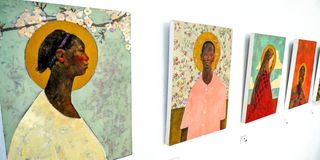
Pendergast makes portraiture look deceptively effortless. Her signature oil-on-canvas works lean into dark palettes, punctuated by delicate bursts of light and floral elements that often appear as halos around her subjects, a subtle nod to her parallel life as a yoga and meditation practitioner.

In her latest exhibition, There Was Always One Zebra, Pendergast largely remains faithful to her tradition of portraiture. Most of the faces that populate her canvases are black — individuals she says she encounters in her everyday life here in Kenya, where she now lives.

Oil-on-canvas paintings by Olivia Pendergast, at the One Off Contemporary Art Gallery in Nairobi on March 11, 2026. 

Photo credit: Bonface Bogita | Nation Media Group

Yet she is no new comer to art. She started painting when she was four years old, growing up in a farm in North Carolina, US. Her family encouraged her to follow the footsteps of her uncle and grandfather, who were both full-time visual artists.

Upon completing high school, she took a five-year Bachelor of Fine Arts degree at the Columbus College of Art and Design. For eight years, she worked for various studios as a conceptual designer in the Los Angeles Film Industry, after which she quit and reverted to painting. This is her second solo exhibition at the One Off Art Gallery.

“This is a continuation of what I’ve done before,” she explains. “The work is influenced by the meditation I practice and teach, particularly non-duality meditation. These paintings are symbols of being awake. As a society, we’re so distracted that we’ve forgotten our consciousness. I want the work to make people question whether they are truly awake to what they once were.”

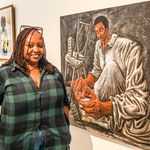
Oil-on-canvas paintings by Olivia Pendergast, at the One Off Contemporary Art Gallery in Nairobi on March 11, 2026. 

Photo credit: Bonface Bogita | Nation Media Group

While the spiritual themes remain central to the exhibition, the show’s title reflects her connection to the country she now calls home.

“Even though the work is about this meditation practice, it is also about Kenya because the work arises from here and most of the people I am painting are in and from Kenya. I wanted to tie it back to the local landscape. The meditation language that I use isn’t originated in Kenya more than it is originated in America, it is more of an Eastern religion and philosophy but I think that Kenyans probably were experiencing what I am talking about way before this philosophy came to Africa; they were living more close to nature, they had a more natural rhythm, there were no distractions, so it is pointing back to what was already there.

The metaphor of zebras plays an important role in the exhibition’s title.

“I love the image of zebras standing together, where it becomes difficult to distinguish one from the other,” she says. “Right now we believe everything is separate. But when you sit in meditation long enough, that illusion starts to dissolve. You begin to see how everything is connected. The zebras are simply a metaphor for that idea.”

As a white artist who frequently paints black subjects, Pendergast acknowledges that her work has sometimes attracted criticism, particularly from audiences who question whether she is stepping outside her cultural “lane.”

Awareness in Prior to the Music (left) and The Great Forgetting,” oil-on-canvas paintings by Olivia Pendergast, displayed at the One Off Contemporary Art Gallery in Nairobi on March 11, 2026.

Photo credit: Bonface Bogita | Nation Media Group

“Mostly the people who had a problem with it were middle-aged white women from America,” she says. “I’ve had a few Kenyans ask about it politely, and I’m fine with that. I know I’m sometimes walking on thin ice, but that’s what art is supposed to do.”

She also challenges the idea that identity can be neatly defined.

“I don’t know where my lane begins or ends,” she says. “Genetically I’m German-French by about 29 percent, but I’m also Hungarian, Romani from India, and even two percent West African. I’m basically from everywhere. Is two percent enough to paint black people? Should it be 25 percent? There’s really no way to measure something like that.”

For her, the choice of subjects is far simpler.

“We are all working out stuff here, and art is our own little therapy thing. Truthfully, I find my art beautiful with African skin. I have kind of forgotten how to work with the mzungu palette. I am not a painter of Kenyans, I just happen to live in Kenya and I love painting people and frankly Kenyans are beautiful, their skin is beautiful they are in my immediate surroundings.”

Whereas many a visual artist would envision themselves working and showcasing in places like New York and Los Angeles where Pendergast has lived and worked, being in Kenya fells different and more authentic for the US born artist.

“The art scene in Kenya is more intimate. Everybody is so switched on and excited and I want to be around that. I don’t know if it would be like that back home, I wouldn’t socialise as I do here. I interact with people with whom we have nothing in common except being human and lovers of art, yet we have such raw interactions.”

At the exhibition, the price of her portraits range between Sh96,938 and Sh800, 000. The exhibition runs until March 22.

Follow ourWhatsApp channel for the latest business and markets updates.

PAYE Tax Calculator

Note: The results are not exact but very close to the actual.