Time flies with great content! Renew in to keep enjoying all our premium content.
Prime
Where nature spices up history
Photo/Courtesy
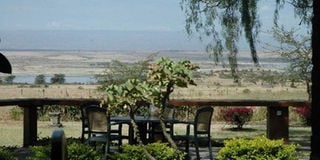
View of Lake Elementaita from Lake Elementaita Lodge terrace.
From the shady terraces of the old colonial home that is Lake Elementaita Lodge, the monument that marks the grave of the owner – Lord Galbraith Cole – resembles and evokes many feelings.
Under the scorching midday sun, the lodge is a metaphor of defiance.
This is because the vegetation around this old lodge remains stoically indifferent to the elements of weather in direct contrast to the grayness of the vegetation around it that often changes colour and shape with the seasons.
And in the dusty whirlpools beyond, way past the enigmatic hill, the Sleeping Moran, it looks like the last structure that struggled ages ago to outlast an apocalypse.
Settled
Lake Elementaita Lodge has a vivacious history that goes back to 1916 when it was built.
The owner, Lord Cole, who had fought in the Boer Wars moved to Kikopey area and settled on the 100,000 acres farm.
Kikopey, by the way, is Maasai word meaning “a place where green turns white,” (in relation to the soda and diatomite found around the lake).
Lord Cole settled opposite his brother-in-law, Lord Delamere and built a big cattle ranch complete with piped spring water from the Kikopey hills.
He also (for some reason we will never know) shot hundreds of Zebras and had problems with lions (totally expected, since he was taking food off the lions mouths).
In 1911 he shot a local who had stolen one of his precious sheep and after a trial he was deported but later returned to Kenya dressed as a Somali but soon had to flee again to Zanzibar.
His mother pleaded his case with the British government and he was allowed back into the country much later.
By this time he had started showing early signs of rheumatoid arthritis. In 1918, he started building the house that is now the lodge.
But 1920 was not a very good year for Lord Cole because his farm was constantly plagued by drought, fires, Rinderpest and East Coast Fever even as his health deteriorated.
In 1929, Lord Cole, blind on one eye and riddled with pain from arthritis, spent most of his days on the wheelchair; a broken man.
And when he couldn’t take it any more, he took a gun, stuck it on his chin and shot himself. It is from his terrace at the lodge, that now I sit, mulling over the tragedy that became of Lord Cole.
I imagined him seated at the same spot, looking out into the open plains and to the beautiful lake, and even that arresting beauty before him doesn’t inspire him to want to live.
Untouched
It is easy to “be in the moment” of Lord Cole’s scenario because his house, red bricked building still remains somewhat “untouched” over time.
The bricks remain aged and fashionably worn. The ceilings are high and there is a sooted fireplace in the common room where residents can watch television. The small intimate dining area is marked by white pristine tablecloths.
The lodge, now owned and managed by Jacaranda Hotel Group, has 33 twin and double rooms, each with a private bathroom in the newer cottages in the flowered garden. It looks beautifully scorched.
There is a swimming pool that, surprisingly, has very cold water. But it’s one of the best place to while away the hot afternoons while basking by the pool, nursing a cold beer and watching the hills beyond.
There, you might envisage Lord Cole, stalking and shooting down poor Zebras to feel good about himself.
Dusty place
At the reception, ask for a Maasai guide and drive down to the Lake Elementaita - another Maasai word derived from the term “muteita” meaning “dusty place.”
The guide will tell you that the lake was recognised as a Ramsar site, a wetland of international importance.
He will also tell you about the millions of lesser flamingos that throng the lake, which is also a stopover for migrating birds - some 350 species of them if you have the time and patience to count.
At the lake, the guide will explain to you why you can no longer see any flamingos, like he did to me.
“The water levels increased due to rains and thus covering the algae which the birds feed on,” he said, “they migrated to Lake Natron but they will be back.”
Remove your shoes and dip your legs into the hot springs or better still, strip down to your underpants and sit in the warm soothing water that, the local communities believe to have medicinal values.
You can read your book there, the birds wont mind.
Obelisk
And by all means, ask him to take you to Lord Cole’s monument that stands on a hilltop.
This monument - also called the obelisk – was erected by Lady Eleanor, the widow in memory of her husband.
There are no writings on the obelisk, or rather; the writings that were there were cemented out by Lady Eleanor. She preferred the monument not to have any writings.
But the view out there is magnificent, especially in the late afternoons when a breeze blows through from across the hills beyond.
The beauty of Lake Elementaita lodge is the fact that you are living under a history, which seems to still swirl about if you pay enough attention.
You will smell it in the main house at dinner when the silence is only broken by the clinking of cutlery from diners.
You will hear it when you sit at the terrace as the wind whistles it in your ear, carrying it from the hills.
And you will see it in the embodiment of the obelisk, perhaps the most tangible mascot of Lake Elementaita Lodge’s fascinating history.
Unlock a world of exclusive content today!Unlock a world of exclusive content today!