Time flies with great content! Renew in to keep enjoying all our premium content.
Prime
Investors to share in collapsed stockbrokers’ NSE ownership
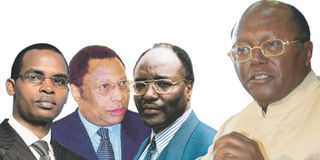
From Left: Patrick Ndwigah Gakiavih, John Munge, Ngenye Kariuki and Kung’u Gatabaki.
Failed brokers will not benefit directly from their ownership of the Nairobi Stock Exchange when the bourse sells shares to the public early next year, the market regulator has said.
Capital Markets Authority (CMA) has published new regulations that lock the collapsed brokers into co-owning the shares with investors who lost money in the successive insolvencies through the Investor Compensation Fund.
That means the sales proceeds will be used to settle investor claims before the brokers lay their hands on it – if at all.
CMA published the new rules 10 days after Charles Rubia, a major shareholder in collapsed Francis Thuo Stockbrokers, formally wrote to the regulators demanding its share of the market nearly six years after it was suspended from the trading floor for failure to meet its financial obligations.
Kung’u Gatabaki, the CMA chairman Monday said that the proposed regulations are intended to ensure that no investor loses money to the collapsed brokers.
“Shares should be allocated to the brokers together with investors who lost out,” he said.
The Capital Markets (Demutualisation of the Nairobi Stock Exchange Limited) Regulations, 2011 were published Monday with a one-month window for public discussion.
Change of ownership structure is expected to be swift, according to both NSE and CMA, taking no more than three months.
Public ownership of the NSE will see brokers halve their stake from 80 per cent (with balance shared equally by ICF and Treasury) to 40 per cent in three years.
The requirement for joint ownership of shares by collapsed brokers and their clients is expected to cut short the celebration that followed their inclusion in last month’s share allocation schedule that saw Francis Thuo come out to fight for its portion of the bourse.
Shah Munge & Partners, Ngenye Kariuki, Nyaga and Discount in receivership were allocated a million shares each to the exclusion of Francis Thuo.
Valuation of the seats — a prerequisite under the proposed rules — is yet to be done but Nyaga Stockbrokers and Discount are understood to owe clients the most at more than Sh1 billion each that has to be deducted from any share sale.
“The number of shares calculated under subparagraph (c) that would otherwise have been allocated to members of the exchange that have not restored normal operations after having recourse to the Investor Compensation Fund or being subjected to Statutory Management by the Authority and the identification of the entity to whom the same shall be allocated,” say the regulations on the filings NSE must do.
It is not clear how the CMA will treat this issue after NSE board created the now contentious allocation schedule that left Francis Thuo shareholders out.
Mr Gatabaki said CMA was addressing the matter. In a letter to the chief executive of NSE Peter Mwangi, and copied to CMA chief executive Stella Kilonzo, Mr Rubia has demanded confirmation of the fact that his firm is eligible for share allocation.
The Rubia and Channa families co-own the fallen broker with the Thuo family. Their contention arises out of the fact that former NSE managing director Chris Mwebesa in 2007 wrote a letter confirming that their seat at the bourse was intact.
Francis Thuo collapsed with client money estimated to have been worth at least Sh150 million.
But that is where the clear facts end. The NSE board sold a seat for Sh250 million to Russian investment bank Renaissance Capital and spent Sh150 million to compensate Francis Thuo customers.
That left the impression that it was Francis Thuo’s seat that had been sold to Renaissance.
The NSE board appeared to confirm that fact when it approved a share structure with 21 members excluding Francis Thuo and including Renaissance Capital.
But Mr Rubia, who chaired the firm shortly before collapse wrote to the NSE demanding the balance of the sales proceeds, eliciting a letter from Mr Mwebesa confirming that the seat was intact.
“In view of what has been reported in the local media recently, that the stock exchange is to be turned into public ownership by an issue of shares, please advise and confirm that Ms/s Thuo Partners will be the one to be allocated some shares in the proposed scheme,” Mr Rubia says in a letter dated July 19, 2011.
NSE chairman Eddy Njoroge, however, dismissed Francis Thuo’s demands, saying the seat was sold to RenCap and the matter closed.
“Their seat was sold to Renaissance Capital and the money used to compensate investors. It is no longer an issue,” said Mr Njoroge. That position was, however, at variance with RenCap’s view that it bought a newly created seat.
“We were sold a new seat at the price of Sh251 million that had been subjected to an auction process,” said RenCap CEO Patrick Mweheire.
It has not helped that none of the failed brokers was listed on the NSE member board published on the website at the time they were allocated the shares.
Other items on the NSE’s table in the run up to demutualisation are planning for new independent management of commercial and regulatory functions.
The bourse will also furnish the regulator with a detailed five-year business development plan and show how rights and liabilities of members would be treated.
CMA hopes to approve demutualisation of the bourse upon 30 days of receiving the necessary filings by NSE.
That means players in the industry are hoping to use 60 days to complete both public discussion and approval.
“We are happy with the rules which were drafted by the Demutualisation Steering Committee in which we were represented. The process should be over in three months,” said Mr Njoroge.
The NSE upon receiving approval changes into a company limited by shares (open to new stakeholders) as opposed to a mutually owned limited by guarantee (private).