Time flies with great content! Renew in to keep enjoying all our premium content.
Prime
MPs give themselves powers to set salary in new Bill
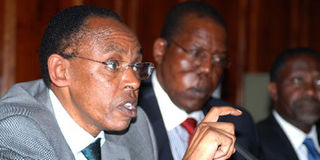
Justice and Legal Affairs committee vice-chairman Njoroge Baiya speaks when IEBC officials appeared before the committee last week. The committee has published The Constitution (Amendment) Bill 2013, which seeks to remove MPs from the list of State officers. FILE
MPs have published a controversial Bill seeking to change the Constitution so that they can continue setting their salaries.
The Constitution (Amendment) Bill 2013 aims to remove legislators, members of county assemblies and judicial officials from the list of State officers, removing the mandate of determining their compensation from the Salaries and Remuneration Commission (SRC).
“This Bill is informed by the need to uphold the doctrine of separation of powers between the various arms of government,” states the Bill published by the Justice and Legal Affairs Committee three weeks ago but distributed last Friday.
The Bill that would amend Article 260 of the has already drawn criticism from civil rights groups who say the amendments are unwarranted.
“This is self serving and is connected to the issue of salaries. This is not a good reason for amending the Constitution. Parliament should not be the first to opt out of the provisions of the law simply because the Article aggrieves their interests,” said Mars Group executive director Mwalimu Mati.
Mr Mati said the inclusion of judicial officials in the changes was calculated at cushioning the parliamentarians from a possible backlash should the proposed law be challenged in court.
The Bill was published by the committee chairman Samuel Chepkonga, the Ainabkoi MP, without the input of the Commission on the Implementation of the Constitution (CIC).
“We have not seen that Bill and it has not come to our attention,” said CIC member Kamotho Waiganjo when reached for comment.
The Bill is expected to be introduced in Parliament this week after it is read for the first time.
According to Article 256, the public will have 90 days to debate the proposal before Parliament can debate and pass it.
Mr Chepkonga said the changes would ensure there is an efficient system of checks and balances among the different arms of government.
“By including all the officers of the three arms of government — Executive, Judiciary and Parliament — under the definition of State officers, the Constitution compromises their independence,” the Bill states.
CIC is established to monitor, facilitate, coordinate and oversee the development of the legislation and administrative procedures required to implement the Constitution.
MPs have been battling the SRC, chaired by Sarah Serem, after it reviewed downwards salaries earned by the legislators and other State officers.
The MPs rejected the Sh532,500 per month, down from the Sh851,000 earned by their counterparts in the 10th Parliament, offered in a stand-off that lasted three months.
However, they later accepted the salary after a deal brokered by Deputy President William Ruto gave them a Sh5 million car grant and additional committee sitting allowances.
The deal also offered them a tax-free top up of Sh135,255 per month or 31 per cent of their basic salary for a contributory pension scheme.
SRC had by then dropped a requirement that sittings be limited to four per week in a bid to control allowances, increasing the sessions to 16.
The monthly salary at Sh532,500 is subjected to 30 per cent tax , but the gross pay is now more than Sh1.1 million. Members of the 10th Parliament earned a car grant of Sh3.3 million.
“The Bill is purely motivated by the desire to remove MPs from the armpit of SRC and other oversight bodies,” Mr Mati said, adding that removing the Judiciary and the Legislature from SRC would also exempt them from integrity demands under Chapter Six.
“I think they are not seeing the ultimate repercussions. They will not be under any obligation under the chapter on Integrity. This will embolden those who are anti-devolution and those who seek to undermine sections of the Constitution,” he said.
Mr Mati said the amendment should be taken to the electorate [in a referendum] because MPs will be redrawing the Constitution with regards to the three arms of government.