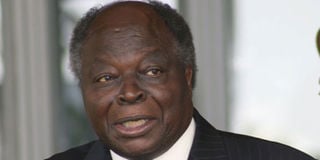
President Kibaki has stopped further cuts in mobile phone termination charges, giving telecom operators reprieve from a looming renewal of tariff wars.
What you need to know:
The fee at the heart of rivalry
On May 18, the President met telecoms operators and later directed that a reduction in termination charges be stopped.
Safaricom andTelkom Kenya had opposed plans to reduce the charges citing possible loss of jobs.
Airtel had pushed for the reduction, saying it had based its entire business model on the assumption that the cost would come down to benefit consumers.
President Kibaki has stopped further cuts in mobile phone termination charges, giving telecom operators reprieve from a looming renewal of tariff wars.
In a directive issued after a meeting with telecoms operators on May 18, the President ordered an immediate stop to the reduction of termination charges — signalling that it will take some time before the operators get new headroom to cut call costs as has happened in the past 10 months.
The decision, which has since been ratified by industry regulator, the Communications Commission of Kenya’s (CCK) board, means that the interconnection charges – the fee that operators levy calls terminating within their networks from outside – will remain at current levels in the medium term, giving the operators some level of revenue predictability.
The charges were expected to drop to Sh1.44 from the current rate of Sh2.21 beginning next month, setting the stage for a new round of price wars.
The freeze on termination charges effectively means victory for Safaricom and Telkom Kenya – the two operators who had opposed a further reduction in termination charges citing its negative impact on the sector’s profitability, risk of job losses and overall economic growth.
It also sends Airtel, the low-cost mass market Indian operator that entered Kenya last year and has been pushing for a further glide in the charges, back to the drawing back over its strategy in Kenya.
Airtel maintained its push for further cuts in interconnection charges saying overturning a process that was transparently carried out and involved all stakeholders would be unprocedural and harmful to consumer interests.
“A change in the implementation plan for the MTR will have a severe impact on our business going forward because we have based our entire Business Operating Plan on the successful implementation of the MTR,” said Mr Rene Meza, the Airtel managing director.
It was Airtel’s backing for the planned cuts in cross-network charges and Safaricom’s bid to freeze the charges at the current level that sparked a vicious war in the industry that went to the Prime Minister’s office for mediation.
The PM, Mr Raila Odinga, then formed a committee of industry experts to look into the matter but President Kibaki moved ahead of the plan to officially release the findings Tuesday.
The Office of the Prime Minister said the findings will be released next week but it was not clear whether the report has taken into account the presidential directive.
“The Communication Commission of Kenya board held a meeting on May 20 and the implementation of the mobile termination rate cuts was suspended pending a detailed evaluation of the economic impact of the current charges,” Information permanent secretary Bitange Ndemo said in a letter to the Permanent Secretary in the Office of the President, Ambassador Francis Muthaura.
The operators’ meeting with the President on May 18 also agreed that the government would take immediate measures to address escalating price wars and the risk they posed to the telecoms industry’s growth.
President Kibaki issued the directive just as the CCK released its annual report showing that the price wars which began in August last year saw Safaricom’s market share drop to 69.9 per cent from 75.9 per cent last year as rival Airtel and Orange increased their market share to 15.2 per cent from 13.5 per cent; and 8.5 per cent from 4.0 per cent, respectively.
Mr Michael Ghossein, the chief executive at Telkom Kenya, declined to comment on the presidential directive saying he had not received official communication on the matter.
It was a review of cross network tariffs to Sh2.21 in July last year that helped Airtel to slash its calling charges to other networks to Sh3 from Sh6, forcing other operators to follow suit.
The decline in call costs, though good for consumers, portends a deep cut in voice call and text messaging revenues and ultimately a slow down in sector profitability.
Safaricom’s net income dropped to Sh13.2 billion in March 2011, compared to Sh15.2 billion the previous year.
The telecom giant’s operating expenses grew 25 per cent to Sh45.8 billion in what the company attributed to intensified customer acquisition initiatives — especially for data and M-Pesa segments of the business — increased cost of value added services and the cost of expansion.
The CCK report released on Monday however indicates that the low mobile tariffs have helped to increase penetration in the country as well as minutes of usage.
Mobile penetration reached 63.2 per 100 from the previous 55.9 per 100 inhabitants, according to the report.
The penetration figures have however been questioned by some of the operators who say they don’t reflect the real mobile penetration level because many users own multiple SIM cards.
Safaricom, Kenya’s leading operator, has for example insisted that the penetration stands at 45 per cent of the total population and argues that any drastic drop in the tariffs may slow the operators’ ability to expand to rural areas.
But the CCK defended the drop in calling tariffs on grounds that the operators recovered their costs through increased minutes of usage and value addition.
The looming decline in call costs has stocked controversy in the telecoms industry that has sometimes seen the policy makers at the ministry differ with the regulator.
Dr Ndemo has, for instance, backed Safaricom and Telkom Kenya in their opposition to stop further tariff cuts citing the risk to jobs.
But a draft report prepared by the PM’s office argues that interconnection charges cannot form a solid basis for measuring the telecoms sector’s sustainability because it directly accounts for only seven per cent of all calls.
“Mobile termination rate therefore has limited impact on the entire business portfolio,” the committee said in a report.
The team had further recommended that the CCK reviews the telecoms business in relation to established pricing ethics to ensure that operators do not practice predatory pricing at the expense of the health of the economy.
The draft report also backed an earlier proposal by Airtel that the mobile operators create a clearing house for the mobile money transfers, opening a new battlefront in the industry.
Airtel first made the proposal three months ago arguing that it would reduce costs to consumers and enable recipients of cash transfers to draw them from their rivals’ outlets.
Though one can send money across the networks, the transfer process remains complex and costs 10 times more than the cost of sending money within a network, and has become one more obstacle to consumers of mobile phone service moving from one network to another.