Time flies with great content! Renew in to keep enjoying all our premium content.
Prime
Krafty Artz taps local talent to grow handicraft business
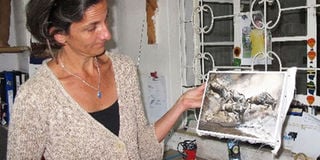
Pepe Shaw displays one of her products. Photo/Courtesy
It takes a good understanding of what people like and what designs will sell in the craft industry. Pepe Shaw, the owner of Krafty Artz, has built a successful business around this personal proven formula.
Ms Shaw spends most of her time at her workshop in Nakuru and only comes to Nairobi twice a month to take inventory of her consignments in gift shops around the city.
She has seen Krafty Artz grow three fold with 60 employees since she bought the business in 2009. The majority of the products were and are still made with wood and decorated with African wildlife.
“I introduced our new designs and made sure that the production efficiencies were in place. This is what is needed all the time in this business,” she says.
Built on the talent of local Kenyan artisans, the business has been around for almost 20 years. When Ms Shaw bought it, the products were well known and liked, thus kept most of the original designs. She also introduced hand painted stainless steel flasks and thermal cups.
Ms Shaw and her husband moved to Kenya in 2008. The business gave her a chance to continue to be in an industry that she loved.
Back in the UK, she used to work in the gift industry and as a sales director worked with gift shops and attended craft trade shows.
“Taking the challenge of running a gift business was not the problem, my challenge was learning how to produce them. I was involved in just selling a finished article. It has been a steep learning curve over the last three years,” she says.
The learning involved managing the production which requires time. A tray, for example, takes about three weeks to complete; from the workshop to the artists who have to wait for each coat of paint to dry before adding another coat.
Her sales background has helped her redesign how Krafty Artz does its business especially in promoting its products.
They can be found in lodges and hotel boutiques. It has increased its presence in Nairobi with consignments to gift shops like the Spinner’s Web, The Banana Box and The Sustainable Shop.
“We are a Nakuru-based workshop. Having a concession like in Spinner’s Web is great as it offers us a showroom within Nairobi to gives people a place where they can view the full range,” she says.
Another strategy has been to attend craft fairs where they can showcase new designs. Every year, she tries to come up with one or two new designs or refresh an old design. Last year, she took part in the Spring Valley Bazaar and Christmas Craft Fair.
The latter attracts buyers from the lodges, Uganda and Tanzania. It guarantees a wider audience. Although she admits jokingly that she has no artistic bone in her body, she works in partnership with her lead artist, Stephen Mutinda. She comes up with ideas and he will work to turn them into viable products.
“He also has a good understanding of the capacity and ability of the other artists. When we work on a new design, we are trying to come up with something that everybody will be able to do and produce to the quality that we need,” says Ms Shaw.
Right designs
Getting the right designs has enabled her to cater for the diverse tastes of two distinct markets; tourists and local residents.
The tourists want designs that reflect African wildlife while the local residents do not. For this market, she has introduced designs around flowers like the African Flame lily, birds and promoted existing strong designs such as the guinea fowl range which is one of their popular designs.
Her biggest export market is the UK though recently, she started supplying a Norwegian Zoo shop and shops in Canada and Greece.
In dealing with the export market, she has to ensure that the wood used comes from sustainable sources and that the paints and vanishes used meet the European safety standards. However, this is not a challenge. One of the challenges with Kenyan handicraft is consistency in quality.