Time flies with great content! Renew in to keep enjoying all our premium content.
Prime
Past events to blame for Polish president death
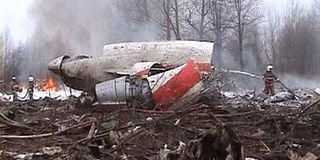
Image from video footage shows firefighters working to extinguish the flames near the wreckage of a Polish government Tupolev Tu-154 aircraft after it crashed near Smolensk airport in western Russia April 10, 2010. Polish President Lech Kaczynski was killed when the plane carrying 132 people crashed in thick fog on its approach to the Russian airport on Saturday, killing everyone on board, officials said. Photo/REUTERS
In Russia, somewhere behind every event lurks the question: Who is to blame?
In the tragedy that claimed the lives of Polish President Lech Kaczynski and 95 other Polish leaders, we can answer that question with certainty in at least one respect: history is to blame.
The event is so hideous that it seems like a bad joke, or an evil KGB plot, a mad conspiracy out of James Bond – or some combination of all three.
Yet the crash that has sent all of Poland into mourning was none of these things.
A tragedy that defies any logical explanation confirms only one thing: the cruelty of chance.
What if no fog prevented the safe landing at Smolensk airport?
What if the plane was not a 20-year-old, Russian-made Tupolev-154, but a newer and safer model?
What if the Polish pilot had obeyed the Russian air traffic controller who tried to divert the plane to Moscow or Minsk?
Unfortunately, the cruelty of chance also lies at the heart of the centuries of mistrust between Poland and Russia.
The irony is that this tragedy came at a time when mistrust seemed, to be giving way to better, more businesslike relations and greater understanding.
After 70 years of denial, Russia’s leadership (if not yet ordinary Russians) were ready to admit that Joseph Stalin’s NKVD (precursor to the KGB) slaughtered more than 20,000 Polish officers, intellectuals, and clergy in the nearby Katyn forest in 1940.
Indeed, Russian Prime Minister Vladimir Putin, a former KGB officer himself, invited his Polish counterpart, Donald Tusk, to commemorate that tragedy together.
But Kaczynski, a member of Solidarity in the 1980’s who was eager to overthrow the communist regime, was more mistrustful of the Russians than Tusk.
He put together his own delegation to visit Katyn, and wondered aloud if the Russians would give him a visa. Certainly, no Russians were invited.
When the pilot of the presidential plane (ironically, again, Soviet made) was advised not to land in the thick fog, either he, or perhaps even the president himself, may have mistrusted the Russians’ willingness to give honest advice.
Indeed, they may well have wondered if the cunning ex-KGB men around Putin simply wanted to make Kaczynski’s Katyn commemoration a mockery?
Russian-Polish suspicions and disagreements date back to the 16th century, when Poland was the far greater power; indeed, the Grand Duchy of Moscow was a backwater.
Now there is talk, in both Warsaw and Moscow, that the tragedy of Katyn might usher in a new era in bilateral relations.
Perhaps so, but as the Polish essayist Stanislaw Jerzy Lec said: “You can close your eyes to reality, but not to memories.”
Khrushcheva is senior fellow at World Policy Institute in New York.
Unlock a world of exclusive content today!Unlock a world of exclusive content today!