Time flies with great content! Renew in to keep enjoying all our premium content.
Prime
Give pastoralists security and top dollar for hides
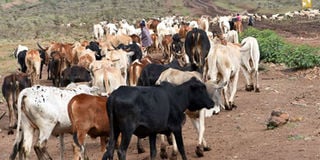
Insecurity hinders business operations in the sense that they have to close before darkness falls. FILE PHOTO | NMG
Recently, I accompanied a team to the North Eastern part of Kenya. Most of the counties in the region fall under the Arid and Semi-Arid Lands (ASALs) that are predominantly pastoralist.
In Turkana and Marsabit, I noticed various levels of informal businesses that women dominate.
Despite the fact that most still have to contend with issues such as insecurity, working in poor conditions, inadequately serviced working spaces, all of which affect their productivity and profitability, these businesses play a central role in sustaining the financial ecosystem of these regions.
Insecurity hinders business operations in the sense that they have to close before darkness falls.
Linked to this is the fact that visitor movements are restricted unless accompanied by a security agent.
This limits interaction with a large number of businesses, thus denying them revenue.
Insecurity is a strong deterrent to investors who are not originally from the region.
Most businesses that operate along the national border towns rely heavily on cross-border interactions for both the supply and demand of goods and services.
In cases where the border closes to handle security concerns, they lose revenue due to curfews that can last weeks, thus negatively affecting their profitability and productivity.
According to the Ministry of Devolution, the ASALs host about 70 per cent of the national livestock herd with an estimated value of about Sh70 billion.
Livestock accounts for about 90 per cent of employment in the ASALs and more than 95 per cent of family income and contributes an average of Sh10 billion a year from 23.2 million animals.
There are a few facilities in the region to handle this capacity, hence a large number of livestock is transported to Nairobi.
It is thus paramount to hasten the establishment of abattoirs with cold storage facilities to fully tap into this resource.
As the country contemplates the revival of a depleted leather industry, capacity-building plans targeting pastoralists with programmes of good animal husbandry will enhance the quality of leather produced.
This will also immensely contribute to increasing avenues through which quality sustainable livelihoods become a reality for families in the region.
As it is, the pastoralists only consider meat as the primary source of revenue and, in most cases, the hide is discarded.
It, therefore, comes as no surprise that the Kenya Leather Development Council has pointed out that the quality of Kenya’s leather has declined by 70 per cent since the 1970s.
Tackling unemployment among the youth in the region is key to reducing the insecurity caused by terrorism.
Due to idleness, most youth are snared by recruits who promise a source of income.
Creating opportunities that will engage them will go a long way in ensuring that there is a secure and stable business environment.
In a bid to develop livelihoods in the region, the government and development partners need to implement policies and programmes that are geared towards maximising the livestock resource in the region.
ALEX LITU, Informal economy analyst.
Unlock a world of exclusive content today!Unlock a world of exclusive content today!