Time flies with great content! Renew in to keep enjoying all our premium content.
Prime
A taste of culture and architecture in Algeria
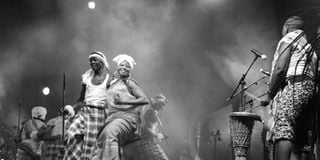
Bandari Dancers from Kenya perform at the pan-African cultural festival in Algiers: There are no shoe shiners, chaotic matatus, and bicycles. /Kamau Mutunga
A ray of gold and green lights wink from the plane window, alerting travellers they are arriving in the Mediterranean city of Algiers at midnight.
It was July 1, four days to the Algerian Independence Day celebrations, the beginning of two months of summer holidays in Africa’s second largest country.
Algeria is also bracing itself for the Second Pan-African Cultural Festival of Algiers, just the reason you’re part of more than 8,000 guests from Africa.
The organisers of the Sh5 billion extravaganza aren’t taking chances: there is police escort from Houri Bourmediene International airport, something akin to VIP treatment.
However, at this place the escort isn’t a stamp of authority; it is a precautionary measure incase the insurgents create any political migraine.
Not cool, really, considering the festival was first, and last held, 40 years ago — seven years after Algerian Independence.
“Don’t tour around without police escort,” the guide, a hospitality intern from Cape Verde Islands , warns you. He has been here for four years, so he should know.
“The country is recovering from years of civil war, and the insurgents can take advantage of the festival and cause trouble,” Adelano, our guide, elaborates.
Oil revenue Indeed, Algeria has come a long way; from the bleak “black years” of a 15-year civil strife in the ‘90s to the current wealthy tranquility courtesy of a $90 billion (Sh6.9 trillion) strong economy fuelled by oil and gas revenue that accounts for the improving infrastructure and industry. Of course, sooner or later you ignore Adelano’s warning, and venture out for nights of carousal, without any dire consequences.
As a Kenyan, there are several things you notice about Algiers, the hilly port capital of white washed buildings of not more than six stories high: the absence of shoe shiners, dust, bicycles and smoke emitting matatus.
For public transport, there are private taxis and the State-run bus company at Sh20 around town and the peri-urban centres.
But with fuel at Sh23 a litre — cheaper than a loaf of bread in Kenya — residents prefer personal cars, mostly 1300 c.c. European models: Renault, Chevrolet, Peugeot, and the like.
Second-hand cars, popular with Kenyans were banned in 1998. And although 90 per cent of Algiers drives, there are no choking traffic jams on the wide highways, expressways and flyovers; the kind Kenya envisions for the Vision 2030 economic development package. There are sirens from police outriders preceding a convoy of Mercedes Benzes on the road. It is Algerian President Abdelaziz Bouteflika.
The 72-year-old president, who is serving his second five-year term — with an indefinite third term since Parliament passed a controversial law for a limitless tenure — is on a spending spree.
Bouteflika was re-elected in 2005 on a platform of economic growth plans for the over 35 million Algerians, the kind licking low cholesterol ice cream in the many scattered parlours all over Algiers, or hanging out in gardens, water fountains, and lounging in public parks or zooming on motor bikes or driving.
Bankers, traders, and other workers enjoy riding on smooth roads without traffic jam free expressways into 15-storey State flats where they pay subsidised rent.
And though like all countries there are beggars, hawkers, roadside maize roasters, among others, one on average, can hardly tell the difference between the “have yachts and the nots” in this rapidly modernising city that still preserves its old mystique.
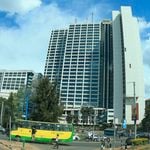
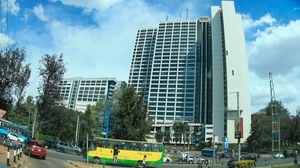
The Algerian Stock Exchange is sandwiched between off-white flats with blue metal meshed balconies. That sort of architecture. You get lost, and all buildings look alike; the city is slum-free.
Manicured lawns, public quadrangles, water fountains, sculptures and monuments and fence portraits honouring heroes of freedom struggle, and life-size wall artworks accentuate the city’s creative use of space: An inter-city road tunnel houses flats upstairs, a flyover has parking downstairs, a slope has slabbed terraces used during public performances.
The buildings sport French architecture dating back to 1830, the year they invaded Algiers, and colonised Algeria, on the pretext that their consul was insulted. Algeria was made an integral part of France until 1958. You can tell the buildings are old and need a fresh coat of paint.
Compulsory education The citizens, even those swilling alcohol in this liberal Muslim country, portray its silent prosperity in an expensive city, “civilisation” having its space in a conservative society. But most feel its wealth is still cusped by a government that controls an economy largely dependent on gas and energy sectors.
Both account for 60 per cent of budget revenues, 30 per cent of Gross Domestic Product and over 95 per cent of export earnings. Algeria is ranked 14th in petroleum revenues, with over 11.8 billion barrels of oil reserves, and the world’s eighth largest in natural gas reserves, besides being Africa’s largest oat market.
Despite all, the citizens enjoy the fruits of a modernisation drive that took off in the late ‘70s, early ‘80s when agriculture was put under collective control, oil facilities nationalised, mega industrialisation engine revved up; resulting in the creation of new industries, schools and universities.
Education is compulsory, and free for children from age six and 15, all through Algeria’s over 40 institutions of higher learning including 15 universities where 60 per cent of students are women, dominating the disciplines of law, engineering and medicine, according to the National Social Economic Council report of 2008.
Male students, the report revealed, have a tendency to work early. Algerian women find education, not only a route to freedom from patriarchal mores, but also a step to higher social standing.
They also get a chance to mingle with foreign students, like Kenyan medical majors — Aisha and Tony whom I bumped into in town. They are here on scholarship in the Universities of Algiers, Blida, Oran, Annab, and Houri Bourmediene University of Science and Technology.
Algeria’s prosperity saw an increase in population, with fertility levels shooting from 10 to 60 per cent since the ‘80s, and with it, a need for housing an increasingly urbanised population.
When he first assumed office in ’99, President Bouteflika launched, Support Plan for Economic Recovery (SPR), a five-year roadmap to, among others, boost infrastructure projects, agriculture production — the bananas we’re having for dinner are imported from Ecuador — construction of roads and social housing units.
Indeed, the tallest buildings are not commercial, but 10- to 15-storey modern housing “estates,” which according to UNDP, ranks Algeria as the country with the highest per capita housing unit occupancies in the world.
Though the Sh500 billion Support Plan spending saw the annual economic growth average five per cent, it still left a shortfall of 1.5 million units. But Bouteflika came up with a more ambitious tool — the Complimentary Plan for Economic Growth Support — during his second term in 2005.
The five-year $60 billion blueprint aims at, among others, putting up one million housing units, completing the 1,200 kilometre East-West highway, the Algiers subway transport project, and creating two million new jobs.
The plan also has 1,300 public companies up for grabs, with 150 having already been privatised, mostly in the food processing, cement, chemical and construction industries and tourism, which only contributes one per cent of GDP.
Algeria lags behind its neighbours, and mostly depend on Tunisians and Algerian-French who account for the slightly over 200, 000 visitors. Threats of terrorism and a wanting hospitality industry (my hotel is five-star but the carpet is chipped) are to blame.
But there are thousands of “cultural tourists”, including Kenyans, taking part in the Pan-African Cultural Festival of Algiers that aims at integrating artistic exchanges in the country of Albert Camus and Frantz Fanon, while opening this society struggling to open up to the rest of Africa, and the world.
Morocco is not attending, as there is still a standoff over Algeria’s supposed political backing for the Popular Front for the Liberation of Western Sahara, which has been waging a low wattage guerilla campaign for the autonomy of Sahrawi, a mineral-rich Spanish colony which was annexed by Morocco 32 years ago.
Amnesty programme Bouteflika has managed to contain, mostly the Berber and Islamic protest movements which began political rabble-rousing in the ‘80s, agitating for the end of single party rule, which the then president Chadli Bedjedid ended in 1988.
Multiparty elections were held two years later, but when the Islamic Patriotic Front won the first round, the army intervened, and cancelled the second round, forcing Bendjedid to resign.
All political parties based on religion were banned, culminating in a 10-year Civil War in which more than 160, 000 people perished. But by 2002, the main guerrilla outfits had either been destroyed or surrendered via an amnesty programme. But very few people speak English. You order chicken and roast potatoes; you get lamb chops, vegetables and Algerian soup.