Time flies with great content! Renew in to keep enjoying all our premium content.
Prime
Australia offers new market for Nile perch exports
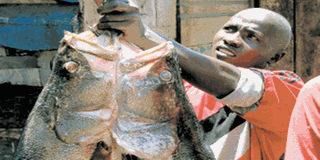
A fisherman weighs Nile perch at Kasenyi landing site in Uganda. The fish is one of the key exports from East Africa to the European Union market. File
Stiff competition in Asia and western Europe has left Kenya looking for new markets for its Nile perch stock with Australia being touted as a potential alternative
Nile perch sales in the traditional markets have reduced over the years as more price-sensitive consumers opt for the cheaper Pangasius species.
“Australia may again become an attractive market for Nile perch because of its similarity to barramundi, a local freshwater fish,” the Food and Agriculture Organisation (FAO) said in a market outlook.
ile perch and Pangasius products traditionally rival each other in international markets owing to a generalised classification as “white meat”.
Vietnamese Pangasius are already popular in western European markets where its low price has boosted its sale in the face of the economic crisis. Spain and Germany are now the top two importers of Vietnamese pangasius.
That has put under pressure Kenya and other East Africa countries that mainly rely on Lake Victoria to support their Nile perch industries.
Dwindling stock at the lake because of indiscriminate fishing and weak prices globally have also depressed earnings.
The consumption of Nile perch in Europe has remained steady despite a gradual shift to the rival Pangasius by consumers.
Statistics showed that in the first quarter of 2011, the EU remained the main market for Nile perch exports with 8,200 tonnes of fillets coming from these Kenya, Uganda and Tanzania.
The import figures have remained stable compared with the same period in 2010.
In 2010 Kenya exported 3,600 tonnes of Nile perch fillets to EU markets, while Tanzania sold 16,300 tonnes and Uganda 11,800 tonnes.
Apart from competition from Pangasius, the Lake Victoria Nile perch industry has also suffered an image problem over claims of illegal arms trade in exchange for fish and poor fishing methods that deprived the lake of its potential resources.
“Though environmental degradation has affected stocks, the water hyacinth menace has also led to a dip in numbers because vessels cannot move,” Abdullah Noor, a dealer in Kisumu said by phone.
Statistics by the Fisheries department showed that the Nile perch stock in Lake Victoria declined from 1.9 million tonnes to 1.2 million between 1999 and 2001 before dropping drastically to 544,000 tonnes in 2005. The stocks were estimated at 370,000 tonnes in 2008.
“For Nile perch to regain its former valued status, local governments and fishing companies need to work together to ensure sustainable management of this important resource, and also to address the issue of illegal fishing,” FAO said.
To stall the dip in Lake Victoria’s economic fortunes governments in the region have taken to reforms such forming beach management units to oversee prudent utilisation of resources.
The governments of Kenya, Uganda and Tanzania have also launched initiatives that specifically target Nile perch and the use of eco-labelling to encourage sustainable fishing and the reduction of negative impacts on the environment.
Nile perch dealers on Lake Victoria are currently implementing certification through various schemes such as Naturland, a German eco-certifier.
The certification covers about eight landing sites in the western region of Lake Victoria and involves about 1,000 fishermen, in Bukoba, Tanzania. Under the arrangement products from the area will be both frozen and chilled fillets and initially sold in Germany.
“On a positive note the Dutch company, Anova Food, announced in May that sales of its Naturland-certified sustainable Nile perch products now account for over 20 per cent of total sales in that categoy in the US,” FAO said.
Producers of the rival pangasius have also taken to certification, signaling competition to Nile perch dealers.
For instance in April 2009 Global GAP, announced its new pangasius and tilapia standards, which were published after having been tested on fish farms.