Time flies with great content! Renew in to keep enjoying all our premium content.
Prime
Bata Kenya spruces up popular Safari Boot brand to boost sales
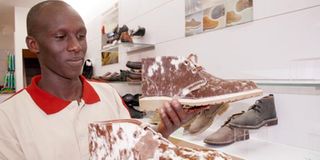
A Bata shop attendant shows off a pair of newly launched Safari Boots. /Frederick Onyango
Three weeks ago, Bata released 300 fresh pairs of Hair On, a variant of the Safari Boot, into the market to test the waters.
The original version of the loose-fitting indigenous shoe with a rough finish that exudes the promise to endure a rough terrain was designed in 1966.
Today, the boot continues to command a formidable market, both in Kenya and abroad.
Originally designed for an emerging tourist market, it went on to dominate that segment and then to cross over in its appeal and to capture part of the local shoe market.
The Safari Boot, whose Swahili names literally suggests a shoe on an escapade, has had an adventurous life.
It has been to the top of Mount Kenya and across many a valley.
Kenyan tour guides on safari and Kenyan tourism officials on international marketing campaigns will almost always have a pair of Safari Boots close by.
Kenyan icon Whether dominating the view on an overhang billboard or perched patiently on a shelf waiting for a suitor, Bata’s Safari Boot is an undisputed Kenyan icon. Wherever it travels, it easily conjures up the image of Kenya.
To leverage its success, Bata brands the Safari Boot as the shoe that says you have been to Africa.
“This is one of the brands that have kept Bata Kenya afloat through the years,” says Agnes Murila Bata’s Merchandising Manager.
“Anyone walking into any Bata Kenya outlet will easily notice the shoe.”
Other popular Bata brands in Kenya include Pata Pata or flip-flops whose sales amount to 14 million pairs a year, Ngoma, the dancing shoes of choice for the rural woman, with 2 million pairs sold each year and Toughees, Bata’s signature unisex shoes for the school market, 700,000 of which are sold each year.
Inside a busy factory in Limuru, the home of the Safari Boot, 20 men work briskly to keep up with demand.
Each part of the shoe is handled by a specialist, the entire process a labour intensive exercise that needs to be carried out at fast pace.
According to Bata Kenya, the factory is currently supplying the market —local and international— 18,000 pairs of Safari Boots every week.
Bata Kenya data also indicates that the Boot is one of the company’s most profitable and resilient brands, with several other companies attempting to imitate it but never achieving or surpassing its stature.
Of the 20 million pairs of shoes that the company stitched last year, 600,000 pairs were Safari Boots.
This year, the company targets to sell 800,000 pairs.
“So far so good, we are certain to meet our sales targets,” say Murila.
With a retail price in the region of Sh2,000, that’s a tidy sum into Bata’s purse.
Hair On, the new variant of the Safari Boot recently released to test the market, is as hairy as a fresh cowhide and features the natural colours of a cowhide. Everything else about the new variant will remain the same.
Last year, Bata Kenya released Kick Safari to titillate the market and, according to Bata, the response has been good.
The strategy, according to Murila who has worked with Bata for over a decade, is to keep extending the product range of the Safari Boot to keep the brand alive.
However, despite these recent product innovations, nothing beats the original boot in sales and goodwill.
Product innovation Designed under the leadership of Italian designer and artist Giulio Zanacco, then the chief designer at Bata Kenya, the original Safari Boot has come a long way, with only minor changes made to it over the years.
Made of cow hide, the boot is offered in different finishes and as a low cut or a high cut boot, according to customer preference. What cuts across these variants is the comfort, the hardy nature of the shoe and the ease of cleaning it, no matter how rough a walk it has taken.
Most shoes produced around the world today are machine made.
The Safari Boot is still mostly hand stitched, giving it a distinct, authentic look, and setting it apart from attempts at imitation.
Although initially a distinctly male affair, as gender roles have gradually changed over the years, women have increasingly donned this resilient brand of footwear.
It is also exported to Uganda, its main export market, Zambia, Sudan and Europe.
Unlock a world of exclusive content today!Unlock a world of exclusive content today!