Time flies with great content! Renew in to keep enjoying all our premium content.
Prime
Busy year for top companies in the corridors of justice
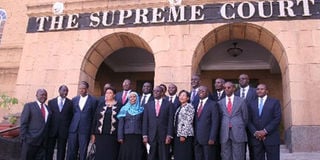
Chief Justice Willy Mutunga (centre) poses for a photo with the 16 newly appointed court of appeal judges at Supreme court on December 11, 2012 after they were sworn in at state house. Photo/PHOEBE OKALL
Top Kenya companies will have a busy year in court as they face their workers, business partners and rivals in high profile disputes, partly made possible by reforms in the Judiciary.
Safaricom, Kenya Airways, CMC Motors, Faulu Kenya and Jaguar Land Rover are some of the companies that will return to court after the Christmas vacation for legal battles.
Legal experts have said that some of these disputes could not have made it to court under the previous judicial regime, which was blamed for corruption and delays in closing cases, undermining confidence in litigation.
“The Judiciary has improved and has dispensed some cases expeditiously, like the Kenya Airways (and aviation workers union case). This has made those who traditionally shun the court for being slow turn to court,” said Okweh Achiendo, an advocate.
The Judiciary has been at the centre of reforms that have seen the office of the Chief Justice, Deputy Chief Justice and judges filled competitively. Further, sitting judges have been vetted by the Judges and Magistrates Vetting Board, with 11 judges being sent home so far.
Last month, the board found Nicholas Ombija, Mary Ang’awa, Murigi Mugo, Joseph Sergon and Leonard Njagi unfit to continue serving as High Court judges.
Lady Justice Ang’awa was sent home because of her style and conduct, which the panel termed as unbecoming after she was disrespectful to a witness.
“There are now legal and practical efforts to make the Judiciary’s operation independent,” says Mr Achiendo.
With the renewed confidence in the Judiciary, we have seen business partners end up in court when the deal goes sour as is in the case of CMC Motors and Jaguar Land Rover (JLR). In the past, litigants in such a case would have shunned the courts for its slow pace.
CMC will be fighting to retain its franchise with JLR, and it has already obtained an injunction stopping JLR from terminating the contract.
CMC is fighting to retain the contract of the brand that accounts for 30 per cent of its annual unit sales after JLR threw it into a crisis with the announcement that it would transfer the rights to exclusively trade in Land Rover Defender, Jaguar and Range Rover brands to rival RMA Group.
The court has also seen workers face off with their employers, in classic labour cases that in the past would not have made it to court for fear of the lengthy process and costs.
It’s a ruling that generated sharp reaction from employer’s federation, union and economic analysts, but the only option is to return to court again and seek reprieve, and Kenya airways has filled application for postponement of the ruling pending appeal.
The Kenya Airways case is a manifestation of the power and independence that Kenyan court enjoys today.
Rivals are seeking solace in the corridors of justice as occasioned by the case pending in court where Faulu Kenya has sued Safaricom. Faulu claims that Safaricom infringed copyright in launching M-Shwari, a virtual banking platform.
The deposit-taking financial institution alleges it had proposed to enter into a partnership with Safaricom to deploy a similar product, including preparation of a concept paper detailing how it was going to operate. Safaricom has denied these claims saying it not only fully owned the product, but that its conceptualisation was done fully within the law.
Safaricom has already lost the first round of the court battle against Faulu after the High Court declined to refer a copyright infringement dispute between the two institutions to a tribunal.
The court has in the recent past delivered rulings or issued orders against executives, asserting the principle of division of functions.
Henry Kurauka, a high court advocate, says some of the recent rulings made by the High Court have shown the independence of the Judiciary.
Last month, the courts suspended the switching off of analogue television signals until January 11 after the Consumer Federation of Kenya (Cofek) went to court. The switch-over on December 31, 2012 had the support of the Ministry of Information and Communication.
In October, the industrial court put on hold the proposed new NHIF rates, which had backing of some senior Ministry of Health officials including Medical Services minister Anyang’ Nyongo’.
The Kenya Union of Domestic, Hotels, Educational Institutions, Hospitals & Allied Workers Union (Kudheiha) moved to court to challenge the new proposed NHIF rate saying the NHIF board, Prof Nyongo’ and Labour Minister John Munyes were intending to enforce the enhanced rates without consultations.
In october, Justice Roselyn Nambuye ordered the government to pay a local manufacturing firm, Orbit Chemical Industries, in excess of Sh11.4 billion for loss of use of its 100 acre-prime land in Embakasi.
“Judiciary is well on course; we have seen public appointments cancelled, orders given, even in the instances where government has been stubborn,” says Kurauka,