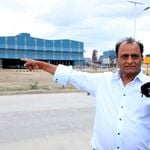
Steel and cement billionaire Narendra Raval has lost a mining levy concession after the Auditor-General raised concerns that he enjoyed undue advantage over his rivals.
Mr Raval’s firm, National Cement Company, was in 2020 allowed to pay a lower mining levy of Sh100 per tonne of cement while rivals paid a higher charge of Sh140, triggering protests from competitors and the public auditor.
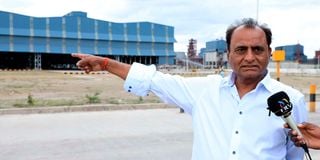
Auditor-General Nancy Gathungu has disclosed in a July report that the State Department of Mining revoked the concessionary rate following audit questions that also challenged the legality of the sweetheart deal.
National Cement, with its Simba Cement brand, has expanded through acquisition and the construction of a new plant, which has enabled the firm to emerge as the top player against older rivals like East Africa Portland Cement and Bamburi Cement.
“The management submitted that the State Department of Mining issued a revocation for the preferential rate and the company is now paying at the common rate,” Ms Gathungu said in the report, which follows on audit recommendations from MPs.
Mr Raval confirmed the withdrawal of the levy concession through a text message.
“We have no arrears. We pay monthly Sh255/tonne as per the law,” said the tycoon in a SMS response to the Business Daily.
The lawmakers had called for the revocation of Mr Raval’s lower tariff within one year in 2022, arguing that all cement firms must pay a uniform rate.
The MPs also demanded that the cement tycoon reimburse the State the benefit that is estimated at Sh10 million monthly, which the Auditor-General termed illegal.
The chief public auditor reckons that Mr Raval was offered the concession in a period when Kenya had no law empowering the Mining Cabinet Secretary to offer duty reliefs to cement firms. She also faulted granting the benefit to one company.
The Royalty Collection and Management Regulations were gazetted in 2024 and define circumstances under which a company should be granted concessions.
“Although a letter from the CS dated 14 March, 2021 provided for audit authorised the company to pay a reduced cement levy rate different from the gazette rate of Sh140 per ton, the letter was not based on any existing regulations as required,” said an audit covering the year to June 2022.
“It was not clear why the reduced levy rate of Sh100 applied only to one company while the sector had several players manufacturing the same product.”
Mr Raval, popularly known as Guru due to his priestly background, enjoys close ties with President William Ruto and former President Uhuru Kenyatta.
He has recently tightened his grip on the region’s cement and steel industries on the back of deal-making, which has made him one of Kenya’s wealthiest industrialists.
The National Assembly in February last year adopted a report directing that all companies in the cement sector pay uniform levies and asked the Mining Principal Secretary (PS) to ensure the company pay millions of shillings it had enjoyed as benefits during the period.
“Demand for the arrears resulting from the difference has been issued as provided,” the Auditor-General said.
Between July 2020 and March 2022, previous audits show, Mr Raval underpaid cement levies by Sh193.2 million on the 6.19 million tonnes of cement his company produced. The levy is linked to limestone mining, a key raw material for cement production.
National Cement has factories in Emali, Nakuru and West Pokot counties.
In 2018, the company launched a Sh30.3 billion cement clinker plant in Merrueshi/Mbirikani in Kajiado County.
The following year, Mr Raval acquired the Kenyan assets of bankrupt cement manufacturer Athi River Mining for Sh5 billion, and constructed two new cement factories in Njoro, Nakuru and Mariakani in Mombasa.
He recently bought Rwanda’s oldest cement manufacturer, CIMERWA Plc.
The investments are the product of Devki’s internal resources and bank loans.
In 1992, Mr Raval took out a loan and started a roofing and fencing materials business while developing a small steel rolling mill near Athi River on the outskirts of Nairobi. That business morphed into the behemoth that is Devki Group.
Devki recently sold back a majority stake in the geothermal power plant, Sosian Menengai Geothermal Power, to Gideon Moi, a son of Kenya’s second President and former Baringo Senator, for an undisclosed sum.
Mr Raval had bought the majority stake in the geothermal venture through an entity called Sosian Energy in 2017.
He is now eyeing the virgin production of steel, the first in Kenya and one of the few on the continent, where the bulk of firms use scrap metal to produce the commodity.
The iron ore from Uganda is expected to feed Mr Raval’s new factory in Kwale County, billed to be the second such plant in Africa.
The Sh45 billion plant was unveiled by Dr Ruto in late 2022 in his first major public assignment after clinching the presidency, underlining Mr Raval’s proximity to the head of state, who in April last year graced the opening of the tycoon’s clinker plant in West Pokot.