Time flies with great content! Renew in to keep enjoying all our premium content.
Prime
Emirates Group steps up poaching of KQ engineers
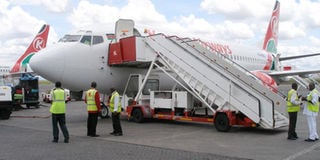
Kenya Airways engineers conduct pre-flight checks on a plane. Emirates Group’s aviation and travel services unit, Dnata, on Friday called on Kenyan-based electrical, electronics, mechanical and automobile engineers to apply for jobs. PHOTO | FILE
The Dubai State-owned Emirates Group, which owns the Emirates Airlines, has stepped up recruitment of Kenyan aeronautical technicians and ground handling staff piling pressure on troubled national carrier Kenya Airways that is grappling with mass staff exodus and labour disputes.
Emirates Group’s aviation and travel services unit, Dnata, which operates in 83 countries and is one of the world’s largest air services providers offering ground handling, cargo, travel, and flight catering services, on Friday called on Kenyan-based electrical, electronics, mechanical and automobile engineers to apply for jobs.
“We are one of the largest air services providers with over 38,000 employees across six continents.
“The airlines we serve demand the best in efficiency, safety and service excellence…we are seeking qualified ground handling professionals to join our team in Dubai,” said the Dubai based Dnata in a notice.
Dnata is owned by the Emirates Group, the State-controlled international aviation holding company which also owns the Emirates Airlines.
The aviation services company provides ground handling services at 17 airports and the Emirates Airlines, the largest airline in the Middle East.
The hunt for talent is expected to pile pressure on Kenya Airways, known as KQ by its international code. The national carrier’s employees have raised their clamour for better perks and improved working conditions amid shrinking profits for the airline.
KQ pilots last week issued a seven-day strike notice which expires Monday, demanding the removal of chief executive Mbuvi Ngunze and chairman Dennis Awori.
Some cabin crew and ground staff have also been on a go slow.
The carrier’s workforce has increasingly come under attack from Middle Eastern airlines in the recent past.
KQ’s management first revealed its fears and frustration arising from the mass staff exodus last month when it acknowledged to have lost more than 60 pilots.
The staff poaching, KQ said then, is not confined to its best engineers and has sometimes spilled over to non-technical employees too.
Kenya Airways had 523 pilots in March 2015 but that number dropped to 489 pilots in 2016, representing loss of about 30 pilots. Others have left in the current financial year.
Mr Ngunze said last month the number of pilots now stands at 460 and engineers at 600.
He blamed the attrition to poaching of skilled staff by Middle East airlines, which are offering lucrative perks and salaries to KQ’s highly trained specialists.
“It is true that there has been some increase in the numbers of engineers who have left KQ recently. We must bear in mind that the Middle East is looking for talent from all over the world because of their rapid growth.
“But it should be remembered that we had been training significantly as part of our growth so we have certain elements of back fill,” said Mr Ngunze during the airline’s 40th annual general meeting in Nairobi.
Bulging with cash, Middle East airlines have been offering Kenyan pilots and engineers hefty perks to cross over.
Emirates Airlines flies to more than 140 destinations in six continents, operating a fleet of over 250 wide-bodied aircraft. The airline has 170 aircraft on order worth $58 billion.
The Emirates Group has a turnover of about $18.4 billion and employs more than 62,000 employees across all its 50 business units and associated firms, making it one of the biggest employers in the Middle East.
The company is wholly owned by the Government of Dubai directly under the Investment Corporation of Dubai and as part of Dubai Inc.
Unlock a world of exclusive content today!Unlock a world of exclusive content today!