Time flies with great content! Renew in to keep enjoying all our premium content.
Prime
Entrepreneurs who built empires from scratch
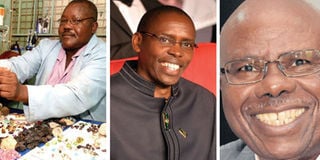
From left, goldsmith Peter Munyoki, Optiven Limited CEO George Wachiuri and Bia Tosha's Peter Burugu. PHOTOS | FILE |
Steve Jobs once said: “You cannot ask customers what they want and then try to give that to them. By the time you get it built, they will want something new.”
This famous quote from the deceased co-founder of Apple suggests that true innovation is about pin-pointing a need in society and, if considered viable, going for it. That quality, he added, distinguishes a leader from a follower.
In 2015, the Business Daily highlighted tens of entrepreneurs who have chosen this path and, through hard work and perseverance through tough times, grew their ideas into businesses of repute.
Here is a list of some of these businesspeople and their journeys. ---------------------
How former EABL employee built a beer distribution empire spanning Nairobi to Namanga, rivalling Karume
This is the story of 68-year-old Peter Burugu who claims that Bia Tosha, his distributorship company of two decades, handles 12 out of every 100 cases of beer that leave EABL’s Ruaraka factory.
Mr Burugu was until April 1995 an employee of the brewer, rising from an accounts trainee to being in charge of its distribution and logistics department, a career that spanned 27 years.
He retired early and, due to the wealth of knowledge he possessed, his former employer requested him to begin distributing alcohol in Kiambu, taking over the turf of billionaire businessman Njenga Karume – now deceased – who had partnered with South African Breweries (SAB) of the Castle Lager brand.
Every year, these vehicles supply pubs and restaurants with as much as 2.4 million cases of beer and 20,000 cases of assorted spirits, a haul which last year returned revenues of Sh4.6 billion. The company’s present market includes Industrial Area, South C, Hurlingham, Kiserian, Rongai, Juja and Namanga. ------------------------
‘I failed 15 times before I built my Sh1 billion real estate firm’
How many times would you fruitlessly attempt to get a start-up going before throwing in the towel? Two times? Three times?
Today Mr Wachiuri, the CEO of Optiven Investments, looks back at the hurdles which dogged him for more than 15 years with a smile. This is because the real estate developer has earned prestigious accolades over time.
They include the company’s surprise ranking as the overall winner in the Top 100 mid-sized companies 2014/15. Optiven was also the best real estate company in the mid-sized category.
Optiven sells value-added plots with emphasis on conserving the environment, which includes planting trees. The firm also emphasises on providing security, piped clean water and infrastructure among other facilities. -----------------------------
Move to fill void put trucking firm on the road to success
This is the story of four “truck enthusiasts” who built a transportation empire with its roots in a South C yard.
Multiple Hauliers East Africa trucks dot Kenya’s major highways, transporting cargo like imported petroleum, vehicles and foodstuff from the port of Mombasa to neighbouring landlocked countries.
At the time, they were transporting agricultural produce destined for export from Uganda to Mombasa and kerosene in the opposite direction, operating from a leased facility.
The company, which was incorporated in 1982, moved on to clinch deals with oil companies like Caltex, Agip, and Shell (that now trades under Vivo Energy), with Uganda remaining their main destination.
Rajinder Baryan, 61, is the chairman and managing director of the firm that has branches in Mombasa, Kisumu, Busia, Malaba, Kampala and Juba. Clients include Bamburi Cement and Damco. ---------------------------------
How the goldsmith family of Kirinyaga Road struck it rich
Nairobi’s Kirinyaga Road is known for many things, mostly being the go-to place for motor vehicle spare parts. It is also infamous for being the capital of the grey market.
In June, the Business Daily caught up with a gold smith family that makes gold and silver rings as well as other valuable ornaments using precious stones such as tanzanite, ruby, rhodolite and green garnets.
Peter Munyoki, 63, and his son buy gold dust from traders who source it from mines in Tanzania and Migori while silver is recycled from old accessories such as rings and chains.
Gold rings made at the Munyoki’s range between Sh3,500 and Sh24,000, prices that are relatively cheaper than what mainstream jewellers in Nairobi charge.
Silver rings, on the other hand, cost between Sh3,000 and Sh9,000 depending on the size of ring and whether a customer needs a precious stone like tanzanite set on it. ----------------------------------------
Shortage of bride price led to Sh400m business
When Daniel Githua, the current Tuskys CEO, took a friend to a dowry ceremony in August 2009, the tough negotiations that ensued would set him on a path to forming a company that is today worth Sh400 million.
Despite hard bargaining over the brideprice, the groom’s entourage fell short of Sh120,000. The funding gap gave Mr Githua the idea of bailing out his friend and at the same time making a profit.
Further analysis revealed that there was an opportunity for emergency lending and he decided to try his luck in the business, sowing the seed for Speed Capital.
Together with Ben Ireri, a friend from his days at the Starehe Boys Centre, the two began loaning small sums of money, mostly to friends and associates. By the end of the year they had issued Sh5 million worth of loans.
Today, Speed Capital’s workforce has increased to 90 with more branches in the pipeline. --------------------------------------
EABL retrenchee taps craft beer for discerning drinkers
As far as obvious statements go, “Kenyans love their alcohol” ranks high up on the list.
Charles Njogu knows this all too well having worked at the East African Breweries Limited (EABL) for 32 years as a chemical engineer.
In 2013, the 57-year-old was among the 100 employees who left the regional brewer in the wake of a retrenchment instituted to save costs.
In July last year, after seven months out of a job, Mr Njogu opened Sirville Brewery and Lounge, a microbrewery on the first floor of the Galleria Mall in Nairobi where he brews and serves four types of beer.
They are Tsavo Lager, Mara Pils, Amboseli Ale and Aberdares Bitter Ale.
His business is referred to as craft brewing. This trade, which is highly popular in the US, involves use of facilities that produce less than 1.8 million litres per year with some brewers, like Mr Njogu, serving their clients on site.
The beer is made using the usual ingredients like hops, malt, barley and yeast, with the brewers adding unique ingredients that distinguish their brands from mainstream products.
Mr Njogu and his four business partners have managed to rake in more than Sh70 million in revenues in the first year of operation, an amount which is slightly higher than their initial capital investment.
Sirville Brewery, which is coined from Mr Njogu’s Sironi Village in Nyahururu, has an annual brewing capacity of about 180,000 litres. -------------------------------------
Trader overcame failure to build empire from grains of rice
When Charles Njiru started working in the 1980s, every month he just had Sh300 to his name, money he earned as a tailor.
More than three decades later, Mr Njiru has become a multi-millionaire, with the first-ever rice wagons worth Sh13.2 million that distribute about three tonnes of grain from his milling factory to various counties every day.
His flagship business, the 11-year-old Nice Rice Mill, has a capacity of 150 tonnes a day and churns out about 70 per cent of the more than 40,000 tonnes of rice produced in Mwea every year.
The factory, which he estimates is valued at over Sh300 million, sits on a three-acre piece of land, employs 80 permanent staff and close to 5,000 others indirectly through transport and retail businesses.
This is the story of a serial entrepreneur who has tried everything from sewing, matatu business, transporting, construction and brewing but has found success in the Mwea rice.
Unlock a world of exclusive content today!Unlock a world of exclusive content today!