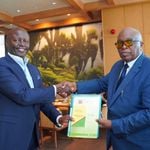
Former Ugandan attorney-general has taken a 14.63 percent stake in Sidian Bank after buying Sh1.03 billion worth of shares from Centum Investments, marking another shift in the ownership of the low-tier lender.
William Byaruhanga, who served as attorney-general from 2016 to 2021, is now the fourth-largest shareholder in Sidian Bank, which has emerged as one of Kenya’s fastest growing banks.
His firm, Kenbe Investments, bought half of an Investment vehicle dubbed Bakki Holdings Company from Centum Investments.
This gave the wealthy lawyer a 14.63 percent direct stake in Sidian through Bakki Holdings Company, which owns 29.2 percent of the bank from the previous 40 percent.
The split of Bakki shares comes amid heightened deal-making in Sidian in the wake of Centum’s staggered reduction of its stake in the low-tier lender, which has seen new owners take control of the bank.
The deals follow the decision by Centum in January 2023 to end a pact with Nigeria’s Access Bank to sell its 83.4 percent shareholding in Sidian for Sh4.3 billion Had the transaction proceeded, it would have been the second acquisition in Kenya for Access Bank, which acquired Transnational Bank, now called Access Bank Kenya, in 2020.
Centum opted for staggered sale of its ownership, ceding a 43 percent stake to investment vehicles-- Wizpro Enterprises Limited, Afram Limited, Pioneer General Insurance, Pioneer Life Investments and Telesec Africa—for Sh3.2 billion.
Half of the remaining 40 percent stake was later sold to Mr Byaruhanga’s firm, Kenbe Investments, cementing the lawyer’s dealings with Centum, which he joined as director in 2016.
“Our stake in Sidian Bank reduced from 20 percent to 14.63 percent, a current carrying value of Sh1 billion, an increase from Sh900 million in the previous financial year,” said Centum Investments in its annual report.
“The reduction in our stake was not due to the sale of shares, rather it was a result of dilution in shareholding from an ongoing rights issue in Sidian Bank in the year,” added the investment firm, while signalling that Mr Byaruhanga also sat out the rights issue.
Mr Byaruhanga, who is a close ally and confidant of President Yoweri Museveni, is a major real estate investor in Uganda, holding prime properties in Kampala and across the country.
He also owns a hotel, a sugar company and an interest in Kampala law firm, Kasirye, Byaruhanga and Company Advocates.
He opted not to seek a fresh term as attorney-general in 2021 to focus on growing his business empire.
Mr Byaruhanga owns 90 percent of Kenbe Investment, with his wife taking the remaining 10 percent, giving her an indirect 1.4 percent stake in Sidian Bank.
Sidian has six institutional investors after the sale of stakes by Centum and the exit of nine individual owners.
The owners have injected Sh3 billion in capital over the past 18 months through three rights issues.
Centum Investments and Mr Byaruhanga did not participate in the rights issues, which diluted the combined ownership under Bakki to 27.27 percent from 40 percent.
This saw other investors increase their holdings.
Wizpro Enterprises grew its ownership to 24.95 percent from 18.27 percent while Afram raised its stake to 24.3 percent from 7.91 percent.
Pioneer General Insurance and its sister company, Pioneer Life Investments, cut their stakes to 16.89 percent from 24.8 percent and 4.49 percent to 3.06 percent, respectively.
Telesec Africa holds 3.47 percent, down from 4.49 percent before the capital raising.
Telesec Africa was previously owned by Kiharu Member of Parliament Ndindi Nyoro before the lawmaker transferred his ownership to John Mbugua Maina in 2020.
Wizpro Enterprises is owned by the chair of Kenya Tea Development Agency (KTDA) Management Service firm Solomon Muriithi Maina, who also owns a 4.22 percent stake in Housing Finance valued at Sh509 million.
Sidian is expected to make another cash demand from its shareholders after the Central Bank of Kenya cited the lender for having thin core capital adequacy ratios.
A Central Bank of Kenya (CBK) stress test in May revealed that Sidian’s capital levels would be inadequate in case of defaults, arguing that its retained profits would be insufficient to make it compliant.
“Core CAR [capital adequacy ratio] for Bank of Africa and Sidian Bank remains below the regulatory requirement after adjustment for full provisioning since 2022, indicating vulnerability to shocks,” said the CBK.
Sidian’s half-year net profit grew 4.5 times, making it the fastest-growing bank among Kenya’s 38 banks.
It reported a net profit of Sh1 billion for the six months ended June 2025, up from Sh221 million posted in the same period last year on the back of increased earnings from government paper.
Its deposits grew 70.8 percent to Sh59.8 billion in the year to June, while its lending rose 4.8 percent to Sh26.9 billion.
The bulk of the deposits were invested in Treasury bills and bonds, with the bank’s portfolio of government securities tripling to Sh39.3 billion over the 12 months.
The bank’s earnings from government securities rose to Sh1.8 billion from Sh875 million, underlining the portfolio growth.