Time flies with great content! Renew in to keep enjoying all our premium content.
Prime
Oil marketing companies phase out smaller gas cylinders
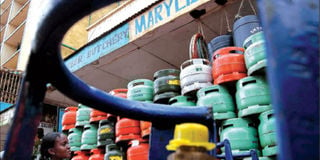
A cooking gas outlet. Gas dealers said the smaller containers were not profitable, prompting the push to have gas sold in the 13-kilogramme cylinder, which many low income households may not afford. Photo/FILE
Confusion has hit the cooking gas market after some oil marketers moved to phase out smaller cylinders in favour of the more profitable 13-kilogramme container.
The move will discourage use of cooking gas among low income households that largely rely on wood fuel or kerosene for domestic use, turning back the clock on adoption of clean energy.
Gas dealers said the smaller containers were not profitable, prompting the push to have gas sold in the 13-kilogramme cylinder, which many low income households may not afford.
“The three-kilogramme cylinders are just not economical for us,” Hashi Energy chief executive officer Mohamed Adan said.
A spot check by the Business Daily around the Nairobi central business district revealed dwindling stocks for the three kilogramme (3kg) and six kilogramme (6kg) cooking gas cylinders with the former almost missing in most filling stations.
The 3-kg economy size Liquefied Petroleum Gas (LPG) cylinders are popular among lower end households and are used by those in the middle class on their travels to camping sites or rural homes where there is no electricity supply.
Total Kenya has been exchanging 6-kg cylinders for the larger 13kg in a two-month promotion. This has seen consumers take empty 6-kg cylinders to Total outlets in exchange for filled 13-kg cylinders at a subsidised fee of Sh4,400.
Total, however, said the 3 kg cylinders are not popular because they involve frequent refills and repairing worn out cylinders to ensure safety.
“The 3kg gas has recorded slow business,” Total corporate affairs manager Maurice K’Anjejo said.
Households have been paying Sh580 to refill a 3kg cylinder and Sh1,200 for 6kg, depending on the outlet.
KenolKobil has completely cut the 3-kg cylinders out of its stock and is encouraging use of the 13-kilogram cylinder through a promotion where a set comprising gas, hose pipe and regulator is costing Sh7,560.
Hashi Energy is also giving the 3-kg cylinders a wide berth but has arranged financing with Equity Bank for low income households seeking to upgrade to the 6kg and 13 kg cylinders.
The deal, set to be unveiled later this month, will see households pay a monthly instalment of Sh500 for one year for a 6kg gas cylinder. The 6kg container costs about Sh4,600 when bought in cash.
However, National Oil which introduced the 3kg cylinders in 2011 said it would continue to sell it through its dealers across the country. A complete cylinder (including gas) retails at Sh2,910 and can be refilled at Sh580.
Institute of Economic Affairs CEO Kwame Owino said the phasing out reflected the changing needs of an emerging middle class. “Gas dealers are only responding to a change in demand,” he explained.
Traders are already shunning selling gas in smaller quantities because of low profit.
“The 3kg and 6kg cylinders do not have good profits because of their smaller quantities,” said gas dealer Vincent Mutungo, who runs a shop in Komarock, Nairobi.
Traders get as much as Sh720 profit on the 13 kg cylinder compared to Sh270 on the 3 kg and 6 kg cylinders.
“This discourages traders from stocking the item. You get little profit yet the commodity is not as fast moving as the 13 kg cylinder,” he said. The average price for the 13 kg cylinder is Sh2,500, that of 6kg Sh1,300 and the 3kg Sh800.
Consumers with the 3kg cylinders are forced to move from one outlet to another in search of refills and, in frustration, to eventually buy the 13-kg cylinder.
“I was forced to buy the standard cylinder two weeks ago to avoid being inconvenienced,” Damaris Kunga, who lives in Rongai on the outskirts of Nairobi, said. The changes could also see some consumers saddled with cylinders which they cannot use or sell.
The moves in the gas market are at variance with trends in Kenya where most consumer goods are increasingly being packed in smaller quantities in order to make them affordable by the bottom end of the market.
The trend which has been dubbed the kadogo (small) economy has promoted purchase of items for immediate use ranging from sugar to toothpaste and airtime.
Kenya National Bureau of Statistics data shows LPG consumption was on a steady decline from 5.87 million tonnes in January to 4.68 million tonnes in March despite a decline in prices from more than Sh3,000 to Sh2,500.
Additional reporting by Xinhua.
Unlock a world of exclusive content today!Unlock a world of exclusive content today!