Relief for Tata Chemicals in Sh17bn land rates row with Kajiado County

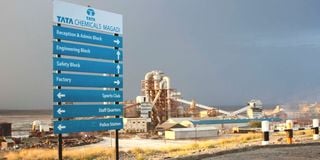
Tata Chemicals Magadi plant

Tata Chemicals Magadi plant.

Photo credit: File | Nation

Tata Chemicals Magadi Limited has won a long-running dispute with Kajiado County after the Court of Appeal quashed a Sh17.4 billion demand for payment of land rates and royalties for exploiting soda ash.

A bench of three judges of the appellate court quashed the demand for payment, saying the Kajiado County Finance Act, 2014, which the devolved unit was using to demand the money, offended the Mining Act and Article 62(1) and (3) of the Constitution.
The court further said the revenue-raising conduct of the county government contravened Article 209(5) insofar as the operations of the company, formerly Magadi Soda, were paralysed to force it to pay the amount in question.

“We have looked at the Colonial Lease and the Further Lease of 7th December 2004. They were between the appellant, Tata Chemicals and the Government of Kenya. The lease was extended to 2053. In both leases, the respondent (Kajiado) was not a contracting party. The land rates and royalties were reserved and payable to the Government of Kenya,” said the court.

The county government demanded the amount from accrued land rates arrears since 2013, for the 224,000 acres of land, used to exploit soda ash.

The county government later enacted the Kajiado Finance Bills 2013/2014, 2015/2016, 2016/2017, and 2017/2018, levying and increasing land rates to Sh11,000 per acre and Sh14,000 per acre, for the railway line, respectively.

The company complained about the exponential increase, which it said was going to paralyse its operations.

This was because it was operating with negative net worth and had been kept going by a line of credit from the parent company.

The county went ahead and enacted the Kajiado County Finance Bill 2018/2019, which prescribed land rates at Sh2,000 per acre, but the company contested the Bill, saying they had not been gazetted in the Kenya Gazette.

The court said even assuming that all the premises leased from the national government by the company were not public land, and were rateable properties, the determination of the land rates payable was under the repealed Rating Act and the Valuation for Rating Act.

The court pointed out that the Acts mandated a formal process for valuing properties, including the creation and maintenance of a valuation roll, which was essential for determining fair rates based on the property’s value.

The appellate court said the legislation ensured legal compliance, fairness, and transparency in land rating, as the laws provided a uniform framework for valuation, public participation, and establishment of valuation rolls.

“They allowed landowners to object to valuations and ensure their interests were considered. Lastly, the Acts prevented arbitrary taxation and ensured accountability in revenue collection for public service,” said the court.

The court said there was no indication that when the county government asked for the payment of land rates from the company, it was as a result of a determination under the Rating Act and the Valuation for Rating Act.

According to the court, without the rates having been determined under the Rating Act and the Valuation for Rating Act, the demand made to the county government was arbitrary and illegal.

This was because the county government did not put in place an open and accountable framework for determining the payable land rates, and the company, as a landowner, was not provided with an open and objective framework that allowed it the opportunity to challenge whatever rates were being proposed, in breach of the constitution.

“In conclusion, we determine that the appellant was not obliged to pay the Sh. 17,448,485,646/= as demanded by the respondent because the land rates had not been determined in compliance with the Rating Act, the Valuation of Rating Act Articles 201 and 209(3) and (5) of the Constitution,” said the court.

PAYE Tax Calculator

Note: The results are not exact but very close to the actual.