Time flies with great content! Renew in to keep enjoying all our premium content.
Prime
Reprieve for Kakuzi in fight for Makuyu Golf Club land
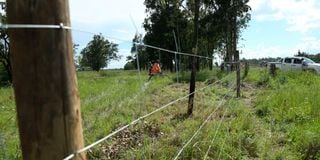
A newly constructed fence on the boundary of the 72-acre piece of land in Murang’a at the heart of a disputed between agribusiness conglomerate Kakuzi and Makuyu Golf Club.
Listed agricultural trading company, Kakuzi, has secured an order from the Supreme Court suspending a decision by a lower court that granted Makuyu Golf Club about 72 acres of its expansive land.
A bench of six judges suspended the decision granting the club the contested land, pending the hearing and determination of its second appeal.
The Environment and Land Court had ruled in favour of the club, saying the members had acquired the land through adverse possession, having used the golf course continuously for more than 10 years.
A subsequent appeal by Kakuzi PLC was dismissed by the Court of Appeal in November last year, forcing the Nairobi Securities Exchange-listed firm to escalate the fight to the Supreme Court.
“Bearing in mind the nature of the competing claims of both parties over the suit property, we find it is just to preserve the status quo by granting an order of stay of execution pending the hearing and determination of the judgment,” said the court.
The court agreed with Kakuzi after expressing fears of the impending execution of the decision of the trial court before the appeal was heard.
Kakuzi argued that it acquired the land in Murang’a in 1967 for agricultural use, and Makuyu Club has been using approximately 70 acres of the land as a golf course with its knowledge and express consent.
The club filed the case in 2002 seeking to be declared the owner of the land by virtue of adverse possession, having occupied it for a period exceeding 12 years since 1934.
Kakuzi submitted that it was apprehensive that the club would execute the decision, a move that would render the appeal a mere academic exercise.
Kakuzi was allowed to escalate the matter to the Supreme Court so that the judges of the apex court could clarify the application of the principles of adverse possession.
Kakuzi wants the Supreme Court to determine whether informal arrangements for the use of land, including the charitable right to the use of land, a key feature of Kenya's land use system, would give rise to a claim for adverse possession.
he company also wants the court to determine whether landowners who have not revoked their consent will be liable to lose their properties in adverse possession claims and whether the absence of an adverse incident can trigger the running of time for purposes of a claim on adverse possession.
Makuyu Club, however, said there was no such informal arrangement between Kakuzi and Makuyu Club since the property was donated by white settlers as a golf course in 1934, and Kakuzi bought it in 1967 and did not make any efforts to assert its rights.
The appellate court ruled last year that the club had exclusively used the contested land as a golf course since 1934, even before it was acquired by Kakuzi Ltd, and remained in use after the agricultural firm bought the expansive land in 1967.
Kakuzi Ltd claimed that the members of the Makuyu Club had been using the contested land as a golf course with the express knowledge and consent of its predecessor.
The company said it has been the one supporting the Club by helping in maintenance of the golf course by supplying diesel oil, petrol lubricants as well as lending tractors and lawnmowers, and paying wages for clubhouse watchmen.
The company further said Kakuzi was the one paying wages of the golf course employees, providing items of equipment to watchmen such as coats and torches, and providing building and maintenance materials.
But in the judgment the appeal court said the acts of supplying water to the club, grass mowers, paying workers, and supporting through donations and such like activity do not qualify as asserting one's right to property, as it did not have the effect of interrupting the members’ possession, or of dispossessing it of the property.