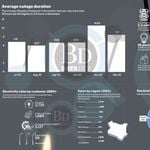
Service outages on Safaricom’s network surged by nearly five-fold to an average of 19.3 minutes per week in the year to March 2024, new disclosures show, due to electricity blackouts that affected the firm’s installations.
This was a significant jump from the previous year’s average of 4.1 minutes of weekly outages on the Safaricom network—inconveniencing the firm’s 44.6 million customers as of March 2024 and piling pressure to find alternative reliable power supplies.
The network outages meant that Safaricom customers were unable to make calls, send text messages, use data or send money points.
“The average weekly unavailable minutes graph captures the increased average downtime caused by power issues. In the 2024 financial year, we experienced an increase in power-related disruptions, which highlights the need for further investment in energy reliance, such as expanding the use of renewable energy sources,” Safaricom revealed in its newly launched sustainability report.
Safaricom says it has focused on reducing downtime related to power issues and optimising its radio access network (Ran) to provide uninterrupted connectivity as mitigation measures.
The mean unavailability of Ran — a wireless telecommunications system that connects devices to another part of the network via a radio link — also deteriorated to a rate of 36.7 percent from 29.9 percent previously.
The operator says the increase in the unavailability of its network is also a factor in the growing demand for data and increased usage.
By March 2024, Safaricom had 19,706 base stations, which anchor its mobile network ecosystem and connect mobile devices by transmitting and receiving radio signals.
The telco primarily relies on a mix of electricity supply from Kenya Power and generator sets to power its network infrastructure, but has been improving its solar and hybrid solutions to stabilise its network operations.
Only 276 Safaricom sites relied solely on Kenya Power for electricity during the period under review, compared to 839 sites in the previous year.
A further 35 sites run on diesel generators round-the-clock and throughout the year, compared to 111 sites previously.
The number of sites powered by solar and hybrid solutions remained unchanged in the period at 1,432.
Safaricom noted an increased reliance on diesel generators to offset power outages from the grid.
“Our reliance on diesel generators increased from 0.7 percent to nine percent due to power cuts and grid unavailability constraints. The rise in diesel consumption underscores the ongoing challenges we face in maintaining consistent power supply. To counterbalance, we are optimising our renewable energy resources, including real-time monitoring and panel maintenance, to enhance efficiency and performance across our sites,” Safaricom added.
The telco says it plans to install 3,000 solar photovoltaic (PV) sites over the next year and a half to eliminate the need for diesel generators.
Safaricom’s outage came even as a report by the Energy and Petroleum Authority (Epra) showed that it took Kenya Power an average of 10.14 hours to reconnect its millions of customers back to the national grid after a blackout in the year to June, underlining the shaky state of the utility’s ageing distribution system.
Data from Epra shows that power outages surged to an average of 10.14 hours a month in the year to June, up from 8.37 hours a year earlier.
The duration of outages is measured on a System Average Interruption Duration Index (Saidi) and the rise has forced consumers to opt for backup and own power generation, notably solar and biomass, in a bid to ease the impact of Kenya Power’s unreliability.
The Saidi is a measure of the total duration of interruptions a customer would experience in a given period and is measured in units of time (minutes, hours) per month or year.