State misses affordable housing buyer registration target by 48 percent

President William Ruto congratulates new homeowners of the Machakos Town Affordable Housing Programme Phase 1 on November 14, 2025.

Photo credit: PCS

Less than 300,000 Kenyans registered to buy the State’s affordable houses by June 2025, new disclosures show, debunking statements by bureaucrats that close to a million Kenyans had enrolled to purchase units under the scheme.

The disclosures by the State Department for Housing and Urban Development show that by the end of June, 292,326 Kenyans had registered on Boma Yangu, the platform created for the public to register and save towards owning houses.
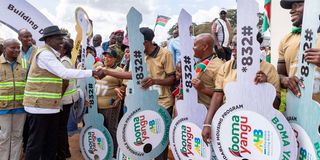
The number was about half of the 565,800 Kenyans the government targeted to onboard on the platform, implying a cold reception for President William Ruto’s pet project among Kenyans.

“Target not achieved. Fewer people than anticipated registered on Boma Yangu,” the state department said in disclosures regarding “the number of cumulative potential home-owners registered on Boma Yangu.”

The 292,326 represent about 0.5 percent of Kenya’s total population of 53.3 million, according to the Kenya National Bureau of Statistics (KNBS) population statistics for 2025, including children.

The disclosures by the State Department for Housing are in presentations for budget proposals for the fiscal year starting July 2027, which capture achievements made over three years to June 2025. 

The revelations are, however, despite statements by public officials that more than half a million Kenyans have registered on the platform to save for the purchase of affordable houses, with current figures on the Boma Yangu website showing 894,859.

In the budget documents, the state department also indicated that between July 2022 and June 2025, the government completed just 2,075 housing units under the Affordable Housing Programme (AHP), blaming legal challenges for missed targets.

“The AHP completed 2,075 housing units across various counties, including 605 in Bondeni, 1,080 in Mukuru, and several institutional and prison units, while ongoing projects include 62,123 affordable on average of 32 percent, 44,803 social on average of 17 percent, and 11,527 institutional housing units at 22 percent completion level,” it said.

The State Department blamed court litigation and the lack of a law to enable the use of Housing Levy collections from workers for failing to achieve targets.

It revealed that it failed to achieve targeted construction levels for some 217,654 affordable housing units in 2022/23 and 2024/25 due to a restriction on expenditure before the regulations were passed, slowing down progress.

The state department also failed in its targeted construction levels for 80,909 social housing units, the documents show.

“Target not achieved due to court litigations, which stopped the construction. However, 1,080 units are complete, 44,803 units are ongoing at an average of 17 percent completion,” the state department says.

The government spent a total of Sh81.4 billion on the construction of affordable houses over the three years to June 2025.

Budget documents show that the AHP has a total budget of Sh627 billion running from July 2023 to June 2032, noting that expenditure has been low in the initial years due to the lack of Affordable Housing Regulations, which were passed early last year.

The state department, however, notes that occupancy levels for completed houses have been high, with all of the houses built in Homa Bay and Mukuru having been bought, while 80 percent of 605 units in Bondeni, Nakuru, have been taken.

The government targets to deliver 500,000 affordable, social, institutional, and student housing units by 2029, which will be less than a quarter of the initial promise of 250,000 houses annually.

For the State to achieve this ambitious goal, it would need to complete 124,481 houses annually, starting from July 2025 to June 2029, which seems unlikely.

This is because the government completed just 2,075 houses over three years to the end of June 2025, three of the seven years targeted in the projections.

“By 2029, at least 500,000 affordable, social, institutional, and student housing units delivered, with an average of 80 percent occupancy and improved estate management,” the state department says.

The government also wants to raise revenues from the sale of houses from Sh15.25 billion currently to Sh579 billion by 2029.
In the next fiscal year, allocations to the AHP are expected to rise by 18 percent to Sh112.28 billion, the budget documents show.
[email protected]

PAYE Tax Calculator

Note: The results are not exact but very close to the actual.