Time flies with great content! Renew in to keep enjoying all our premium content.
Prime
The avant garde sculptor who changes junk into fine art
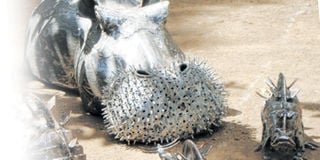
Life-size metal sculptures of wildlife such as hippos. Correspondent
Kioko Mwitiki may not be the first scrap metal sculptor in East Africa. He gives that credit to Ugandan artists.
“First was Francis Nnaggenda,” says the first Kenyan scrap metal artist, referring to the retired chairman of Makerere University’s Margaret Trowell School of fine art.
“Then came John Odoch Ameny,” whose larger than life-size scrap metal sculpture inspired Kioko while he was still a fine art student at KU ( Kenyatta University) and Odoch was exhibiting at African Heritage, quietly in exile from the Milton Obote and Idi Amin regimes.
Kioko also had his own political problems during the 1980s. “I was a recipient of the same “walking papers” that many student activists got in the post-1982 (attempted coup) period,” confessed the one-time Pambana protester.
“There were 70 of us that got kicked out in March of 1985,” recalls Kioko who is still rather proud to have been featured on a front page photo of The Standard that time, when anti-then President Moi sentiments were high. Briefly incarcerated with 28 others, Kioko was eventually called back to KU to complete his university degree in 1986.
But not before he had picked up one of his most valuable technical skills, and one which he has used and even taught to others almost every day since then.
Needing a job once he was out of school, Kioko found his way to the Nakuru Aluminium Works.
“That was where I learned welding,” says the man who has taught that same skill to countless school-leavers, many of whom have gone on to become self-supporting sculptors who, in turn, train their own apprentices.
“One is in Mtwapa where he has trained a small nucleus of scrap metal sculptors who are doing very well,” says Kioko with an undisguised sense of pride.
“There’s another working the same way in Kangemi and another in Dagoretti,” adds the former art teacher at Consolata Primary in Nairobi.
These were his first trainees, young men mainly from western Kenya who had been sent to him by parents worried that their sons were not qualified to do anything constructive with the education they had thus far received.
Initially, Kioko had not planned to teach. Indeed, after a three year stint teaching art at Consolata , he formally quit the profession to devote himself to his art.
But even while he was at Consolata, Kioko found time to work closely with the Nairobi National Museum and achieve a measure of success with his art. But teaching evolved naturally when, as his art projects grew both in scale and number, he realised he needed to hire skilled welders to help him with his art.
But once he realised it might make more sense to mentor young welder apprentices rather than hire old-hands, Kioko also found he had a role to play in uplifting the lives of “grassroot” Kenyans who might otherwise remain trapped in rural poverty —a peculiar problem that now plagues his mother’s Akamba community.
Noting that historically, the Wamunyu Co-operative Society used to provide substantial livelihoods for skilled Akamba carvers, Kioko says that these artists have fallen into hard times.
“The downside of Wangari (Maathai)’s campaign to save African hardwood forests has hit the community especially hard since it has practically killed the market for hardwood carvings.”
Having found that former carvers are especially keen to adapt and retrain as not only welders but also stone carvers, Kioko is not just teaching skills in welding and working with recycled scrap metal.
He’s also seen that places like Kitui are rich in shale stone, which can potentially replace hardwood as the main medium that renowned Akamba carvers can now use.
Seeing himself as a sort of ‘marketing consultant” as well as mentor, Kioko has also found ways to work artistically with calabash gourds which are plentiful in Ukambani.
Clearly committed to improving the lives of local artisans, it is almost hard to believe that Kioko finds time to travel abroad and take up “guest artist” residencies for several months at a time.
But for the last few years, he’s been spending three-month “summers” in the United States, first at the renowned San Diego Zoo in California, then at the Desert Museum in Arizona.
And even before he attracted the attention of the Foundation for Women which helped organise his recent US sojourns, (and who get 15 per cent of the profits he makes from the American sales of his art) Kioko was an invited guest to many parts of the world.
The earnings go toward worthy causes to support women.
Ironically, his first trip overseas was to Montana, USA where he worked with Native American Kootnei Indians teaching skills similar to what he teaches Kamba carvers like Mwema Munyao.
The recipient of a Reader’s Digest/Lila Wallace Foundation fellowship in 1995, Kioko had already been recycling ‘“junk” metal into fine art for several years.
So his mentoring among the Kootnei was a kind of continuation of his work reshaping “found objects” such as sundry car parts-shock absorbers, ball bearings, spark plugs and chains, into art.
Subsequently, he’s exhibited in Denmark, Spain, Nigeria, UK and France. Most frequently, he’s been invited by private collectors.
In 2007 he went to London on a trip sponsored by the Kenya Tourism Board where he was hired to do the décor for the Kenya Stand at the World Tourism Fair.
Kioko appreciates the importance of marketing not only for Kenya generally but specifically for Kenyan artistes and artisans who need to know how to market their work to improve their quality of life.
Competition
His own quality of life has improved steadily over the years, to the point where his “junk art’ is in such demand internationally that he has had to ship whole container-loads of life-size wildlife overseas—everything from gorilla, giraffe and elephant to whole herds of water buffalo, warthogs and wildebeest!
Opening Pimbi Gallery in 1996 also makes him one of the few Kenyan artists to feature an art centre in his back yard.
Nonetheless, Kioko remains grounded with his training of guys like Mwewa, who worked for years at Gikomba until the market dried up and he almost lost hope until he met Kioko who has both trained and employed both Mwewa and his son Munyao.
One other indicator of how grounded Kioko remains is to see how he personally continues to scavenge Nairobi’s major junkyards, in Kawangware and Kariobangi North.
It has been a challenge to get good scrap metal, Kioko claims, since the Chinese were exporting it all up until the government put a halt to that practice.
The problem of Chinese competition for scrap has not died. But even the Chinese can’t keep Kioko from fulfilling his many dreams.
His latest plan is to set up an outdoor sculpture park, complete with galleries, an educational centre and rondovals where visiting artists can stay and work for free “as long as they give back by working with the local Maasai community.”
The park will be about 60 kilometres from Nairobi down Magadi Road and he hopes to open it next year in a place called Kona Baridi.
In the meantime, Kioko continues with his training “jua kali” artisans and recycling scrap metal to make a form of Kenyan art that he doesn’t mind calling “junk art” since he knows the tremendous skill involved in transforming junk into fine art.
Unlock a world of exclusive content today!Unlock a world of exclusive content today!