Time flies with great content! Renew in to keep enjoying all our premium content.
Prime
Top executives replaced as Adetu firms grip on EABL
Beer-maker East African Breweries Limited (EABL) has executed an ambitious restructuring plan that has led to the merger of key business units and the replacement of at least five senior managers.
The reorganisation is the culmination of a major strategy and business review plan that EABL’s managing director Seni Adetu initiated in March, aiming for a lean executive team with fewer reporting layers that can support the brewer’s new growth drive.
The changes are Mr Adetu’s first show of hand since he took the company’s top seat from Gerald Mahinda in June last year.
People familiar with the matter said they also highlight the growing quest by Diageo, which owns 49.9 per cent of EABL, to tighten its grip on the company’s executive suites with the recent increase in the number of top managers seconded from the global beer giant.
Top on the list of those who have been replaced are three directors – Ken Kariuki, Ann Mambo and Ivo Buratovich – who headed the corporate affairs department, the sales department and EABL’s Uganda subsidiary respectively.
Mr Kariuki and Ms Mambo have left the company while Mr Buratovich moves to Nigeria, according to communication sent to the brewer’s staff.
One other top manager Mr George Karanja, who was the group’s head of strategy, left in June making a total of four the number of directors who have left since Mr Adetu took over the reins at the beer firm.
Brenda Mbathi, formerly the government affairs director, was tapped on Monday to replace Mr Kariuki as corporate relations director.
EABL has also merged the supply division, which dealt with strategy on the production side of the business, with the demand division that has been handling the sales part of the business.
This merger has led to the redeployment of a number of directors and senior manager as EABL seeks to downsize its executive suite that is made up of more than 30 people.
Sources at EABL, who cannot be named because they have no authority to speak for the company, said the redesign of operations is aimed at reducing overhead costs and the long chain of command in a market that is becoming increasingly competitive.
“There has been duplication of roles and it appears this is being dealt with,” said our source who is a senior manager in the company.
Analysts however view the changes as a drive by Mr Adetu to chart his own strategic direction by having a firm grip on the management.
“I would not say he (Mr Adetu) is dismantling Mr Mahinda’s structure, but it is normal for a new manager to try new ideas and people in search for growth,” said Erick Musau, a financial analyst at African Alliance. “EABL has been working hard to reduce waste and the reorganisation signals that it is trying to find ways to be efficient,” he said.
The reorganisation focus on the marketing and sales division, signals that the firm is betting on growing its top line across East Africa to shore up the bottom-line.
More recently, East Africa has become a battle zone between SABMiller subsidiaries in Uganda and Tanzania and Diageo-led EABL as both firm’s race to grow their regional footprint.
Diageo is the world’s biggest beer maker while SABMiller is the second largest by volumes.
Both are keen to get a firm foothold in emerging markets such as East Africa to secure future earnings and profits.
EABL has been tapping deep into Diageo’s talent reservoir as it seeks to grow and defend its regional market with executives seconded from the UK getting a bigger role in the ongoing redesign of the company’s operations.
For instance, EABL’s sales department is now headed by a Diageo executive Geoff Biggs, who took over the position on September 8 having joined EABL in July as commercial development director.
Other Diageo executives who have joined the firm in the past 12 months include Adesola Sotande, the head of finance, and Mark Abbey, the group controller.
EABL is looking at playing the East African game with its focus on Tanzania, Uganda, Sudan and the Great Lakes market while protecting the Kenyan market.
“Yes, Kenya is our fortress but at the end of the day we are East Africa Breweries and we must play the East Africa game,” Mr Adetu told the Business Daily in an earlier interview setting the stage for a vicious battle for control of the Eastern Africa market after SABMiller unveiled similar plans.
Already, a battle for market dominance is under way in Uganda between Uganda Breweries, owned 98.2 per cent by EABL, and Nile Breweries - where SABMiller has a 60 per cent stake.
Two firms
In Tanzania, the two firms are preparing for a big battle after they broke an eight year partnership at Tanzania Breweries Limited (TBL) where SABMiller has 52.83 per cent stake.
The two firms had entered into an agreement in 2002 to manufacture and distribute each other’s flagship brands, but EABL argues that it is increasingly getting the short end of the stick.
As a result, EABL successfully sought to end the partnership and instead bought rival Serengeti Breweries--setting off another market share war.
The Kenyan market, where beer volumes have been growing at slower pace since 2007, accounts for 83 per cent of EABL profits.
In 2007, EABL returned double digit growth, much of it driven by the low priced Senator Keg-- which delivers volumes, but less value compared to flagship Tusker, WhiteCap and Pilsner brands.
But a price increase on Senator Keg slowed down the brand’s growth in the market.
EABL grew its volumes in Kenya by 2 per cent in the year to June, but its sales and operating profits were up 12 and 18 per cent respectively helped by price increments on flagship brands.
EABL announced price increase of between Sh5 to Sh10 per bottle in October on selected brands including Tusker, White Cap and Guinness citing rising production costs that had slowed down profit growth, especially in the key Kenyan market.
Some analysts saw the price adjustments as an admission by EABL that price and not volumes will be the key driver of growth this year, but warned that EABL will have to move to new markets to grow its profits.
Besides south Sudan, EABL is keen on acquiring a brewer in Ethiopia after a botched bid in 2008.
EABL had hoped to snap one of the three state-owned breweries in Ethiopia when its government withdrew the sale tenders.
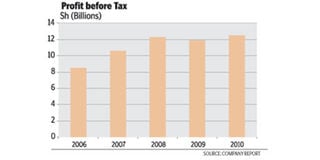
Kenya’s largest manufacturer by market value grew its net revenue 10 per cent to Sh38 billion in the year to June, but saw net profit grow four per cent to Sh7.1 billion.
Unlock a world of exclusive content today!Unlock a world of exclusive content today!