Women champion use of ‘fireless stove’ in rural households

Kisumu Indoors Air Pollution Network chairperson Angeline Abong’o explains how a fireless cooker works. Photo/Jacob Owiti

A group of women have revolutionised cooking in rural homes using heat from insulated baskets. Popularly known as ‘fireless cookers’, the group has been making the products for sale to residents in rural areas at affordable prices.

The insulated basket allow pots to continue cooking food even when they are taken off a source of heat.
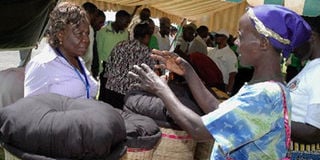
Started five years ago, Kisumu Indoors Air Pollution Network (KIAPNET) has been making the ‘fireless cookers’ with an aim of conserving the environment as well to provide entrepreneurial skills and create employment to low-income earners at rural villages.

The group’s leader, Angeline Abongo says the initiative was established after former US secretary of state Hillary Clinton launched the Alliance for Clean Cookstove in September 2010.

The organisation aims to improve lives, empower women and mitigate effects of climate change. The global project targets 100 million homes with clean and efficient stoves and fuel by 2020.

The KIAPNET members pooled resources to invest in the venture to promote the environment-friendly cooking method.

‘‘I used to experience a severe cough and headache but did not know that it was as a result of smoke,’’ says Ms Abongo.

According to World Health Organisation (WHO) report on indoor pollution and health, exposure of smoke is the fifth worst health risk factor in poor countries, particularly among women and children.

It also states that indoor pollution leads to almost two million premature deaths annually twice that of malaria.

Globally, about three billion people cook and heat their homes using open fires and leaky stoves burning biomass — wood, animal dung and crop waste — and coal, says the WHO.

‘‘By making families less dependent on fuel, they no longer have to make a choice between sending their children to school and asking them to collect firewood,’’ says the group leader.

With an initial investment of Sh5,000, the group now makes about Sh50,000 in sales of the cookers, targeting at least 1,000 households a month.

According to KIAPNET vice chairperson Benter Ogutu, the cookers reduce energy costs and contribute to a sustainable local economy.

‘‘Embracing fireless cookers can reduce fuel use by 40 per cent, preserve food nutrients and save time,’’ she says.Ms Ogutu adds that long cooking makes food more digestible and improves its flavour. ‘‘The food is briefly boiled on fire and then placed inside the insulated basket,’’ she says.

The women have learned weaving skills to ensure maximum insulation and durability of the cooking baskets.

They use locally sourced materials such as papyrus reeds from the shores of Lake Victoria to make the basket and use old pieces of clothes as insulators. Dry heat-resistant polythene lining protects the material.

‘‘I have been able to pay fee for my children and put food on the table through the fireless cookers business,’’ says Ms Ogutu.

The ‘fireless cooker’ uses heat retained by the pots to cook food.

The food is first cooked on a traditional stove before it is transferred into insulated baskets.

‘‘Fetching firewood is a big challenge for women, given that we also have a responsibility to conserve forests,’’ she adds.

Beatrice Awino, a member of the group, concurs. “This is the way forward to conserve our forests,’’ she says.

The price of the basket cookers ranges between Sh350 and Sh1,500, depending on size. Members of the group, however, say that a lack of ready market for their  product remains a major setback because the product is hardly known in most rural areas.

A ‘fireless cooker’ is suitable in preparation of foods that require long boiling, stewing or steaming such as cereals, meat, steamed bread or pudding and traditional vegetables.

For instance, meat stew takes about an hour and 30 minutes to prepare using this method. The group has sold more than 1,000 cookers so far.

They operate a bank account for the members’ savings and the money is used to raise school fees for their children and the profit is equally shared among group members every month.

The group urges women, especially in the rural areas who rely on firewood is to embrace the ‘fireless cookers’ as opposed to firewood, which has adverse effects to both health and the environment.

PAYE Tax Calculator

Note: The results are not exact but very close to the actual.