Time flies with great content! Renew in to keep enjoying all our premium content.
Prime
Farmer beats stigma to multiply returns from rabbit rearing
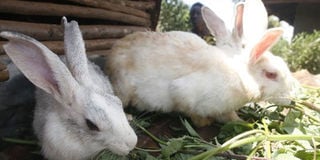
Rabbits in a farm in Kisumu County. Rabbit rearing is turning out to be a lucrative economic activity. Photo/File
By the time Godfrey Gichuhi quit his clerical job in 1972, he had made up his mind that he was going into farming.
Yet, as he struggled to make ends meet as a farmer, little did he know that his breakthrough would come from his childhood passion — keeping rabbits.
“Everything was a struggle until I ventured into rabbit breeding,” says Mr Gichuhi, 74, and a father of seven.
Today, nothing would entice him to look for an alternative income-generating activity.
“If the government offered me a job as a District Commissioner, I would politely say no,” he says.
Besides travelling to various countries in eastern Africa, rabbit farming has made it possible for Mr Gichuhi to meet top leaders in the country, including former President Daniel arap Moi and President Mwai Kibaki.
“Since 1989, I have been receiving the national Best Rabbit Breeders’ trophy from presidents as they open trade fairs. Out of my experience in rabbit breeding, I have been invited to give lectures on rabbit husbandry in neighbouring countries,” he says.
He has been to Tanzania, Uganda and the Congo to train farmers on modern rabbit breeding practices.
This being his 15th year in commercial rabbit breeding, he confesses that it is a well paying occupation that has transformed his financial fortunes.
And the man is thinking big since he says he has sent three of his daughters to South Sudan to examine the viability of opening a rabbit meat hotel in Juba. From his earnings from the job, Mr Gichuhi has bought a plot and is now building a permanent house.
“I know more is coming,” he says and discounts the notion that there is no market for rabbit meat. According to him, the demand for rabbit meat exceeds the supply.
“You only need to have rabbits that you want to sell to realise that the market is ready and waiting,” he says and challenges those with rabbits ready for sale to contact him.
He says that five-star hotels, butcheries and individual buyers have been swamping him with supply tenders and he has been unable to meet the demand.
“A hotel in Nairobi came to my farm and placed a weekly order of 300 kilos of rabbit meat,” he says. That translates to about 50 rabbits per week.
“I traversed my region trying to get joint partnerships to meet the tender demand but there are not enough rabbits for slaughter. I missed it,” he says.
This followed another order and was expected to supply 100 rabbits per week in Nairobi, but again underproduction cost him the opportunity.
“On a daily basis I retain a stock of 500 mature rabbits. Among them are pregnant ones that cannot be slaughtered. What we need are many breeders who jointly and under a cooperative can manage to have a daily stock of at least 2,000 mature rabbits,” he says.
At his farm, pedigree breeds that are two-months-old go for Sh1,200 each while a four-months-old costs Sh1,500 each. A six-month rabbit costs Sh2,500. A served female one goes for Sh3,000.
He says that for farmers to access rabbit fur markets, they have to have enough rabbits and for co-operatives to increase their market access and bargaining power.
Born in 1938 in Kiangi village of Ruthagati, Nyeri District, Mr Gichuhi grew up in a poor family and did not enjoy the benefits of quality education and had to drop out of school in primary level.
Still, he landed a job as a clerk with the Nakuru County Council. But soon qualified job seekers started presenting themselves for employment, imperilling his career.
“I quietly returned to my village from where I started various forms of farming. But in 1987, something happened in that remote village,” he says. A team from the Kenya Institute of Organic Farming visited the area for a farmers’ field day and among the topics of the day was rabbit breeding.
“I became interested. I was wondering how the small creatures that I used to rear during my childhood could form a commercial venture,” he says.
But the trainers told the farmers about emergence of pedigree breeds that were being reared for commercial purposes and his interest surpassed his negative attitude towards rearing rabbits, which was considered a pastime for boys.
Out of the 30 adults who attended that training, only Mr Gichuhi embraced the idea of commercial rabbit breeding.
“Today, the very same adults who used to laugh at me when I bought five starting stock rabbits all at a cost of Sh2,500 are all over me trying to get tips on how to join me in this venture,” he says.
Unlock a world of exclusive content today!Unlock a world of exclusive content today!