How agripreneur hacked US, Middle East ‘managu’, ‘terere’ markets

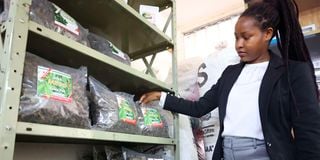
Esperance Chesoli, team lead at IREN Growthpad, arranges sealed packs of African indigenous vegetables during an interview at their Hurlingham, Nairobi office on July 1, 2025.

Photo credit: Evans Habil | Nation Media Group

A year-long stay in Germany was all it took for Kenyan economist and policy analyst James Shikwati to spot an overlooked market opportunity rooted in nostalgia and the craving for home.

Living abroad, Mr Shikwati witnessed first-hand the longing among African diaspora communities for traditional foods, especially indigenous vegetables such as spider plant (saga), jute mallow (murenda), and amaranth (terere).
“Just like others, I craved for the delicacies,” he recalls. But these vegetables were hard to find, often expensive, and rarely available in dried, shelf-stable form.

This insight, combined with his experience documenting farming practices and women’s culinary traditions, formed the basis of his entrepreneurial pivot.

In 2021, he established Inter Region Economic Network (IREN) Growthpad, a company that processes and exports African indigenous vegetables. The venture gained momentum in 2022 after Mr Shikwati secured a distribution contact in the United States.

With a processing facility in Kakamega, the company solar-dries, packages, and ships vegetables to Nairobi for both local distribution and international export. On average, the firm handles 300 kilos of dried vegetables per shipment monthly, with peak seasons reaching 750 kilogrammes.

The factory can process up to 500 kilogrammes of fresh vegetables daily, though production is deliberately capped to match current storage and market capacity. Plans, Mr Shikwati says, are underway to expand that capacity to at least three tonnes per day.

James Shikwati, founder and director of IREN Growthpad, during an interview at his Hurlingham office in Nairobi on July 1, 2025.

Photo credit: Evans Habil | Nation Media Group

IREN Growthpad is now actively targeting the local Kenyan market, leveraging the country’s rising production of indigenous vegetables, which averaged 300,000 tonnes annually between 2011 and 2019, according to the Ministry of Agriculture. Yet, only five percent of this is exported—an indicator of untapped domestic potential.

“We must grow our economy by promoting what we grow,” Mr Shikwati says. “I wonder why we export tea and coffee yet have no control over market forces. That can be changed through value addition.”

Getting FDA certification

IREN Growthpad’s origins were humble. The early days involved working with women who dried vegetables using makeshift structures and large sufurias (cooking pot), often at the mercy of the wind. Their first batch went to the US.

To scale up, Shikwati partnered with the Kenya Industrial Research and Development Institute (KIRDI) for technical support in food processing. He also invested over Sh3 million from personal savings and bank loans to set up a solar-powered drying facility that complies with both local and international food safety standards.

For the US market, the company is registered with the Food and Drug Administration (FDA), a requirement for all food imports. Locally, the business adheres to certifications from the Horticultural Crops Directorate and the Kenya Bureau of Standards.

A costly affair

Shipping, however, remains a costly affair. A 140-kilogramme package can cost over $2,000 in freight. Dried vegetables also do not fit neatly into standard shipping containers, further complicating logistics. Most deliveries are handled by DHL and are coordinated through the company’s Nairobi hub in Hurlingham.

Working with farmers

At the heart of Mr Shikwati’s model are the more than 1,300 contracted farmers—80 percent of them women and youth—who supply fresh produce. Each farmer delivers between 40 and 60 kilogrammes of vegetables and earns an average of Sh50 per kilo, depending on the variety.

Dried rattled Pod (Mitoo) and Dried Cowpeas (kunde) on display at the Inter Region Economic Network (IREN) Growthpad offices in Hurlinghum, Nairobi on July 1,2025.

Photo credit: Evans Habil | Nation Media Group

Besides terere, saga, and murenda, the company also processes black nightshade (managu/sucha), rattlepod (mito), and cowpea leaves (kunde).

Quality control

To maintain quality, incoming vegetables undergo strict inspection. “The vegetables must not have roots; the leaves must be green, not yellow or with holes,” says Esperance Chesoli, team lead at IREN Growthpad.

After inspection, the vegetables are washed, plucked, and briefly blanched to preserve their colour, texture, and nutrients. They are then dried using solar dryers—typically over three days, or five in colder weather—before being packaged into 250g and 500g units and sent to Nairobi.

Growth and collaboration

The business has grown from a solo operation to one that now employs six permanent staff and contracts around 25 women and youth for harvesting.

James Shikwati, founder and director of IREN Growthpad, during an interview at his Hurlingham office in Nairobi on July 1, 2025.

Photo credit: Evans Habil | Nation Media Group

To further strengthen the value chain, Mr Shikwati collaborates with institutions such as Jomo Kenyatta University of Agriculture and Technology (JKUAT) and Masinde Muliro University.

JKUAT supplies certified seeds, while Masinde Muliro provides standardised recipes for vegetable preparation. Rural Outreach Africa and several banks also support the company’s farmer training and market linkage efforts.

Navigating the hurdles

Despite the growth, challenges persist. Mr Shikwati points to inconsistent supply quality, delayed payments from international clients, and frequent changes in tax regulations as major hurdles. Access to financing is also limited, as most financial institutions view vegetable farming as high-risk.

He believes that a national policy framework for indigenous vegetables, akin to those that exist for tea, coffee, and flowers, would help formalise the sector and attract investment.

Although the government released a draft strategy paper on African indigenous vegetables last year, Mr Shikwati feels more needs to be done to boost the sub-sector’s visibility and viability.

Lessons from the journey

Reflecting on his journey, Mr Shikwati cautions against expecting overnight success. “People often think farming brings quick returns. But building a multimillion-shilling enterprise takes time—and starts with using what you already have,” he says.

For him, indigenous vegetables are more than a product—they are a path to economic empowerment, cultural preservation, and sustainable trade.

PAYE Tax Calculator

Note: The results are not exact but very close to the actual.