How ex-engineer turned 20 acres of dry, rocky land to thriving dragon fruit farm

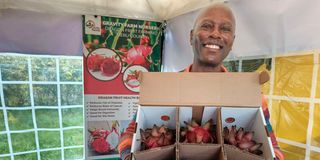
Anthony Mugambi, a Meru County farmer, showcases his dragon fruits at the 4th KALRO Open Week Exhibition in Kabete, Kiambu County, on February 27, 2026.

Photo credit: Sammy Waweru | Nation Media Group

Anthony Mugambi started buying land 22 years ago. At that time, he paid Sh160,000 for a two-acre piece of land in a village in Meru County. It was in a rocky area with scattered shrubs, with little rain.

Over time, he kept buying more parcels of land, so by 2012, the telecommunications engineer had accumulated 15 acres.
“I saw an opportunity beckoning in the area," he says when asked why he kept investing in land.

When he reached 50 acres, he began thinking seriously about how to turn his idle land, most of it rocky and dry, into a money-spinner. He had occasionally planted maize and beans for his own use, but he was looking for ways to transform the land into a profitable agribusiness.

He set aside 20 acres for dragon fruit farming after a visit to China, where he saw the fruit.

“In a supermarket, I paid $10 (Sh1,290) for a single piece. The high price sparked my curiosity,” he says.

Back in Kenya, he researched and discovered its original name, pitaya, native to Central and South America. It belongs to the cactus family and thrives in arid climates. Vietnam is the world’s leading producer, while China is among the biggest consumers.

“An expensive fruit, drought-tolerant, suited for dry lands? It made business sense,” Mr Kinoti says.

Anthony Mugambi (right), a Meru County farmer, and Japhet Mutugi cut a dragon fruit together at the 4th KALRO Open Week Exhibition in Kabete, Kiambu County, on February 27, 2026.

Photo credit: Sammy Waweru | Nation Media Group

He began experimenting. He extracted tiny seeds from a fruit and planted them on a 100-by-100 square-foot plot carved out of what he describes as a “valley of rocks.”

The seeds germinated after about 30 days. Excited, he watered them generously. However, they died. “It is a cactus; waterlogging is its enemy,” he says.

He sought another fruit, researched more, and tried again. The second attempt was more deliberate.

Over eight years, he observed, selected and waited. The first fruit from those seeds was harvested. Out of about 100 plantlets, only 10 fruited, and just four displayed desirable traits. Those four became his mother plants.

Today, he has Gravity Farms, which is 20 acres under the dragon fruits. On 15 acres, he grows red-fleshed varieties, and on two acres, he has planted white-fleshed varieties, and the remaining acreage is under the yellow variety known as Palora.

“The yellow variety is the sweetest and smallest, taking over 90 days to mature, while the red and white average 51 days,” he tells BDLife.

The farm is in a semi-arid zone with low rainfall, and water management has been central to its success. Mr Kinoti relies on rainfall, harvested runoff, a river crossing the land and a reservoir with a capacity of more than 100,000 litres.

Anthony Mugambi (right), a Meru County farmer, and Japhet Mutugi display a cut dragon fruit at the 4th KALRO Open Week Exhibition in Kabete, Kiambu County, on February 27, 2026.

Photo credit: Sammy Waweru | Nation Media Group

He has also done land reclamation on some parts of the land. Land that lay idle for over two decades now employs many people, and the value has risen sharply, too. He says an acre that once went for Sh80,000 now goes for over Sh500,000.

He quit engineering to focus on farming full-time. The shift from a career spanning 20 years, he says, was bold, but by then, the orchard had proven its promise.

Dragon fruit harvesting happens about five times a month, though production is yet to reach optimal levels due to ongoing soil rehabilitation that he is doing.

“Prices range between Sh500 and Sh2,500 per kilo, depending on the season. A kilo typically comprises two to three fruits weighing about 450 to 500 grammes each,” he says.

The high consumer demand because the fruit is considered rich in antioxidants and vitamin C, with immunity-boosting and anti-inflammatory benefits, is paying off.

“I have had buyers from Germany, the UK, the United Arab Emirates, Italy and Turkey who have requested up to two tonnes weekly, but I prefer to consolidate local supply first before exploring the export market,” he says.

His business has also expanded into propagation. He produces more than 100,000 seedlings monthly, selling them at between Sh100 and Sh500 depending on variety and stage.

He says plans are underway to invest in tissue culture technology to scale production.

Mr Kinoti has also been developing a hybrid variety, which has taken six years, and secured plant breeder’s rights certification from the Kenya Plant Health Inspectorate Service (Kephis), granting 25-year protection.

The hybrid known as Kika is sweeter, crunchier and more aromatic, with improved tolerance and longer shelf life.

From cuttings, the dragon fruit takes about one to one-and-a-half years to mature, faster in warm, humid regions. “Good agronomic practice is critical: certified seedlings, proper land preparation, weed control and organic nutrients,” Mr Kinoti says.

Organic manure

On his farm, he uses the cow, goat and sheep manure, which he says work well, while chicken manure is ideal at the fruiting stage.

Anthony Mugambi, a Meru County farmer, showcases his dragon fruits at the 4th KALRO Open Week Exhibition in Kabete, Kiambu County, on February 27, 2026.

Photo credit: Sammy Waweru | Nation Media Group

What started as a one-man operation now employs 10 full-time staff.

“But the journey has not been easy. It involved rehabilitating the rocky parts, demanded heavy investment in soil improvement and infrastructure. Market education has been another hurdle; many consumers are still unfamiliar with the fruit,” he says.

He views farming as a long game. “It is not a sprint or a marathon. It is a road race. You may take 15 years to build stability,” he says, adding, “Kenya can easily rank among the top three global dragon fruit producers, if farmers make use of the arable land.”

Follow ourWhatsApp channel for the latest business and markets updates.

PAYE Tax Calculator

Note: The results are not exact but very close to the actual.