By mid-October, racks in Nairobi’s sports shops rarely stay full for long. Marathon season sends a rush of customers looking for sneakers they can trust on the road, whether they’re serious athletes or just joining the city’s growing fitness culture. Sellers say this is when shoes move fastest, from the Central Business District (CBD) stalls to mall boutiques.
The spike is more than just seasonal excitement. For many Kenyans, sneakers have become part of everyday life, used for running, gym workouts, weekend walks or simply a corporate look.
Caroline Njeri, who runs Gerry Running Shoes in Nairobi’s Bazaar Plaza, is among those hoping to cash in on the rising demand. She opened the shop in 2020, when gyms were shut and she turned to running to keep fit. At first, she ran in her regular workout sneakers, but her feet began to hurt.
Caroline Njeri, owner of Gerry Running Shoes, at her shop in Nairobi’s Bazaar Building on October 2, 2025.
Photo credit: Francis Nderitu | Nation Media Group
“I sustained very bad injuries,” she says. “I didn’t know then that you can’t just run in any casual sneaker. You need specific running shoes. That’s how I started researching, and eventually this idea was born.”
Her store, which deals exclusively in thrifted (second-hand) but original-brand running shoes, has since become a go-to for both new and seasoned runners.
Apart from just doing business, she aims to educate Kenyans about the difference between regular sneakers and shoes designed for running. “Many people don’t know. They think we’re just selling normal sneakers, yet these are specialised running shoes. And when you run in the wrong shoe, you risk injury.”
Business, she says, peaks around marathon seasons, when even casual walkers want proper footwear. “There’s camaraderie in running. Everyone wants to be part of it, and people want to do it in good shoes. Even if you bought a pair last year, you’ll still want another one for the next season.”
Her bestsellers are running shoes, followed by gym shoes and walking shoes. Prices range widely, from as low as Sh3,500 for lightly used pairs to over Sh20,000 for premium brands. “The most expensive I’ve sold was a carbon-plated racing shoe at Sh25,000,” she says, “But people are willing to pay because they see it as investing in their health.”
Caroline insists that the Kenyan recreational running community has grown, and with it, demand for quality footwear. Her clientele includes everyone from seasoned marathoners to young people joining running clubs like We Run Nairobi.
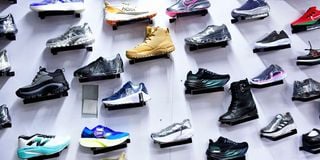
Some of the running shoes on display at Gerry Running Shoes in Nairobi’s Bazaar Building on October 2, 2025.
Photo credit: Francis Nderitu | Nation Media Group
Brand preferences vary, some swear by Nike or Adidas, others won’t run in anything but Brooks, Asics or Hoka. “Each has its fans,” she says. “What matters is comfort and support. Marathoners shop differently because they know exactly what they want, even down to whether a shoe is carbon plated.”
Still, the business faces hurdles. Counterfeits flood the market, making it harder to push original shoes, even thrifted ones. And convincing customers that quality running shoes are worth the price takes constant education. “Sometimes people think we’re pricey, but you’d rather buy a good shoe once than spend money later on physiotherapy for injuries,” she says.
For Caroline, the payoff isn’t just sales but seeing more Kenyans take up the sport safely. “Young people are embracing running, and that’s encouraging,” she adds. “We want them to become ambassadors for the culture of running in proper shoes.”
Caroline also points out that the appeal of running shoes goes beyond athletics. “People with plantar fasciitis (a condition commonly causes heel pain), back pain, or swelling feet benefit too. Even professionals like medics, who stand for long hours, find relief wearing them.”
Average sales
Caroline says sales fluctuate depending on the time of year. “On average, we move around 15 to 25 pairs a day,” she says. “But in peak seasons, that can shoot up to 50 pairs daily.”
Caroline Njeri, owner of Gerry Running Shoes, at her shop in Nairobi’s Bazaar Building on October 2, 2025.
Photo credit: Francis Nderitu | Nation Media Group
Caroline adds that while demand is high, the business isn’t without its hurdles. “Another challenge is the high taxes, which end up pushing up the shoe prices,” she says. That means balancing affordability for customers while still keeping the business sustainable.
Elsewhere, for Eric Njoroge, who runs Teazy Collection in Thika Town, says this year has tested even the most resilient sellers.
“The demand has been steady, but the biggest challenge has been supply,” he says. “There are times you go to restock and come back with literally nothing. Shipping delays, higher freight costs, and frustrating customs processes have made supply so low that it has hurt business.”
Even so, he notes that marathons still bring a spike in sales. “Whether it’s an experienced runner or just a beginner, people want new sneakers for the race. That’s when business is normally good for us.”
His shop is best known for running shoes, which he says move faster than gym or casual sneakers. Customers typically spend between Sh2,500 and Sh3,500, though many ask specifically for premium brands.
“Most people come in with recommendations from coaches, gym instructors, or fellow runners. Nike, Adidas, Asics; those are the names they want.”
For Njoroge, the sneaker boom isn’t only about sports. “Most of my customers are chasing a healthy lifestyle,” he says. “Morning runs before work have become a routine for many, and sneakers are part of that culture.”
He adds that comfort is the top concern for buyers, while marathon runners tend to be more open to suggestions compared to casual customers who prioritise aesthetics.
Still, the business has its pitfalls, chief among them counterfeits and import challenges. “Fake sneakers sell at much lower prices, sometimes without customers realising they’re fake. That undercuts sellers of authentic shoes.”
Some of the running shoes on display at Gerry Running Shoes in Nairobi’s Bazaar Building on October 2, 2025.
Photo credit: Francis Nderitu | Nation Media Group
Despite the hurdles, he believes Nairobi’s sneaker culture is thriving. “People used to only know Nike and Adidas. Now there’s knowledge about so many other brands, and people are willing to invest in quality. Even models made for running, like the New Balance 530, have become fashion items.”
Painful start
Njoroge’s own journey into the business began while working as a call centre agent. Tired of the monotony of working from home, he started running, and quickly realised he was using the wrong shoes. “I struggled with knee pains and discomfort. Proper running shoes were too expensive, so I thought of others like me who couldn’t afford them. That’s how Teazy Collection was born.”
Since then, he has grown a loyal customer base, with his most expensive sale being an Adidas Adizero Adios Pro 3 for Sh9,000. He laughs as he recalls one regular customer with size 46 feet who insists on seeing shoes modeled before purchase.
“I’m a size 42, so I stuff clothes inside the shoe until it fits, then take a picture. Every pair I’ve sold him has been that way. To this day, I don’t think he knows I don’t actually wear size 46.”
Popular shoes
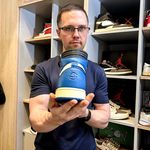
For Benson Muchiri, who runs BND Fitwear in Nairobi’s CBD, New Balance remains the shoe of choice for most of his customers. He describes it as both “budget friendly and a very good shoe,” adding that its balance of affordability and quality fits well with the local market.
Benson Muchiri of BND Fitwear arranges shoes on the shelves during an interview at his shop in Accra Towers on October 2, 2025.
Photo credit: Francis Nderitu | Nation Media Group
Alongside New Balance, he says Asics has also carved out a space, appealing to fitness-conscious Kenyans who are looking for reliable footwear without necessarily splurging on the more premium labels.
His clientele, he explains, is not limited to professional athletes. “You can’t say necessarily athletes,” he notes. “I think Kenyans are more into fitness, because automatically the population is larger compared to athletes. Athletes buy, but if you do the numbers, it’s just the general fitness lovers.”
From casual joggers to everyday gym-goers, the bulk of his sales come from people adopting active lifestyles rather than professional runners alone.
On average, Benson says his shop moves about three boxes of running shoes in a month, roughly 75 pairs. Some days, he adds, the numbers spike depending on demand. “Sometimes you might have corporate customers, so you might have a spike of people who buy in bulk. But mainly for everyday buyers, maybe 10 pairs.”
When customers walk in, price is almost always the first question, he admits, reflecting Kenya’s harsh economic climate. Comfort follows closely, particularly among the older demographic. “People above 35 don’t really care about the fashion sense, comfort is number one,” Bensoni says.
Marathon runners, by contrast, are a different market altogether. “They have a bigger purchasing power, so they purchase premium brands but not in high quantity. They only purchase during the competition period.”
But while sales are steady, he says the business is not without challenges. Counterfeit sneakers flood the market, undercutting prices and confusing customers.
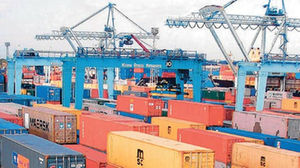
“So, getting to convince a customer to buy a particular shoe at a particular price, yet he has seen it maybe even at half price, is hard,” he says. Import delays also frustrate traders, with goods often held at the port due to government policies or Kenya Revenue Authority bottlenecks.
Online platforms, however, have opened up new opportunities. Benson sells on social media and sees it as a positive shift. “People have greatly embraced technology. We are able to sell across the country. We are not only limited to buyers in Nairobi,” he says.
Younger buyers, in particular, approach sneakers with a different eye, prioritising looks over function. “If they want a shoe, they want a shoe that looks good. Not necessarily for running, but a good-looking shoe. Fashion comes first before any other thing,” he explains.
A changing market
The market itself has changed over time, he observes, with branded sneakers becoming an everyday sight on Nairobi’s streets.
Benson Muchiri of BND Fitwear arranges shoes on the shelves during an interview at his shop in Accra Towers on October 2, 2025.
Photo credit: Francis Nderitu | Nation Media Group
“People are moving toward more branded shoes, more premium quality brands. It’s not like days in the past where people mainly bought mitumba. Nowadays people think that even if they don’t have that much purchasing power, they invest in looking good.”
Benson traces his entry into the trade back to 2020, during the Covid-19 pandemic. At the time, he was selling general fashion items but soon noticed a gap in the market.
“Due to the supply gap, customers were pushing us towards one direction.” With more Kenyans turning to fitness during lockdowns, demand for running shoes surged, and his business grew alongside that wave.
The most expensive sneaker he has sold is a Nike AIR Zoom AlphaFLY, which goes for about Sh12,500 in its original quality. As for his personal preference? “I can’t say one specific brand, but I think New Balance is my favourite. The price is right, and it meets the quality demands,” he says.