Time flies with great content! Renew in to keep enjoying all our premium content.
Prime
Solar dryer guarantees farmers better returns
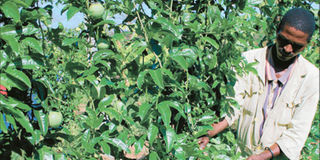
Passion fruit farming. Some of the products that the farmers make are Nutriporridge flour and a range of dried fruits such as mangoes and pineapples. File
In a drive to preserve surplus produce, farmers in Murang’a District have assembled a solar dryer that is delivering value-added, year-round market for fruits and vegetables.
With the help of private food marketing company Azuri Health Ltd, the farmers are now drying their fruit and vegetable crops to make high-value product such as thinly sliced fruits.
These include mangoes that are packaged and sold as snacks that are becoming increasingly popular among urban shoppers.
Beans are pre-cooked and the dried product turned into a meal in just a few minutes, to make a ready food for busy families with little time for cooking.
The dryer is modelled to retain as much food value as possible, with temperatures in the dome getting as high as 70 degrees.
Black polythene traps the heat and beneath it is a layer of sand that retains the heat.
An extractor fan takes away the hot moisture from the fruits and vegetables and completes the drying process.
“There is a thermometer that regulates the temperature and allows us to project the maximum time that each produce should be dried, because the products can get over dried and burn. Close monitoring is very important,” said Azuri Kenya managing director Tei Mukunya.
The modest dryer is a far cry from the mainstream dehydrator designed to dry to a high quality, but which is beyond the means of many of the farmers.
The dryer costs about Sh28,000 at local suppliers such as the Vibrant Health Organisation.
Vegetable preservation
During the drying process, hygiene is also a matter concern.
Azuri Health has set aside sessions where farmers are trained on how best to preserve their produce. Preserving fruits and vegetables has many advantages, including value addition. For example, two raw banana bunches weighing an average of 200 to 240 grammes sell at Sh50 to Sh60.
But the same volume, when dried, is sold at Sh150 at local health stores. Farmers who dry their produce also manage to spread their earnings across the year, selling when prices are high and earning premium returns in the process.
They also are able to supply their families with fruits during off season periods, thereby improving household diets by retaining some of their produce for times when fresh produce is hard to find.
It is estimated that 30 to 40 per cent of fruits and vegetables go to waste on farms and at market places because they perish before consumption. But dried fruits and vegetables last for 12 to 18 months.
Go to waste
Azuri Health has partnered with over 600 farmers predominantly in Central and Western Kenya. While process their produce, Azuri handles marketing, distribution, and sales on their behalf. The farmers have expanded to the regional market with their products being sold as far afield as Sudan.
Azuri Health reports annual sales of Sh12 million.
Some of the products that the farmers package include Nutriporridge flour, sweet potato flour, Kahurura Powder (made from a plant in the pumpkin family), sweet potato cookies, and a range of dried fruits such as mangoes and pineapples.
- African Laughter
Unlock a world of exclusive content today!Unlock a world of exclusive content today!