When Kenya launched the Universal Health Coverage (UHC) programme in 2018, the promise was that every citizen should be able to walk into a health facility and get the care they need, including drugs, without worrying about stock-outs or the bill.
The government set aside money, enrolled counties and told Kenyans that the days of being turned away from a clinic were coming to an end.
Seven years later, many patients are still being turned away because the medicine a doctor prescribed is not in stock. They are then sent to a private chemist, where the same drug costs considerably more.
Scott Dubin, a global supply chain and logistics expert who works on health supply chains across several countries, however, pointed out that poor ‘health logistics’ often results in shortage of drugs in some hospitals in Kenya.
'Health logistics' refers to the planning, management and movement of medical products, supplies, and equipment through the health system so they reach health facilities and patients at the right time, in the right quantity, and in good condition.
For example, if a hospital chain in Nairobi has a warehouse full of medicine in Thika but no trucks scheduled to deliver it to its branches, the shelves will be empty, not because there is no medicine, but because no one organised the journey.
"Kenya's health system is facing the same problem on a national scale. The medicines are often there. The investment has already been made. The problem is getting them to move through the system reliably and on time,” said Mr Dubin.
Data from the State Department of Medical Services shows that in the year ended June 2025, hospitals waited an average of 24 days to receive essential medicines after placing an order.
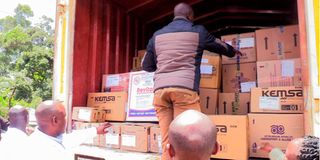
The Kenya Medical Supplies Authority (Kemsa), the government agency responsible for getting medicines to facilities, was delivering roughly half of what counties ordered.
Similarly, a 2024 study across four counties of Turkana, Wajir, Samburu, and Mandera by ThinkWell, InSupply Health and the Chartered Institute of Procurement and Supply found this fragmentation at the root of most supply failures.
The problem is made worse by the way different health programmes operate. HIV, malaria, tuberculosis and maternal health each have their own separate delivery systems, meaning different vehicles travel the same road to the same facility on different days, carrying different products, with no one talking to the other.
"You have multiple programmes spending money to solve the same last-mile problem independently," Mr Dubin said. "That is not just inefficient, it is avoidable. The roads are the same. The facilities are the same. The only thing missing is someone deciding that these deliveries should happen together."
He explains that when a facility is about to run out of a drug, someone has to organise an urgent delivery, often a vehicle that is only partially loaded, travelling a long distance. That is far more expensive than a planned, fully loaded run that covers several facilities in one trip.
To fix the situation, Mr Dubin said the solution narrows down to three things, including better coordination, better information and clearer contracts.
Coordinated operations mean that drugs for various healthcare programmes are jointly delivered to hospitals to save on costs. Right now, they are not.
"Every shilling saved from an unnecessary trip is a shilling that did not have to be spent," said Mr Dubin. "
In terms of information, many health facilities in Kenya still track stock manually, on paper. By the time a shortage is noticed, it may already be too late to prevent a stock-out.
On contracts, Mr Dubin said the government pays logistics providers based on what vehicles and warehouses they have, not on whether medicines actually arrive on time and in the right quantities.
"If you are paying for trucks rather than for results, you are measuring the wrong thing," he said.
A workshop held by the Health ministry in April last year, identified the same problems of medicines running out, paper records, and information that does not flow between facilities and the centre, which kept coming up.
Meanwhile, the Ministry of Health is deploying digital tools through the Digital Health Agency to help facilities and Kemsa track stock in real time, so problems can be spotted and fixed before patients are turned away.
Principal Secretary for Medical Services Ouma Oluga, speaking at a past health supply chain forum, outlined the government's priorities, including tightening procurement and last-mile delivery, restructuring Kemsa, and reducing medicine costs by manufacturing more locally.
"Building self-reliance in health supply chains is not only a strategic necessity but also a moral obligation," Dr Oluga said. "We must invest in local capacity, innovation, and partnerships to ensure every Kenyan has uninterrupted access to essential medicines."