Kenya Revenue Authority (KRA) workers will start wearing body cameras from today in the latest bid to curb staff bribery and collusion schemes, blamed for abetting tax evasion.
The body-worn cameras, popularly known as bodycams, will be used mainly by staff in customs and border control in the latest efforts to nab KRA staff cutting government revenue by engaging in corruption, colluding with tax evaders and taking bribes.
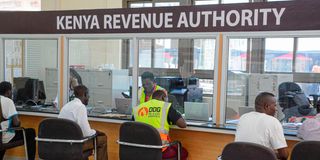
The launch of 350 bodycams at Jomo Kenyatta International Airport (JKIA) makes the KRA one of the few tax administrations globally to deploy the cameras, according to senior officials at Times Tower.
Plans to introduce the cameras have been in the works for several years and follow accusations of KRA staff helping to fraudulently clear cargo and alter tax returns to help people dodge duty payments.
This has seen the agency’s workers amass multi-million shilling assets, including real estate and posh cars that are not consistent with their pay.
The KRA said that the real-time recording offered would deter corruption, reduce confrontation and enhance the collection of taxes by its Customs & Border Control Department.
Some of the taxes and levies collected by the customs department include import duty, 16 percent value-added tax on imports and excise duty on imports. The department also collects the Import Declaration Fee (IDF) and the Railway Development Levy.
However, there have been concerns over revenue leakages, with some imported goods being under-declared.
The Treasury, fretful over the possibility of sparking protests, is going slow on imposing significant new taxes or increasing existing ones.
This has seen the KRA get aggressive with tax cheats flagged after it conducted a series of background checks, lifestyle audits and vetting.
The agency is leveraging on increased use of data and linkages between its systems with third parties such as banks and mobile money platforms like M-Pesa to spy on taxpayers’ activities, use of Internet-enabled cameras at excisable goods processing plants and full rollout of digital electronic tax registers (ETRs) to grow revenue.
In terms of tax collected as a proportion of annual economic output, Kenya has been underperforming other nations like South Africa, the State House said.
A strategic plan indicates that body cameras will be used by staff attached to customs, border control and enforcement as a means of enhancing transparency during interactions with taxpayers.
Some of the KRA’s staff have been under scrutiny for suspected collusion with tax dodgers, negatively impacting revenue collection targets.
The cameras will record interactions with taxpayers, capturing issues raised in real time and how they are resolved—a move expected to serve as a deterrent to rogue employees who have, over the years, amassed fortunes through bribery while turning a blind eye to tax cheats.
Senior customs officials reckon that some of their officers have increasingly faced organised smuggling networks and hostile enforcement environments, with many cases difficult to prosecute due to a lack of real-time photographic or video evidence.
The KRA believes the bodycams will plug the gap through live recording, streaming and secure storage of audio-visual evidence.
The agency has, since last year, stepped up a purge of rogue staff, with dozens sacked and more than Sh500 million recovered through lifestyle audits.
For instance, in the three months between July and September 2024, some 44 KRA officers were sacked for graft-related offences.
In the quarter to December alone, 19 KRA staff were dismissed for graft—more than double compared to the same period of 2023.
The sackings in the second quarter were, however, slightly lower than the 25 KRA staff dismissals in the first quarter of the current 2024/25 financial year amid an internal purge to weed out corruption within the agency.
Besides the dismissals, the KRA said it conducted lifestyle audits on its staff, which led to the recovery of Sh549 million in illicit wealth. Insiders at KRA told the Business Daily that the cameras will be supported by four data storage servers, integrated docking stations and complementary docking systems.
The authority has also established a Central Command Centre to manage and monitor footage, ensuring structured oversight, secure storage and proper review mechanisms.
In addition, the cameras are equipped with real-time GPS positioning for location tracking, LTE connectivity to enable live streaming and remote monitoring, and secure recording capabilities.
These features enhance situational awareness, strengthen supervision of field operations and promote accountability at all levels of enforcement.
The launch of the technology, which has been partly financed by the World Bank, comes at a time when the Treasury has allocated Sh2 billion for the acquisition of a new data recovery site and the upgrade of an ICT centre at Konza Technopolis.
It was not immediately clear if the fresh allocation contained in the first supplementary budget for the financial year ending this June was connected to the deployment of the body-worn cameras, which will also be backed up by data centres.
The body camera will comprise two parts, one for the front and another for the backside of the officers wearing them.
“The front camera will be for high-quality video recording and photography, while the rear camera will be for video calls, providing stable and smooth image transmission,” the KRA said in a call for suppliers of the equipment.
The procurement of the technology was made through a three-year contract with a Chinese security inspection systems firm, Nuctec Hong Kong Company, as the taxman seeks to seal loopholes that smugglers and tax evaders have exploited to dodge taxes, largely through collusion with corrupt KRA customs officers.