Time flies with great content! Renew in to keep enjoying all our premium content.
Prime
Board struggles to revive farmers’ interest in crop
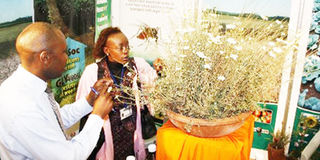
An exhibitor explains to a delegate how the pyrethrum plant is used to manufacture insecticides at the eighth Agoa meeting in Nairobi earlier in the year. Photo/FILE
Mama Grace Soy fondly remembers the 1990’s when she would mobilise her entire family to work on their three acre pyrethrum plantation in Sinendet farm in Molo District.
Because the crop was labour intensive especially during the rainy season, it required her to hire casual labourers to pick the white flowers as well as two others to do the weeding because failure would mean the premature death to her pricey crop.
Because of the high returns that the crop offered, Mrs Soy’s family of eight children were educated from the proceeds of the country’s leading foreign exchange at the time.
However, like other small scale farmers in Molo — which is still the country’s leading pyrethrum producer — interest in the crop started to fall in 2002 when the board refused to release payment for 1999 deliveries despite constant distress calls.
Huge market
“Some of the dejected farmers simply opted for alternative means to sustain their families like horticultural crops and dairy cattle,” she reminisced
In Molo, Mrs Soy is not a lone voice. She echoes the sentiments of 20,000 small scale pyrethrum growers who have drastically cut their acreage despite the huge market potential it has in the world market today.
But the nostalgia in the pyrethrum industry is not confined to Molo.
At Kinungi in Naivasha, 71-year-old Mbugua Mbiu Kio vividly remembers the mornings of 1948 when as a young boy, his father started taking him along to the family’s pyrethrum fields.
“Pyrethrum was his favourite crop because the mzungu used to pay him promptly and so he wanted me to take over as the top farmer among his sons,” he said.
At the time, one Kilogramme of pyrethrum flower was going for Sh60 while school fees - the most common expense that most families faced at the time – was Sh250 per term on average.
From their farm, they would harvest at least 300 kilogrammes every year.
Today, school fees in private schools has risen to an average of Sh20,000 per term while the board has only increased its rates marginally to between Sh90 and Sh150 per kilogramme depending on the level of pyrethrin content.
This is the apathy that now characterises the production of one a crop that Kenya inherited from colonial days as a leading foreign exchange earner.
Currently the national production level has declined to an average of 1,600 tonnes which PBK hopes to reverse in fresh campaigns.
According to the report, Molo still has the potential to produce about 4,000 tonnes of pyrethrum flowers annually – about four times the quantity produced by Rwanda today.
Support farmers
PBK’s own assessments also indicates that flowers from the Subukia area of Nakuru have a capacity to produce pyrethrum with a higher pyrethrin content of 1.68 per cent compared to flowers grown in Naivasha and Gilgil which contain 1.50 per cent.
Apart from the receding acreage, the new managing director Dr Isaac Mulagoli, has to address the alarming extinction of cooperative societies that used to support farmers
For instance, there were 365 pyrethrum growers’ self-help groups, 52 cooperatives and 1,151 individual growers in Molo alone which was at the time accounting for 60 per cent of the flowers grown in the country.
Most of these associations collapsed after farmers failed to repay their debts due to delay by PBK to settle payment for their deliveries.
But Dr Mulagoli maintains the board has worked out new revival strategies that include increasing crop acreage from the current 10,000 to 20,000 acres by propagating 30 million seedlings.
“One of their major investments includes reinstating the seedbed nurseries that had initially been neglected in Oljororok, Molo, Olenguruone and Sabor to ensure availability of certified seedlings following the reinstatement of five Research team members that had been retrenched three months ago,” he said.
Similar venture
That the world is not willing to wait longer as the former giant processor self-destructs was on display recently when a US based customer advanced the board a loan of Sh12 million towards the enhancement of pyrethrum growing in the country.
The loan would be pay through future stock deliveries to the firm.
The government also injected another Sh5 million for similar venture specifically at the Molo research centre for seedling production, a move that would soon result in increased crop production to a projected 8,000 tonnes of dry flowers for processing by next year.
The fresh campaigns are aimed at tripling the number of small scale farmers from 29,000 growers to 70,000 by the end of next year.
The board’s restructuring programme also entails the disposal of non-core assets valued at 403 million whose proceeds would be used to meet the board’s financial obligations.
Dr Mulagoli maintains that the board has potential to pull itself from the current financial hole saying farmers were recently paid a total of Sh16 million for flower deliveries between July and September.
Unlock a world of exclusive content today!Unlock a world of exclusive content today!