Time flies with great content! Renew in to keep enjoying all our premium content.
Prime
Farmers see opportunities and risks as El Niño rains loom
Kenyan farmers who have recently suffered the effects of drought are now bracing themselves for the forecasted El Niño rains, which may be accompanied by floods. In order to mitigate against the risks associated with the onslaught of El Niño, some farmers are considering replacing their traditional maize crop with short-term, more resilient crops like sorghum and cassava. /Joseph Kiheri
For decades, the water pan in Daniel Waatho’s farm at Njoro in Kenya’s Rift Valley province had never dried up– until drought hit the area this year.
“I normally harvest rainwater, but last year [2008] was the last time we had some proper rain, so my water pan has dried up,” he said.
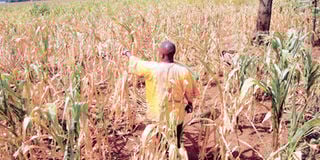
The drought killed his premature maize crop, while his beans shrivelled and died before reaching the podding stage.
That, however, is just one of Waatho’s worries. With the weatherman predicting El Niño rains across Kenya soon, he is torn between preparing his farm to plant maize or diversifying into short-term crops such as beans, sorghum and cassava.
“I am told El Niño rains are coming. Will my crops recover or will the water pan fill up with soil from the upper farms?” he asked, pointing to the pan at the lowest point of his farm.
Be prepared Although it is believed this year’s El Niño rains will not be as severe those of 1998, the Kenya Meteorological Department has urged the country to be prepared for the rains, expected between mid-September and December.
Joseph Mukabana, the department’s director, told a news conference in late August that the El Niño impact was likely to be aggravated by the prolonged drought in many parts of the country.
Food insecurity affects at least 20 million people in the greater Horn of Africa, which includes Kenya according to the USAid-funded Famine Early Warning System Network (FEWS Net).
These countries, it added, suffer from chronic poverty, civil war or insecurity, refugees and internally displaced persons, environmental degradation, poor marketing mechanisms and constrained income opportunities.
“The environment is quite sick, it is not wearing any clothes, the pastures are degraded and the impact is likely to be more soil erosion and siltation,” Mukabana said.
Flooding and mudslides were likely to occur in parts of the country, he added.
Waatho said El Niño would enable him to resume farming.
“Although I can’t say I have given up [maize-planting], I am seriously thinking about going into other crops,” Waatho told IRIN in Njoro.
“I will need seed for these crops; I am therefore appealing to the government to help us farmers with the seed and fertiliser for us to make use of the rains.”
The government has set up a crisis centre in the prime minister’s office to coordinate emergency interventions and is working with relief agencies, NGOs and development partners to plan for the adverse impact of El-Niño-related rains.
“The effects of El Niño are not the flood waters but the after-effects,” Davies Okoko, the disaster preparedness manager for the Kenya Red Cross Society (KRCS), said on 9 September.
“Soon after the floods pass, there will be waterborne diseases, contamination of water sources and other effects.”
Like other relief agencies and the government, KRCS has designed a preparedness plan that includes training members from its 62 branches in emergency response in health, water and sanitation, relief, logistics, communication and reporting.
In collaboration with the public health and sanitation ministry, it has also put in place a structure for rapid deployment and response coordinated by its emergency operation centre.
The society believes the rains will have a beneficial effect. “Favourable conditions are expected by the end of the year,” Abdishakur Othowai, the KRCS special programmes manager, said.
Low yield “El Niño will lead to food production, especially in the [marginally agricultural] Ukambani areas since they rely on short rains.”
Officials says the rains could help a significant recovery of drought-affected crops in parts of Kenya’s Rift Valley Province also.
“We had planned to hit 30 million, 90kg bags this year; we put in a lot of effort to ensure this target was met but we were relying on rainfall which did not come on time and was unevenly distributed; now we are hoping the coming rains will help us recover part of the crop,” Leonard Ochieng, provincial director of agriculture in the Rift Valley, said.
He said the province had the potential to feed Kenya, but its cereal yield this year had been affected by low, erratic and poorly distributed rainfall in some areas.
Up to 40 per cent recovery of the maize crop is possible in the North Rift, which was adversely affected by the poor rainfall, Ochieng said, while the South Rift could recover up to 60 per cent of the crop.
Michael Makokha, the food security and early warning systems specialist for the UN Food and Agriculture Organization (FAO), urged farmers in Rift Valley, Nyanza and Western provinces to take advantage of the anticipated rains to plant off-season crops and bridge their food gaps.
“It is high time communities... re-oriented their tastes and preferences towards agro-ecologically adaptable crops such as cassava, sorghum, sweet potatoes, green grams and cow peas to avoid recurrent household food insecurity,” he told a multi-agency food security assessment team on 5th September.
Agriculture officials in the region called for seeds and fertilisers to be given to farmers by mid-September to enable them take advantage of the rains.
A combination of poor rainfall, declining soil fertility from over-cropping, and deforestation has led to significant maize crop failure in parts of the three provinces.
Traditionally, these were considered Kenya’s grain basket, but agriculturalists predict a maize deficit this year of at least 12 million 90kg bags. Ochieng urged farmers to harvest water during the El Niño rains by investing in roof-catchment structures and water storage tanks.
“We need to look at all aspects of food security and water is an important component; we need to ensure that roof catchments are tapped at household level and each family should at least have a water storage tank,” he said.
Some farmers, however, expressed fear of damage to the maize and bean crops that are nearing maturity stage.
Green maize Zablon Koech, a maize farmer in Nandi North District, said: “If we receive too much rain, we could lose the crop we have in our farms as it would rot before or during harvest.
If the rains come before the maize dries, we might have to cut it and sell it as green maize.”
However, agricultural officials have warned maize farmers against selling most of the crop as green maize as this would impact on food security in the long run.
Odoyo Bittar, the district agricultural officer for Bureti District, said public campaigns to sensitise farmers against selling all their crops as green maize were under way.
“We want to encourage them to keep the crop until its harvest as grain as this will boost food security in the region,” Bittar said.
The Ministry of State for Special Programmes and the UN Office for the Co-ordination of Humanitarian Affairs (OCHA Kenya) have called a workshop on 15th September in Nairobi to discuss El Niño-preparedness plans.
Unlock a world of exclusive content today!Unlock a world of exclusive content today!