Time flies with great content! Renew in to keep enjoying all our premium content.
Prime
MRM ventures into low-cost homes with prefabricated houses
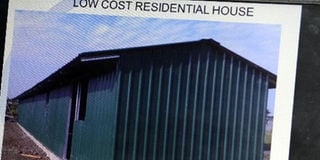
A prefabricated house designed and built for the internally displaced people by Mabati Rolling Mills, August 11 2011. Fredrick Onyango
Mabati Rolling Mills has entered the low-end housing market by offering prefabricated houses as it races to tap that segment of Kenya’s real estate, which investors targeting quick returns have shunned.
The manufacturer of roofing materials is seeking a piece of the property market from selling ready-made steel houses that will retail at Sh80,000 and Sh160,000 for two and four-room homes respectively.
It hopes that the pricing will help it to penetrate the low-end of the market that investors have neglected as they target the lucrative middle and top-end of the market. “We did a pilot whose samples we donated to IDPs and now we want to sell this model to the mass market,” said Kaushik Shah Safal, the group’s CEO for Horn of Africa.
Mabati Rolling Mills is a subsidiary of the Safal Group, manufacturer of flat and long steel products.
“The low income earners care more about the price than the complexity of the designs. We have simple models that can be custom-made for clients depending on their tastes and preferences,” Mr Shah said.
The walls of the houses have an option of being completed using bricks, iron sheets, wood or mud depending on the preferences of the buyer. Already, the MRM has opened satellite offices in Kisumu, Mombasa and Eldoret as it’s seeks to spread the housing project outside Nairobi.
“There is demand for these units and this is why we want to be within reach across the country,” Mr Shah said. “These centres also have trained personnel that can help potential customers put up the structures on their farms.”
Besides homes, the firm says it is also targeting kiosk owners, schools, churches and temporary office sites with steel structures. The success of the plan is anchored on the review of the building code to classify structures built from materials other than brick and mortar as permanent — paving the way for use of the panels to build new homes. Property developers say rigid building laws that do not allow the use of alternative materials is partly to blame for the rapid rise in costs, locking out the poor from home ownership.
Kenya’s annual demand for houses is estimated at 200,000 units whereas the market can only supply 30,000 units, leaving a shortfall of 120,000 units per year.
The shortage has been most acute in the lower and middle sections of the market where investors have shied away fearing measly returns. This has resulted in proliferation of slums in towns. Rapid urbanisation, population growth and expansion of the middle class remain the main drivers of Kenya’s property market that is riding on nearly three decades of under investment in mid-tier segment.
This has seen the cost of homes and land more than double over the past decade, egging investors including state owned National Housing Corporation to invest billions targeted at the high and mid-end of the market. Swelling incomes and large numbers of youths moving to towns and starting families, are seen as yet the other key drivers of demand across all asset classes. This has seen the property asset class outperform the Nairobi Stock Exchange over the past decade, according to a survey by CFC Stanbic.
As a result, corporate, international and individual investors are racing to put money in real estate and property dealers reckon that the market has begun to face a glut that is cooling the runaway property prices.
This is the reason investors such as MRM are betting on the bottom end of the market that is yet to be crowded.