Time flies with great content! Renew in to keep enjoying all our premium content.
Prime
Pyrethrum board lost millions in illegal tenders
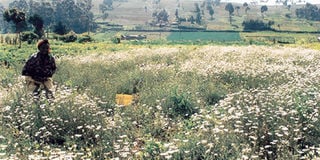
A pyrethrum field: An audit has unearthed irregular procurement at the troubled parastatal and recommended the investigation and prosecution of former top managers. Photo/FILE
As far as her tenure at the Pyrethrum Board of Kenya goes, Mrs Pauline Sego fits the bill of an administrator with many lives.
She survived the stormy coalition government politics that changed PBK board at least twice during her tenure.
Mrs Sego burst onto the parastatal leadership limelight in 2004 after her former boss Martin Owiti was appointed by the government as one of the joint receiver managers for the Miwani-Muhoroni Sugar companies.
Then Agriculture minister, Kipruto Kirwa, appointed Mrs Sego, a crop scientist, who had risen to become Mr Owiti’s deputy, to take over.
When assuming office, she outlined immediate task as repairing the dented public image of the firm.
Allegations of corruption were rife, resulting in low worker morale and farmers cutting acreage under pyrethrum partly due to non-payment.
Although PBK at one time controlled 70 per cent of the world market, by 2006 most of the orders went unserviced, with the board’s records showing requests worth Sh517, 519,946 were largely ignored due to shortage.
This prompted the incoming management to import pyrethrum extract called OR (Oleo Resin) from Rwanda for resale “to ensure that PBK did not lose its traditional market share.”
A forensic report says the importation idea was “noble but its implementation was chaotic as the MD flouted Government procurement procedures and regulations ... against proper advice of the board and senior employees.”
On February 15, 2006, Mr James Kuria, then the production and marketing manager, presented a paper saying the stock available could last six months.
The paper recommended that an alternative source of OR be identified and proposed Societe de Pyrethre au Rwanda (Sopyrwa).
On February 23 and 24, 2006, Mrs Sego sought the directors’ authority to import 415 tonnes of OR from Rwanda.
The proposal was not discussed in the board’s tender committee as provided for in the procurement Act.
The management signed an agreement with Sopyrwa without approval of both the Agriculture ministry and Treasury, says the forensic report.
Records show that PBK signed the agreement with Sopyrwa on March 3, 2006, the same day that Mrs Sego sought the authority from the director of public procurement to single-source the material.
Two weeks later, Mrs Sego applied for authority from the ministry headquarters to import crude pyrethrum extracts and instructed finance manager, Mr Ongiri Osinde, to immediately release US$500,000 as down payment to the firm.
An internal memo between the two officials on April 25 indicates Mr Osinde’s unwillingness to release the money without government approval.
But Mrs Sego and Mr James Njoroge Kuria, then factory manager and a category B account signatory, instructed the bank to remit the money to Sopyrwa.
The Agriculture PS on May 5, 2006 gave Mrs Sego and her team the go-ahead to execute the import deal but the PS approved only 100 tonnes of OR.
Forensic audits indicate that while the first 25-tonne OR consignment was received on August 24, 2006, PBK had been invoiced by Sopyrwa on April 12, 2006 for the same delivery at a cost of $1.5 million.
Weeks later, the Treasury PS, Mr Joseph Kinyua, in a letter dated June 9, 2009, directed PBK officials to follow procurement.
On June 27, 2006, Mr Kinyua wrote again declining PBK’s request for a post-facto authority to honour the Sopyrwa invoices, saying Treasury did not have such powers.
He was reacting to a request by PBK chairman Mr Isaac Mwangi, who said the board would collapse if the government did not grant the authority.
Mr Kinyua allowed the officials to pay for the ordered consignment “because the board must stay in operation,” but warned that the nod would not shield them from future queries.
Mr Osinde directed to pay Sh21, 260,471 in VAT to the custom and excise department for the clearance of the Sopyrwa consignment by July 3, 2006.
He also cleared the $1 million owed to the Rwandan firm.
But the payment split the board into two with a section led by then factory manager, Elly Owawa, and refinery manager only identified as Mr Kamau.
The two officials were members of the finance committee, and advisory team, then chaired by Mr Owawa, and had the mandate of guiding the MD on expenditure plans.
Mr Owawa wanted Mrs Sego to release only half of the money to the Rwandan firm and the other half used to settle farmers’ deliveries.
On the other hand, Mr Kamau’s protestation was that the parastatal was buying OR at a higher price than what PBK was selling crude extracts at.
Different invoices
Audits indicate that while Treasury approved the importation of 25 tonnes of OR, Mrs Sego released payment for 42 tonnes from Sopyrwa.
The report says a cheque of $49,400 for settling Sopyrwa’s debts was drawn in Mrs Sego’s name but was later cancelled.
These processes attracted the attention of the Barclays Bank, pointing out discrepancies.
But Mrs Sego, however, brushed off the suspicions, asking the bank in her letter dated December 4, 2006 to go ahead and remit the $420,000 to Sopyrwa.
In their investigations, the auditors found out that the invoices mailed from the Rwandan firm and the unsigned ones presented for payment were different.
The report recommends investigation of Mrs Sego’s conduct by Kacc and CID “as she is likely to render a compromised image of an administrator.”
In April this year, Kacc asked the Attorney-General to prosecute three top former PBK managers, among them Mrs Sego, for fraud in the irregular purchase of 100 tonnes of raw extract Sopyrwa.
Unlock a world of exclusive content today!Unlock a world of exclusive content today!