Time flies with great content! Renew in to keep enjoying all our premium content.
Prime
Soya milk offers farmers’ group income stream
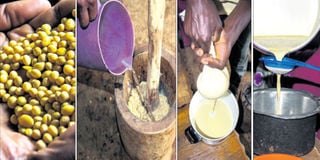
From Left: Soya beans after being soaked in hot water in preparation for milk extraction. A farmer adds water to the beans while crushing them with a mortar and pestle. He squeezes the crushed beans to extract milk. He sieves the milk to remove impurities. Photos/Suleiman Mbatiah
Kenyans may not be familiar with its taste but soya bean milk is as delicious and nutritious as cow milk.
In many rural households across the country, the high cost of milk has shifted the consumption trend from milk to porridge.
Due to its easy accessibility and affordability, soya milk might soon be the leading competitor of dairy products on supermarket shelves.
A group of 14 small scale farmers from Kabazi division in Nakuru County, under the umbrella of Edgewood Value Addition Self-Help Group, has set out to produce milk from the legume on a large scale.
For only Sh30, consumers will get a litre of the milk for making tea, porridge for especially children, mandazi and even chapati.
“There is no difference between soya bean milk and milk from cows and goats. It serves the same purpose. Many people understand this fact when we sensitise them on the legume,” said Reuben Ng’ang’a, the group’s co-ordinator.
Edgewood members embraced the idea of extracting milk from soya beans after a visit to Kenya Agricultural Research Institute (Kari), Njoro centre, in 2010.
Crop researchers and scientists at the institute taught them on soya bean varieties suitable for producing milk and how to extract it.
Extraction
“We were told that Nyala and Gazelle varieties produce good quality milk. Gazelle particularly yields clean milk free from bad smell and greyish colouration,” said Mr Ng’ang’a.
After each farmer bought two-kilogrammes of the Gazelle variety at Sh150 per kilogramme, the farmers planted the seeds. They have collectively harvested about 210 kilogrammes in two years.
“Soya beans take two to three months to mature if the climate is hot, but because this place is cold the crop takes six to seven months to mature which limits the number of times we can plant and harvest in a year,” said Mr Ng’ang’a.
In preparation for extracting milk from the legume, seeds are soaked in warm water for at least 15 minutes. Soaking seeds in cold water results in a permanent foul smell.
The beans are then crushed. The density, quality and quantity of milk produced depends on how thoroughly the seeds are crushed, type of beans and water added.
A quarter a kilogramme of Gazelle beans produces enough milk to make tea for six people.
“If you want light milk you can either use less seeds, or more of them but crush them for less time and add a lot of water. To get thick milk you can take at least 30 to 45 minutes to pound the seeds, but ensure that you don’t dilute it too much,” said Virginia Nyambura, the group’s secretary.
Finally, the milk is squeezed out of the beans using a clean piece of cotton cloth before being sieved to remove impurities.
To market the product, the farmers have embraced a door-to-door marketing strategy in which they give local people free samples for tasting.
They have been attending numerous agricultural exhibitions for the last two years to learn more about the product and grow their customer base.
“Reception of the product has been encouraging. More people are getting interested in consuming the milk and others want to know how it is produced,” said Mr Ng’ang’a.
Despite high demand for the product, the farmers said they were unable to venture into commercial production due to poor technology. They rely on crude traditional tools to extract milk from soya beans.
However, this is set to change from June next year. The group expects a Sh100,000 grant from the Njaa Marufuku Programme, an initiative established in 2005 under the Ministry of Agriculture to boost small scale farming.
Processing
“We plan to buy an extraction machine worth about Sh90,000 to help us produce soya milk in large volumes and supply it to neighbouring supermarkets and shops. We will sell a litre at Sh30,” said Mr Ng’ang’a.
From the proceeds, the group plans to set up a processing plant in Lower Subukia where the climate is conducive for farming soya beans.
“We are also looking at diversifying to yoghurt and making organic fertilisers. We have received a lot of information from agriculture officers and we are set to go,” said Ms Nyambura.
The group is among a few that are working with the Ministry of Agriculture and Kari on proper farming techniques as well as value addition.
The dry season, usually January to March, is their peak season for marketing soya milk as demand rises.
The period is normally characterised by insufficient grass for feeding livestock, resulting in milk scarcity.
“We meet almost daily during the dry season to extract milk from soya beans because there is high demand as there is little milk in circulation unlike in the rainy season. This attracts more consumers to the group,” said Mr Ng’ang’a.
A farmer who wishes to make his own milk buys a kilogramme of soya beans at Sh150.
The group’s biggest challenge is to increase clients because demand fluctuates with seasons.
“Reaching out to many people in all the 11 constituencies in the county is our main task. Later we will think about going national. We must be able to sell to the nearest consumers for our venture to succeed,” said Mr Ng’ang’a.
Researchers have historically referred to soya as the “meat of the field” or “meat without bones’’.
Some studies show that soya beans have protein content similar to that in eggs and cows’ milk.
Additionally, the milk has unique proteins called peptides which include defensins, glycinins, conglycinins and lunasin.
The proteins improve blood pressure regulation, the immune system as well as control blood sugar levels.
Under the US’ Dietary Guidelines for Americans developed by the Department of Health and Human Services and the Department of Agriculture in 2005, citizens are encouraged to take three cups of legumes per week to keep diabetes away and optimise the health of those who already have the disease.