Time flies with great content! Renew in to keep enjoying all our premium content.
Prime
Wrangles shock hits Methodist University
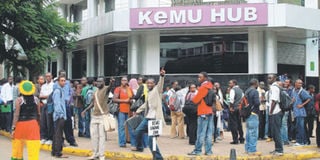
Students from Kenya Methodist University direct traffic after the university was closed due to wrangles on February 18, 2010. Photo/LIZ MUTHONI
Methodist University on Thursday sent shock waves through Kenya’s academic community with an announcement that it had indefinitely closed all its campuses after its teaching and administrative facilities were locked up in a management feud, pitting the sponsors against the Senate.
The wrangles, which later took an apocalyptic twist for Vice Chancellor Mutuma Mugambi, were linked to differences over the university’s expansion drive that has seen it acquire multi-million shilling properties in the capital Nairobi and the church’s hand in the promotion of non-qualified staff to senior academic positions, according to people familiar with the matter.
The University’s Senate, led by Prof Mugambi, had locked horns with the trustees over what they saw as undue interference by the Archbishop of the Methodist Church, Stephen Kanyaru, in the affairs of the institution placing governance of private universities under the spotlight.
“There have been severe disagreements between the management and the sponsor over the running of the institution culminating into a fall-out,” said Prof. Mugambi who was ousted from his position and replaced by his deputy, Alfred Mutema.
The university’s management accused the sponsors of acting in breach of the charter through active participation in important decisions such as introduction of new courses, physical expansion and staff movement.
“Conflict over who does what between the organs are rampant in our institutions of higher learning,” said Andrew Riechi, an education expert at the Institute of Policy Analysis and Research (IPAR), a policy think-tank.
“This leaves the institutions in an awkward position as the sponsors might want one thing but the management wants the other,” he said.
Kenya Methodist University charter mandates the Board of Trustees to appoint council members, who pick the Vice-Chancellor, and allows the presiding bishop of the Methodist Church to sit as the chairman of the council.
But Prof Mugambi claimed that Dr Kanyaru had extended his influence beyond that mandate and was forcing the management’s hand into decisions that could negatively impact on the quality of learning at the institution.
The rifts among Kemu’s top brass are not unique to the multi-billion shilling university that was awarded a charter in 2006, but are common in many other private institutions of higher learning, bringing into sharp focus the ability of the regulator, the Commission for Higher Education (CHE) to ensure compliance.
Concern is rising that explosive wrangles over the management of private colleges could further dilute quality of education in Kenyan universities that has been declining gradually with the deepening of the enrolment crisis since the parallel degree modules were introduced in the late 1990s.
“Leadership and succession battles are common in our universities but this should not happen if the institutions follow to the letter the charters under which they are established,” said Prof Everett Standa, the CHE secretary. “These kinds of tussles cannot be allowed to go on as they are likely to hurt the quality of governance and learning in affected institutions,” said Prof Standa, adding that non compliance with the set regulations could attract heavy penalties including withdrawal of the charter – a move that would effectively shut down such a university.
Demand growing
The row at Kemu rose to a crescendo last week after Dr Kanyaru single handedly disbanded the institution’s Council and Senate, appointed new ones.
The management put up a strong opposition to the move, terming it a breach of the charter that jeopardised the smooth running of the institution with a population of 8,000 students.
The governance concerns come at a time when educationists and employers are increasingly questioning the quality of degrees from local universities even as demand grows for top-notch skills to drive Kenya’s modernizing economy.
Learning institutions are under pressure to admit the surging number of working class learners seeking additional qualifications to remain competitive in the fast-changing job market.
It also emerged that the CHE had mid last year warned the Kemu over the growing tussles among its top organs and their potential impact on the quality of learning at the institution.
The management crisis at Kemu comes at a time when the institution is basking in the glory of a massive expansion drive that has seen it acquire several key buildings in Nairobi to house its soaring student numbers.
University officials said rapid expansion of the college has seen the student population increase by 4,500 in a span of just three years.
Student enrolment at the university has peaked since it acquired Kemu Towers along Nairobi’s University Way that was formerly known as Posta Sacco and the setting up of the ultra-modern Kemu Hub on Koinange Street.
The other three campuses––Meru, Nakuru and Mombasa––have also seen the numbers grow.
Sources also said Kemu’s ongoing expansion drive has further deepened the rifts within the top managers, some of who are said to be uncomfortable with it.
Unlock a world of exclusive content today!Unlock a world of exclusive content today!