JKIA to roll out self-service check-in, bag drop in efficiency push

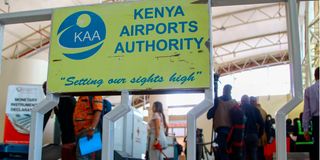
Kenya Airports Authority signage at Jomo Kenyatta International Airport on November 7, 2023. 

Photo credit: Wilfred Nyangaresi | Nation Media Group

The Kenya Airports Authority (KAA) is set to introduce self-service passenger processing booths and automated luggage points at Jomo Kenyatta International Airport (JKIA) as part of a strategy to boost efficiency at the gateway.

The airport manager is procuring a new Common User Passenger Processing System (CUPPS) and Common User Self-Service (CUSS) infrastructure aimed at improving efficiency and passenger flow across the airport.
CUPPS and CUSS are technology platforms standardised by the International Air Transport Association (IATA) that allow airline agents to share facilities such as check-in desks, bag-drop points and boarding gates, helping cut costs and maximise airport capacity.

The CUSS system allows multiple airlines to enable passengers to check in, print baggage tags and boarding passes, and select seats.

“Each workstation shall have various common-use peripherals connected, depending on the location – passport readers, boarding pass printer and baggage tag printer at check-in and transfer desks, boarding pass reader and document printer at boarding gates,” KAA said in a disclosure.

The authority added that the systems will be installed at JKIA under a build-operate-and-transfer model.

Under the proposed system, the airport will deploy 213 workstations to support airline and airport operations. The project will also include 72 common-user self-service kiosks that will allow passengers to independently check in and print their boarding passes.

Additionally, the airport plans to install 20 self-boarding kiosks and 20 bag-drop units that will allow travellers to check in and drop luggage with minimal staff intervention.

There will also be 10 terminal-entry biometric gates aimed at enhancing security and streamlining passenger verification.

The planned infrastructure will be deployed across multiple sections of JKIA, including Terminal 1A, Terminal 1B, Terminal 1C, Terminal 1D, Terminal 2, Arrivals 1E, airport lounges, back offices and additional boarding gates.

Globally, major airports have already adopted similar automation systems to streamline passenger journeys.

At Dubai International Airport, self-service check-in kiosks, automated bag-drop units and biometric boarding gates allow travellers to complete most pre-departure processes independently, reducing queues and processing time.

Heathrow Airport also deploys common-use self-service kiosks that allow passengers from multiple airlines to check in, select seats and print boarding passes at shared terminals.

Similarly, Zayed International Airport in Abu Dhabi has implemented a “Smart Travel” passenger processing system that integrates self-service check-in kiosks, automated bag-drop and biometric boarding gates, cutting passenger processing time by up to 70 percent.

The upgrades come amid wider plans to expand and modernise JKIA.

The State Department for Aviation and Aerospace Development earlier invited bids for the design and construction of expanded facilities at the airport, targeting mega contractors with access to at least Sh100 billion in liquid assets or credit and experience delivering large infrastructure projects in East Africa.

The project is expected to expand the airport’s capacity from 7.5 million passengers annually to 12 million at the current terminal, while also providing for the construction of a new terminal capable of handling about 22 million passengers per year.

Follow ourWhatsApp channel for the latest business and markets updates.

PAYE Tax Calculator

Note: The results are not exact but very close to the actual.