Not all shoes are made equal. Some protect muscles; others give a spring in your step. Some last a thousand miles, while others barely survive a month of long runs.
For marathon training, understanding what you need from a shoe – cushioning, responsiveness, support – can be almost as important as the miles themselves, and sometimes as important as the training plan.
Yet for Emily Chepkor, a lawyer, 11-time marathon runner and founder of We Run Nairobi, the assumption that expensive shoes automatically perform better does not hold.
“No, I don’t think one is better than the other,” she says when asked whether expensive marathon shoes outperform mid-range options. “A lot of it is marketing.”
Technology cycle
Chepkor traces that belief to the way running-shoe technology evolves. Innovations often arrive with fanfare and exclusivity, but they rarely stay there.
Carbon plates, now almost expected in modern marathon shoes, were once locked behind a single brand. “When carbon plates started, they were only with Nike,” she recalls. “For about a year, if you wanted carbon plates, you had to buy Nike.”
That monopoly did not last. Regulatory pressure and market forces eventually opened access.
“When they were banned for a while and then came back, one of the decisions was that the technology had to be made available to every running-shoe brand,” she says. “And also that the shoes had to be in the market for some time before race day.”
The goal, she explains, was to remove undue advantage, and with it, exclusivity. Once the technology spread, price became less of a reliable signal of performance.
“Right now, every price range will have shoes that are just as advanced as the very high-end ones,” she says. “That’s just how technology works.”
She is equally candid about the realities of manufacturing.
“Most running shoes are made in the same region,” she says, pointing to Southeast Asia. “They’re pulling from the same resources, the same factories, the same pool of knowledge.”
What then drives the price difference?
“Eventually, pricing becomes pegged to the heritage of the brand,” she says. “If you’re not that established, you’re likely still making the same shoe, you just don’t have the reputation of a premium brand.”
Emily Chepkor, a lawyer, 11-time marathon runner and founder of We Run Nairobi.
Photo credit: Pool
Miles matter
For Chepkor, that reality explains why mid-range shoes continue to carry runners through demanding marathon training cycles without issue.
“People come from all different economic brackets,” she says. “There are so many marathon runners that this has got to be true.”
Durability, she adds, matters more than branding once the kilometres start piling up. Personally, she replaces training shoes somewhere between 500 and 800 kilometres.
“At 500 kilometres, I start being aware that I’ll need the next shoe,” she says. “I usually wouldn’t push it beyond 800.”
Tracking mileage has become easier thanks to platforms like Strava, which allow runners to log individual shoes and receive notifications as they approach replacement thresholds.
“By the time you’re near 800, you can feel it,” she says. “The shoe isn’t doing what it used to.”
Injury science
Chepkor believes modern marathon shoes are shaped as much by injury prevention as by speed.
“The most common problem has always been knees,” she says. “Excessive cushioning came in to provide distance between the ground and the body.”
Long-distance runners, she explains, are not just pounding the road for 42 kilometres on race day.
“You’re likely running 600 to 1,000 kilometres in training,” she says. “That impact adds up.”
Still, cushioning is not a universal solution. Shoe rotation, she insists, is just as important.
“You shouldn’t be doing your daily runs in carbon plates,” she says. “Those are safe for maybe three or four runs in a training cycle when you’re trying to emulate race day.”
On other days, variety matters.
“Rotating shoes means your feet are exposed to different profiles,” she says. “It helps.”
Her own training reflects that philosophy. Most of her daily runs take place in Karura Forest, where the surface is softer than tarmac. There, she prefers a slimmer shoe.
“I like feeling the ground,” she says. “There’s a sense of oneness.”
Cushioned shoes, she acknowledges, have helped many runners manage pain, particularly those with knee issues, but she remains personally neutral.
“I don’t really care either way,” she says. “But if I had to choose, I’d go slimmer for daily runs.”
Race advantage
When it comes to marathon racing shoes, Chepkor says the modern runner is spoiled for choice. A single training cycle now includes recovery runs, speed work, trail runs and race-day efforts, each requiring slightly different tools.
“The marathon shoe today is usually heavily cushioned and lightly carbon-plated,” she says. “The idea is efficiency. It gives you energy back over a long distance.”
Race day, she believes, is where carbon plates make sense, even for amateurs.
“We’re all amateurs,” she says. “But the marathon distance is still the marathon distance.”
She speaks from experience. After switching from regular shoes to carbon-plated ones, her marathon time dropped by 14 minutes.
“That’s not small,” she says.
The broader shift, she argues, is not just about shoes but about access to information and science.
“We now know more about data, nutrition, recovery, VO₂ max training,” she says. “All of that has helped amateurs get closer to semi-elite performance.”
Still, she warns runners against mistaking technology for shortcuts.
Comfort, she says, remains non-negotiable. “Comfort over hype,” she says.
Not every popular shoe works for every foot. “Some people run in carbon plates and develop ankle pain,” she says. “If it doesn’t work for your body, it doesn’t matter how good the shoe is.”
Her advice to first-time marathon runners is simple: never introduce anything new on race day, especially shoes. She learned that lesson the hard way after racing in a brand-new pair.
At the end of the day, she believes shoes should serve the runner, not the other way around. “If it feels good, supports your training and doesn’t hurt you,” she says, “that’s the right shoe.”
Everyday runners
Where Chepkor focuses on technology and brand perception, runner Keith Wanderah approaches the question from everyday training realities – mileage, frequency and fit.
Expensive shoes, he says, may look the part but do not always make sense during training.
“I’d say expensive shoes are not better off, they are better, but not better off, especially when you’re doing your training,” he says. “Expensive shoes are good for your ego, for social status. But if you’re running often, a mid-range shoe is good.”
Most runners fall squarely into that category.
“Most runners are mid-range runners,” he says. “So a mid-range priced shoe will offer you good value.”
The biggest mistake runners make, he says, often happens before the first run: buying a shoe that does not fit properly. “People buy an expensive shoe that doesn’t fit well,” he says. “And that means you won’t use that shoe for a long while.”
Sizing, in particular, is where many runners go wrong. “A proper running shoe should be at least half a size or a full size bigger,” he says. “When you’re running, your leg expands. If you buy an exact fit, you’ll have a lot of friction, and you won’t have a good experience.”
Another common mistake is choosing the wrong shoe for the terrain. “You find yourself buying a trail shoe instead of a tarmac shoe,” he says. “So you’re not buying the proper shoe for the kind of races you’re doing.”
Fit first
Replacing shoes, Wanderah says, should depend on mileage. “If you’re doing 300 to 500 kilometres a month, then you’ve put enough mileage on the shoe,” he explains. “At that point, it’s okay to retire it.”
Ideally, runners should rotate between multiple pairs. “If you have two training shoes and one race shoe, that’s ideal,” he says. “But worst comes to worst, if you only have one running shoe, run in it.”
Race shoes should not remain untouched until race day. “You have to try to race in them several times,” he says. “Use them during time trials, during key workouts. You need to be familiar with them.”
Brand preference, he believes, is often more about influence than performance. “We associate ourselves with brands,” he says. “You’ll see groups that all run in Adidas, others in OnCloud. It depends a lot on influence.”
Ultimately, performance comes down to fit. “Any shoe will perform well as long as it fits you as a runner,” he says.
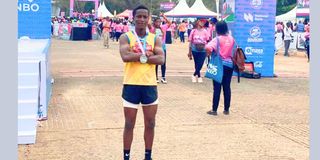
Marathon runner Keith Wanderah says choosing the right running shoe should prioritise fit, cushioning and comfort over price or brand.
Photo credit: Pool
That emphasis on fit carries through to his advice for first-time marathoners. “The most important thing is proper fit, proper cushioning and comfort,” he says. “Your first marathon is not about chasing time. You’re just trying to finish.”
For that reason, familiarity matters more than novelty. A runner does not necessarily need a special race-day shoe. “It could even be your training shoe,” he says. “If you’ve trained in it and you’re comfortable in it, you can go through the marathon with it.”
New shoes, however, must be tested. “You have to break into the shoe,” he says. “Run in it at least three or four times before your first marathon.”
In training, cushioning takes priority over speed. Marathon preparation involves weeks of accumulated mileage. “Sixty to seventy percent of your runs are easy runs,” he says. “You need a shoe with good cushioning so you’re not impacting your joints.”
Responsive shoes still have their place, particularly during speed sessions, but they are not the foundation of a training block. “For intervals or tempo runs, you can use a more responsive shoe,” he says. “But for most runs, cushioning saves your joints and reduces injury risk.”
Many injuries, he adds, stem not from excessive training load but from a lack of knowledge. “New runners don’t know the type of shoe they need, the right size, or the right cushioning,” he says.
Shoes that are too small, too worn or designed for the wrong surface often lead to friction, lost toenails or instability.
Runner profile also matters. Heavier runners, he explains, place more force on their joints and need shoes that can absorb that load.
“When you’re running, you’re putting three to four times your body weight on your joints,” he says. “So heavier runners should look for better cushioning.”
Carbon-plated shoes, in his view, are not a priority for amateurs. “You don’t need a lot of speed,” he says. “Most of your runs should be easy runs.”
Consistency, he argues, matters more than technology. “First, get a shoe that fits well and is comfortable. Carbon plates can come later.” And if they come earlier? “If you’re in a position to buy them, why not?” he says. “But they’re not necessary.”
Training tools
For hybrid athlete Shadrack Atati, the distinction between training shoes and race-day shoes is clear: durability versus speed.
“Marathon racing shoes are designed for speed and efficiency,” he explains. “They’re lighter, have a high bounce and proper support to help achieve your personal best.”
Training shoes, by contrast, prioritise cushioning and endurance to handle the heavy mileage of marathon preparation.
Atati rotates between different shoes depending on the session. Long runs rely on heavily cushioned models, while easy runs and recovery sessions require stability and comfort. Trail runs demand grip and durability, while speed workouts call for lighter, more responsive shoes.
Race days, however, are reserved for lightweight performance shoes designed for marathon pacing.
For Atati, cushioning is essential. “Cushioning protects muscles and joints by absorbing impact during high mileage,” he says.
Responsiveness matters during speed sessions, but comfort dominates the long runs that make up the bulk of marathon preparation. He emphasises proper fit, midsole support, and prevention of foot slippage as critical factors to avoid injuries like blisters or joint strain.
Body weight, pace and foot strike also shape shoe choice. Heavier runners, he notes, need greater cushioning to distribute force and reduce stress on joints.
Beginners, or those focusing on slower runs, benefit from shoes that prioritise comfort and impact absorption, while experienced runners seeking performance may favour lighter, more responsive models. Foot strike also influences selection: heel strikers need shoes with reinforced heel cushioning, while midfoot runners can work with neutral-response shoes.
Photo credit: Pool
Carbon-plated shoes, he adds, remain optional for amateur runners. “They improve efficiency and speed, but they’re not strictly necessary,” he says. “It depends on your pocket.”
Durability varies by type. Training shoes typically last between 500 and 800 kilometres, while lighter race-day shoes often last between 200 and 500 kilometres.
Shoe rotation, he says, remains key. “Training shoes handle longer mileage; race-day shoes are performance-oriented,” he says. “Test your race-day shoes during training before the event to avoid surprises.”
In Kenya’s running conditions – mixed terrain, heat, dust and occasional trails – practicality often outweighs brand prestige.
“Comfort comes first,” Atati says. “Price tag, brand or looks don’t matter if the shoe doesn’t fit your training needs.”
At the end of the day, the advice from runners converges on a simple point: the best marathon shoe is not necessarily the most expensive one. It is the one that fits, supports the mileage and keeps you running.