Time flies with great content! Renew in to keep enjoying all our premium content.
Prime
New Eldoret-Juba road to save truckers over Sh40,000 per trip
A road under construction in Juba mid last year. Kenya and the World Bank in July signed a Sh50bn deal for the rehabilitation of the 601km highway. PHOTO | FILE
The upgrade of a key link road between Kenya and South Sudan will slash the turnaround time between Juba and Mombasa port from the current eight days to five and save each truck an estimated Sh42,924 ($420) in costs, an assessment report on the World Bank-backed project showed.
Kenya and the World Bank in July signed a Sh50 billion deal for the rehabilitation of part of the 601 kilometre highway that links Eldoret to Nakodok on the border with South Sudan.
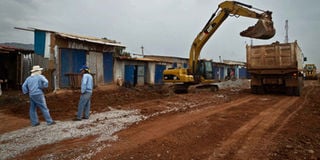
The 960km Eldoret-Juba road is in a deplorable state, partly due to high traffic by relief agencies’ heavy commercial vehicles taking supplies to South Sudan and lack of regular maintenance.
The new highway will be built to bitumen standards and a one-stop border post built at Nadapal besides other transport amenities.
An assessment by Research Sound Support Consultants Limited, on behalf of the World Bank and Kenya government, showed the upgrade of the road corridor will help boost trade through lowering costs.
“The gains of accessibility are obtained by the upgrading of the road infrastructure, which must be supplemented by reduction of transport and trade transaction costs,” the firm said in its final social assessment report on the project.
Presently, one day delay of road transportation costs each truck about Sh14,308($140) in fixed cost and a driver’s time and this is further augmented by an additional cost of 0.5 per cent of goods value per day to the traders, which constitutes lost opportunity cost and financial cost.
“The upgrading of this corridor helps to generate and promote trade and development in the sub-region. Increased accessibility will contribute to creating and enlarging markets, particularly that of regional agricultural trade, but also third country origin products transported along the corridor,” the consultancy firm added.
Plans to lay fibre optic cable along the road as part of the project is expected to enhance Internet connectivity for the population living in the north–western part of Kenya while linking South Sudan with the global Web for the first time.
“This initiative should lead to a substantial reduction in the price of Internet service,” the project report says.
Currently, the retail price of mobile data in South Sudan is over Sh45,990 ($450) per Gigabyte, which makes most Internet applications prohibitively expensive for mobile users.
The high price is partly linked to the fact that mobile operators rely on satellite bandwidth. “Providing wholesale Internet connectivity through a fibre cable should reduce the retail price by more than half within three years of the service becoming operational,” the consultancy firm said.
The project starts early next year and will be implemented over six years as part of the East Africa Regional Transport, Trade and Development Facilitation Project (EARTTDFP).
South Sudan is currently trying to open up its economy to trade with partners in eastern Africa in a bid to consolidate its growth after it successfully seceded from Sudan in July 2011. Its poor transport link to Kenya was among the weaknesses that a team appointed by the East Africa Community (EAC) Council of Ministers cited last year to delay Juba’s membership to the regional bloc.
The planned one-stop border post at Nakodok will supplement the role of the new highway in boosting regional trade.
The one-border-post concept helps in harmonising transit clearance procedures by having officers from two bordering countries handle transit documents concurrently, saving on time. Currently, goods are separately inspected by officers on either side of the border, leading to delays.
Impatient truckers and traders often resort to offering bribes either to jump queues or expedite clearance of their cargo. Kenya and other EAC members have adopted the one-stop-border system as they harmonise customs clearance to reduce the cost of doing business.
Deepening trade
The section of the planned road from Lokichar to Juba will form part of the Lamu Port Southern Sudan Ethiopia Transport Corridor (Lapsset) — a Sh2.5 trillion integrated infrastructure project meant to improve trade between Kenya, Ethiopia and South Sudan.
It entails construction of a new port in Lamu as well as a railway, pipeline, highway, airport and refinery.
Besides cutting over-reliance on Kenya’s Mombasa port, the project is aimed at deepening trade and opening up northern Kenya — a vast area whose economic potential is yet to be tapped because of infrastructure challenges.
Relatively poor transport links between these countries, the less than satisfactory performance of Mombasa and Dar-es-Salaam ports, the high cost of Internet access in many parts of the region, non-existence of fibre optic links, cumbersome trade facilitation procedures and requirements, and a range of technical, political and policy-related factors create obstacles and increase costs on the movement of goods, people, information services, and act as a major impediments on intra- and inter-regional trade, contributing to the under development of the sub-region.